Read this if you…
- like Ancient Wisdom
- like super short books
- want to read material that inspired later military and business strategy
Skip this if you…
- want narrative
- want rigor and detail
- don't want to feel like one of those self-help/business people who love it
The  Take
Take
Super easy quick read, awesome to see what generals thought about back then, even if it is quite simple
Depicted in Art
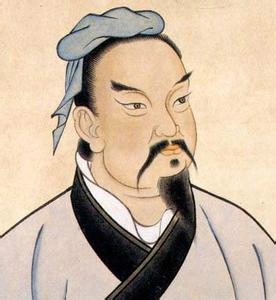
Half-length Qing portrait of Sun Tzu in scholar-general's robes, holding a tablet, beard and topknot in the conventional historical-portrait style.
An accordion-unfolded bamboo book of Sunzi, the strips bound side-by-side, the imperial inscription 乾隆御書 (Qianlong Imperial Calligraphy) visible on the cover panel.
Cropped frame of a single column-block from the Song printed Eleven Commentaries edition, showing the woodblock character cuts at higher resolution.
1192
Schematic map of the 506 BCE Battle of Boju in the Wu–Chu war, with troop positions and movement arrows across the Han River region.
Stone statue of Sun Tzu in scholar-general dress, standing on a plinth in a Chinese-style garden in Tottori, Japan.
2008
Recommended Editions

Thomas Cleary
Shambhala · 1988
Cleary's Shambhala is the version that actually got read. Short, blunt, and packaged with eleven classical Chinese commentators in the margins. Less academic than Nylan but the one most people who quote Sun Tzu are quoting.
Please support us by purchasing through these links, at no extra cost to you!
Notable Quotes
If you know the enemy and know yourself, you need not fear the result of a hundred battles.
- Bill Belichick, NFL head coach, b. 1952: "The only sign we have in the locker room is from The Art of War: 'Every battle is won before it is fought.'"
- Mao Zedong, Chinese Communist revolutionary leader, 1893–1976: "Know the enemy and know yourself, and you can fight a hundred battles with no danger of defeat."
- Henry Kissinger, U.S. Secretary of State and statesman, 1923–2023: "What distinguishes Sun Tzu from Western writers on strategy is the emphasis on the psychological and political elements over the purely military."
- Douglas MacArthur, U.S. General of the Army, 1880–1964: He kept a copy of The Art of War on his desk throughout his career, calling Sun Tzu one of his enduring inspirations.
- Elon Musk, CEO of Tesla and SpaceX, 1971–: I've read it many times — lots of wisdom — but it needs a chapter saying a decisive technology advantage lets you win with minimal casualties.
- Jocko Willink, Navy SEAL commander, author of Extreme Ownership, 1971–: Listed as essential reading for military leaders and devoted a full episode of his podcast to working through the text — the strongest form of endorsement his format offers.