
Read this if you…
- want the most consequential pamphlet of the 19th century
- want to say you've read it (it's super short)
- are a socialist/communist
Skip this if you…
- aren't interested in socialism/communism's roots at all
The lineage through The Communist Manifesto
- The Jungle by Upton Sinclair. The Communist Manifesto shaped it. - When Sinclair converted to socialism in 1902, fellow Socialists pointed him straight at Marx — and *The Jungle* is the result, often called the closest anyone has come to fictionalizing the *Manifesto* - The Packingtown stockyards dramatize Marx's class struggle: the worker ground down to nothing until the novel's didactic socialist climax names the cure
Depicted in Art
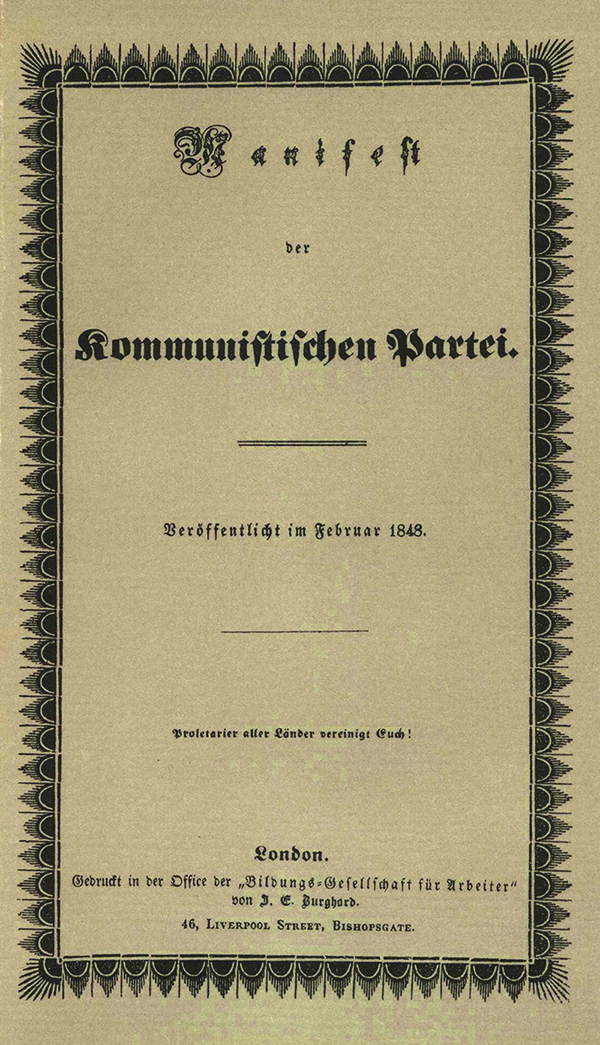
Dark-green paper cover of the 23-page first edition, printed in London in February 1848, bearing the German title 'Manifest der Kommunistischen Partei' in Gothic type.
1848
Studio photograph of Marx at 57: bearded, white-haired, dark suit, seated three-quarter view against a plain studio backdrop.
John Jabez Edwin Mayall, 1875
Formal seated studio photograph of Engels in his late sixties, bearded, in a dark three-piece suit.
Friedrich Engels, 1888
Recommended Editions

Samuel Moore
Penguin Classics · 2002
The 1888 Moore translation, supervised by Engels himself, which is the authorized English text and the version that actually moved history. Gareth Stedman Jones's intro is a small masterpiece of intellectual history on its own.
Please support us by purchasing through these links, at no extra cost to you!
Notable Quotes
A spectre is haunting Europe — the spectre of communism.
- Vladimir Lenin, Russian revolutionary, founder of the USSR, 1870-1924: "This little booklet is worth whole volumes."
- Slavoj Zizek, Slovenian philosopher & cultural critic, b. 1949: "It describes wonderfully the mad dance of capitalist dynamics."
- Eric Hobsbawm, British Marxist historian, 1917–2012: "The world transformed by capitalism which he described in 1848 … is recognizably the world in which we live 150 years later."
- Marshall Berman, American Marxist political theorist, 1940–2013: "The first great modernist work of art."
- Mao Zedong, Chinese revolutionary and statesman, 1893-1976: Reading the Manifesto in a Marxism study group had a profound impact on the young Mao.
- Fidel Castro, Cuban revolutionary and prime minister, 1926-2016: A copy of the Communist Manifesto "fell into my hands" — I read things in it I would never forget.
- Xi Jinping, Chinese statesman, 1953-: A rich theoretical treasure-house we can draw spiritual nourishment from through repeated, in-depth study.
- Nelson Mandela, South African anti-apartheid leader and president, 1918-2013: Mandela was stimulated by the Manifesto but exhausted by Das Kapital, which he gave up.
- Che Guevara, Argentine-Cuban revolutionary and physician, 1928-1967: Guevara studied Marx and Engels intensively and wrote a biographical introduction to them.