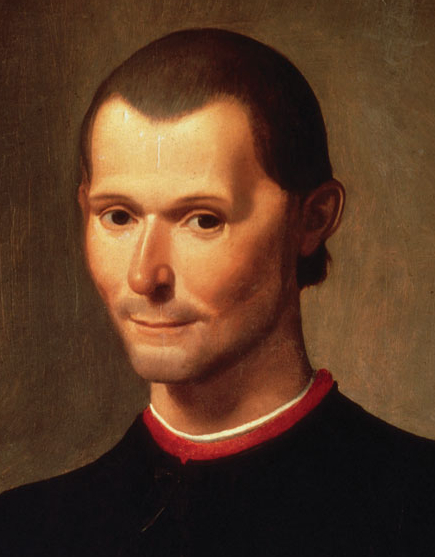
Niccolò Machiavelli
1469–1527 · Italy
“It is much safer to be feared than loved, if one of the two has to be wanting.”
Peak-work percentile in the canon.
The lineage through Niccolò Machiavelli
Drew From(2)
who shaped Niccolò Machiavelli
via Plutarch's Lives
- The Prince's arsenal of examples is largely Plutarch's: Machiavelli cited him by name throughout the Discourses and mined the Lives for the exempla that make his case
- Plutarch supplies the raw material for some of The Prince's most shocking moves — conquering fortune, the calculus of fear — and even the lion-and-fox figure, first recorded as Lysander's maxim
- Read Plutarch and you watch the same lives Machiavelli stripped of their moral varnish and read for power
- Machiavelli's notorious counsel — be a fox and a lion — is a direct repudiation of Cicero's De Officiis, which used the same two beasts to forbid exactly that deceit
- The Prince's chapters on liberality and mercy are arguments with Cicero, not departures from him; Cicero is the orthodoxy being overturned
- Read Cicero on the duties of a good man first and you feel the floor drop out — Machiavelli takes the standard Roman handbook and flips every page
Inspired(1)
who Niccolò Machiavelli shaped
via Richard III
- The Prince didn't just travel to England — it became a stage type. Elizabethan literature carries some 400 references to Machiavelli, and the "Machiavel" was a stock villain audiences knew on sight
- Shakespeare's Richard is that type's masterpiece: power as pure calculation, conscience treated as a luxury for weaker men
- Shakespeare even names the debt — in 3 Henry VI, Richard boasts he can "set the murderous Machiavel to school"
Portraits
The single defining likeness of Machiavelli — the famous posthumous Palazzo Vecchio portrait (c.1550–1600) endlessly reprinted on book covers; no contemporary portrait survives.
Santi di Tito
Tightly cropped head-and-shoulders detail of the canonical Santi di Tito portrait — the cleanest face-only version for a thumbnail or avatar.
Santi di Tito
Life-sized marble statue: Machiavelli stands cloaked in a long robe, an open book held against his hip, head turned to his right with a contemplative downward gaze.
Lorenzo Bartolini, 1845
Bust-length Machiavelli in dark scholar's robes and skullcap, gripping a quill above an open book, gaze turned slightly off-frame in characteristic three-quarter view.
Antonio Maria Crespi Castoldi
Famous Quotes
“It is much safer to be feared than loved, when, of the two, either must be dispensed with.”
“The lion cannot protect himself from traps, and the fox cannot defend himself from wolves. One must therefore be a fox to recognize traps, and a lion to frighten wolves.”
“A prince, therefore, being compelled knowingly to adopt the beast, ought to choose the fox and the lion; because the lion cannot defend himself against snares and the fox cannot defend himself against wolves. Therefore, it is necessary to be a fox to discover the snares and a lion to terrify the wolves.”
“Everyone sees what you appear to be, few experience what you really are.”
About Niccolò Machiavelli
Florentine diplomat, philosopher, and writer, considered the father of modern political science. His treatise The Prince, written after his exile from political life, scandalously separated politics from morality. Its pragmatic analysis of power made 'Machiavellian' a byword for cunning, though the work is far more nuanced than its reputation suggests.