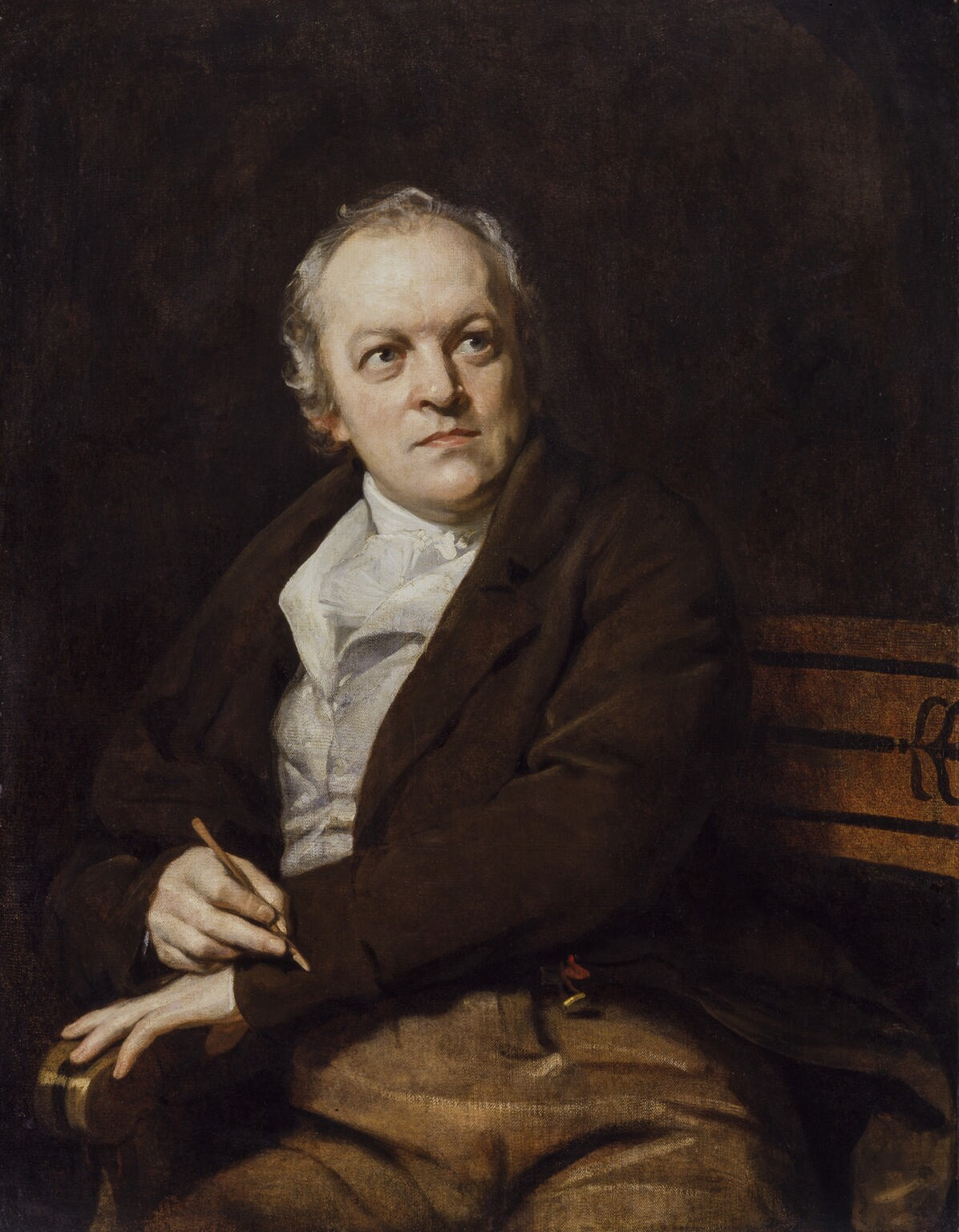
William Blake
1757–1827 · England
“Tyger Tyger, burning bright, / In the forests of the night; / What immortal hand or eye, / Could frame thy fearful symmetry?”
The lineage through William Blake
Drew From(6)
who shaped William Blake
via Paradise Lost
- Blake didn't just admire Paradise Lost — he argued with it, decided Milton was secretly "of the Devil's party without knowing it"
- That reading runs through Blake's prophetic work, and his own epic Milton sends the dead poet back to earth to correct his mistakes
- Read Milton first and Blake's quarrel makes sense: he's rewriting the most ambitious poem in English from the inside
via Job
- The book Blake read his own neglected life through — he reperused Job obsessively and identified with its tested man
- The whirlwind voice conjuring Behemoth and Leviathan haunts 'The Tyger' and its question of what fearful hand could frame such a thing
- Blake closed the loop with 22 engraved 'Illustrations of the Book of Job' (1826) — reading the original shows you the source of his most awestruck verse
- One of Blake's chosen prophets — Ezekiel turns up as a dinner guest in The Marriage of Heaven and Hell
- Ezekiel's four living creatures and burning wheels are the raw material Blake reforges into his Four Zoas and the cherubim of Jerusalem
- Read the vision first and Blake's strangest images stop being random — you're watching him remake an ancient one
- Blake's whole theory of the poet-as-prophet is voiced, in The Marriage of Heaven and Hell, by Isaiah himself — a literal guest at his table
- Read Isaiah first and you hear the visionary register Blake is channeling: the prophet who speaks for God becomes Blake's model for what a poet is
- The seer's authority Blake claims for himself is borrowed straight from the book of Isaiah
via Revelation
- Blake's prophetic machinery — the Four Zoas above all — is built directly from John's Revelation
- The throne-beasts and apocalyptic visions he paints in watercolour are the same ones he reforges in verse; the line from John's Apocalypse to Milton and Jerusalem is the spine of his myth
- Knowing Revelation first turns Blake's hardest poems from private raving into a reader's recognizable revision of the last book of the Bible
- Blake's whole mythology is a reworking of Genesis — the Fall reimagined as the very act of material creation
- "The Book of Urizen" apes Scripture's chapter-and-verse layout to turn the Creation myth inside out; he also illustrated Genesis entire and painted "Elohim Creating Adam"
- Read Genesis first and Blake's inversions land — you can see exactly which myth he's rewriting
Famous Quotes
“Tyger Tyger, burning bright, In the forests of the night; What immortal hand or eye, Could frame thy fearful symmetry?”
“To see a World in a Grain of Sand / And a Heaven in a Wild Flower, / Hold Infinity in the palm of your hand / And Eternity in an hour.”
“To see a World in a Grain of Sand And a Heaven in a Wild Flower, Hold Infinity in the palm of your hand And Eternity in an hour.”
“And did those feet in ancient time, Walk upon Englands mountains green: And was the holy Lamb of God, On Englands pleasant pastures seen!”
About William Blake
English poet, painter, and printmaker, one of the most original artists in English history. His illuminated books — hand-engraved, hand-colored combinations of poetry and visual art — include Songs of Innocence and of Experience and his visionary prophetic works. Largely unrecognized in his lifetime, he is now considered a major figure of Romanticism.