
Read this if you…
- want to read the biblical book most revered by Writers
- are interested in religious/philosophical problem of suffering
- want to read a biblical book that "stands alone" better than most others
- like a debate based exploration of ideas
Skip this if you…
- can't stand biblical/archaic writing
- don't want to read explicitly religious/Christian text
- are expecting a fast moving plot
The lineage through Job
- Faust, First Part by Johann Wolfgang von Goethe. Job shaped it. - *Job*'s opening wager is the blueprint for *Faust*'s 'Prologue in Heaven' - Goethe rebuilt the scene where God and Satan bet over a faithful man — only now Mephistopheles stakes the soul of Faust, God's restless 'striving servant' - He even reaches for deliberately archaic, scriptural German to make the debt to the Hebrew original unmistakable
- The Complete Poems by William Blake. Job shaped it. - Blake returned to *Job* his whole life — he 'devoted himself to a perusal and reperusal' of it and Ezekiel, and personally identified with the suffering man - That obsession culminates in his 22 'Illustrations of the Book of Job' (1826), the summit of his pictorial engagement with the text - Job's whirlwind — God answering out of the storm with Behemoth and Leviathan — stands behind the terrifying maker of 'The Tyger'
- Moby-Dick or, The Whale by Herman Melville. Job shaped it. - Scholars call *Job* "the most informing single principle" of *Moby-Dick*'s composition — the spine the whole book is built on - Melville hands Job's Leviathan straight to Ahab: the inscrutable beast and the silent, unanswerable God become the white whale and Ahab's doomed quarrel with the universe - His prose is soaked in scripture — 650+ biblical references, two-thirds of them Old Testament — and *Job* is the one he keeps coming back to
- The Brothers Karamazov by Fyodor Dostoevsky. Job shaped it. - The book Dostoevsky called a lifelong touchstone — *Job*'s argument with God runs straight into *The Brothers Karamazov* - In Book VI, Elder Zosima recalls hearing *Job* read aloud in church at eight years old — "the seed of God's word" planted in his heart — and builds a whole meditation on it - That scene is autobiographical: the suffering-and-faith problem *Job* poses is the one Dostoevsky spent his last novel wrestling to the ground
- King Lear by William Shakespeare. Job shaped it. - *Lear* is Shakespeare's *Job* — the formidable man stripped to nothing, raging at heaven on open ground - Both stage the same hard question: why does the innocent suffer? Cordelia's undeserved end is Job's torment made dramatic - Harold Bloom calls *Lear* "manifestly influenced by" Job, and the kinship runs deep enough to carry a whole chapter, "The Patience of Lear"
- The Death of Ivan Ilych by Leo Tolstoy. Job shaped it. - Tolstoy named this book as an inspiration for his bleakest novella - Ivan Ilych's long, undeserved-feeling agony — and his cry against the injustice of dying — is Job's drama rebuilt inside a 19th-century bureaucrat - The post-conversion Tolstoy reached back to Job's challenge to divine justice and asked it again of an ordinary man
Depicted in Art
Job sits stripped on the ground in deep shadow while two armored, mocking figures lean over him and a third raises a fist behind.
Gerard Seghers
An emaciated Job sits on the earth in a pale loincloth, head bowed, while his three friends in richly colored robes loom over him gesturing in argument.
Ilya Repin, 1869
Job, his wife, sons, and daughters sit beneath a tree at sunset with sheep at their feet and musical instruments hung silent in the branches.
William Blake, 1825
Satan with outstretched wings and torches hovers above as Job's children are crushed beneath the collapsing roof of the eldest brother's house.
William Blake, 1825
God appears in a churning vortex of cloud and wind above Job, his wife, and his three friends, who shield their faces or kneel in awe.
William Blake, 1825
A wiry, almost skeletal Job, naked and lit from above, clutches his knees on a stone block in a dark interior, eyes lifted in anguish.
Léon Bonnat, 1880
Recommended Editions

King James Version
Oxford University Press · 1611
The most influential and commonly quoted translation in English. The prose rhythm everyone else is responding to, even modern translations.
Please support us by purchasing through these links, at no extra cost to you!
Notable Quotes
Naked came I out of my mother's womb, and naked shall I return thither: the LORD gave, and the LORD hath taken away; blessed be the name of the LORD.
Screen & Stage
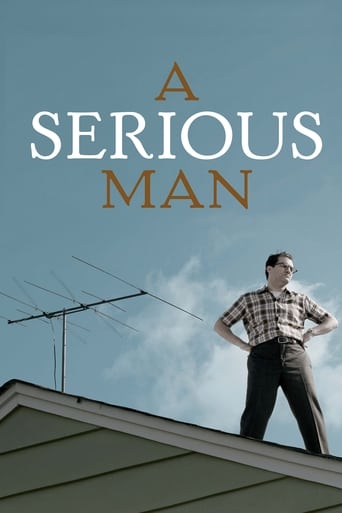 loose
looseA Serious Man
Film · 2009
Ethan Coen

J.B.
Stage · 1958
Archibald MacLeish
Posters via The Movie Database (TMDB)
- Victor Hugo, French novelist and poet, 1802–1885: Hugo said that if all literature were destroyed and he could keep one book, he would save Job.
- Alfred, Lord Tennyson, British Poet Laureate, 1809–1892: Tennyson called Job the greatest poem of either ancient or modern literature.
- Daniel Webster, American statesman and orator, 1782–1852: Webster called Job, as a work of literary genius, one of the most wonderful productions of any age or language.
- Joseph Campbell, American mythologist, 1904–1987: "A hero who … had proven himself capable of facing a greater revelation than the one that satisfied his friends."
- Carl Jung, Swiss psychiatrist, 1875–1961: Jung devoted a whole book, Answer to Job, to wrestling with it, treating the text as one of the central documents of the religious psyche.
- Johann Wolfgang von Goethe, German poet and dramatist, 1749–1832: Goethe modeled Faust's “Prologue in Heaven” directly on Job's prologue — the wager between God and the adversary over a righteous man.
- Robert Frost, American poet, 1874–1963: Frost wrote A Masque of Reason as a verse-drama framed as a “forty-third chapter” of Job — a sustained, affectionate engagement with the book.
- Abraham Lincoln, 16th U.S. President, 1809–1865: Lincoln returned to Job throughout the Civil War; his Second Inaugural reads like a man who had spent years with it.
More by Unknown
- 17Job~500 BCUnknownHard·Quick·113 pagesInfluence90Popularity54BibleWisdomHebrew
- 83Beowulf~1000UnknownHard·Quick·213 pagesInfluence66Popularity72MedievalEpicOld English
- 97The Nibelungenlied~1200UnknownHard·Long·403 pagesInfluence64Popularity30MedievalEpicMiddle High German
- 166The Song of Roland~1100UnknownHard·Short·224 pagesInfluence66Popularity30MedievalEpicOld French
- 196The Poetic Edda~1270UnknownHard·Medium·382 pagesInfluence6Popularity30MedievalEpicOld Norse
- Judith~100 BCUnknownHard·Quick·37 pagesInfluence—Popularity—BibleScripture — NarrativeHebrew
- Prayer of Manasses~150 BCUnknownHard·Quick·3 pagesInfluence—Popularity—BibleLyricAncient Greek
- 1 Maccabees~100 BCUnknownHard·Quick·77 pagesInfluence—Popularity—BibleScripture — NarrativeHebrew
- 2 Maccabees~124 BCUnknownHard·Quick·54 pagesInfluence—Popularity—BibleScripture — NarrativeAncient Greek
- Esther~400 BCUnknownHard·Quick·19 pagesInfluence—Popularity—BibleScripture — NarrativeHebrew
- 1 Esdras~150 BCUnknownHard·Quick·39 pagesInfluence—Popularity—BibleScripture — NarrativeAncient Greek
- 2 Esdras~100UnknownHard·Quick·87 pagesInfluence—Popularity—BibleApocalypticLatin
- Tobit~200 BCUnknownHard·Quick·23 pagesInfluence—Popularity—BibleScripture — NarrativeAramaic