Read this if you…
- like a charming biblical novella with an angel-in-disguise, a love story, and a demon to defeat
- want the deuterocanonical book where the archangel Raphael accompanies a young man on a quest
- care about reading parts of the Bible that read more like folktale than scripture
Skip this if you…
- don't want to read explicitly religious/Christian texts
The lineage through Tobit
- Paradise Lost by John Milton. Tobit shaped it. - Milton plucks the demon Asmodeus straight out of *Tobit* — the "fishy fume" that drove him off Tobit's son's bride becomes Milton's image for Satan's frustrated lust - Tobit's angelic companion Raphael returns too, named in *Paradise Lost* as the spirit who "deign'd to travel with Tobias" - This deuterocanonical book gave Milton two figures — one demonic, one angelic — that he wove directly into his epic
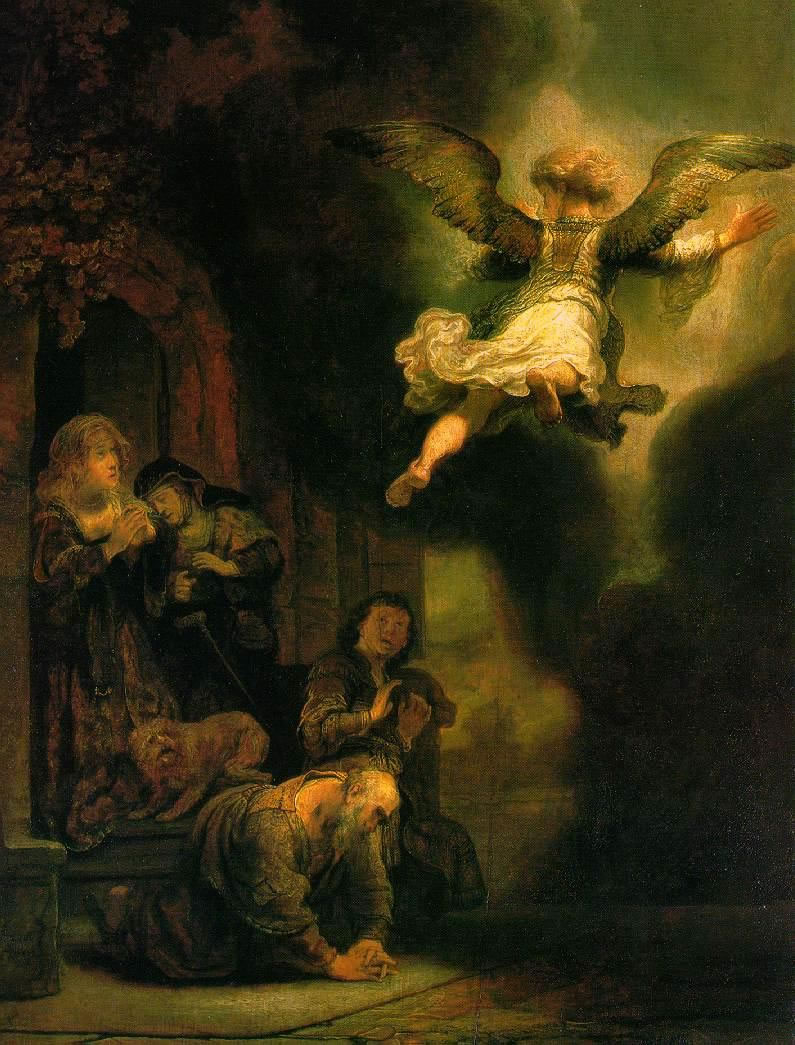
Depicted in Art
Raphael ascends in a blaze of light as Tobit, Tobias, Anna and Sarah kneel in awe; the angel's identity revealed only at the moment of departure.
Rembrandt van Rijn, 1637
Aged blind Tobit sits at home accusing Anna of stealing the goat she has been given; Anna defends herself holding the kid.
Rembrandt van Rijn, 1626
Blind Tobit sits by the hearth in shadow while Anna spins; both wait for Tobias to return from his journey.
Rembrandt van Rijn, 1630
Recommended Editions

King James Version
Oxford University Press · 1611
The most influential and commonly quoted translation in English. The prose rhythm everyone else is responding to, even modern translations.
Please support us by purchasing through these links, at no extra cost to you!
Notable Quotes
Do that to no man which thou hatest.
Screen & Stage

Tobias and the Angel
Stage · 1930
James Bridie
Posters via The Movie Database (TMDB)
- Martin Luther, German theologian and Reformer, 1483–1546: "Even if it were all made up, Tobit would be a beautiful, wholesome, useful drama by a gifted poet — good for us Christians to read."
- Søren Kierkegaard, Danish philosopher, 1813–1855: The true hero of Tobit is not Tobias but Sarah, who dares to be healed and to live.
- Jerome, translator of the Latin Vulgate, Doctor of the Church, c. 347–420: Hearing the Odyssey in Tobit's journey home, Jerome slipped the dog's wagging tail into his Latin — a classicist's tribute.
- Rembrandt van Rijn, Dutch Golden Age painter, 1606–1669: Rembrandt returned to Tobit across his life in more than fifty paintings, drawings, and etchings.
- Carey A. Moore, biblical scholar, Anchor Bible commentator, 1930–2015: "I can honestly say that I really like and admire them. I 'feel at home' with them."
More by Unknown
- 17Job~500 BCUnknownHard·Quick·113 pagesInfluence90Popularity54BibleWisdomHebrew
- 83Beowulf~1000UnknownHard·Quick·213 pagesInfluence66Popularity72MedievalEpicOld English
- 97The Nibelungenlied~1200UnknownHard·Long·403 pagesInfluence64Popularity30MedievalEpicMiddle High German
- 166The Song of Roland~1100UnknownHard·Short·224 pagesInfluence66Popularity30MedievalEpicOld French
- 196The Poetic Edda~1270UnknownHard·Medium·382 pagesInfluence6Popularity30MedievalEpicOld Norse
- Judith~100 BCUnknownHard·Quick·37 pagesInfluence—Popularity—BibleScripture — NarrativeHebrew
- Prayer of Manasses~150 BCUnknownHard·Quick·3 pagesInfluence—Popularity—BibleLyricAncient Greek
- 1 Maccabees~100 BCUnknownHard·Quick·77 pagesInfluence—Popularity—BibleScripture — NarrativeHebrew
- 2 Maccabees~124 BCUnknownHard·Quick·54 pagesInfluence—Popularity—BibleScripture — NarrativeAncient Greek
- Esther~400 BCUnknownHard·Quick·19 pagesInfluence—Popularity—BibleScripture — NarrativeHebrew
- 1 Esdras~150 BCUnknownHard·Quick·39 pagesInfluence—Popularity—BibleScripture — NarrativeAncient Greek
- 2 Esdras~100UnknownHard·Quick·87 pagesInfluence—Popularity—BibleApocalypticLatin
- Tobit~200 BCUnknownHard·Quick·23 pagesInfluence—Popularity—BibleScripture — NarrativeAramaic