
Read this if you…
- appreciate philosophical/experimental writing over narrative writing
- find whales cool
- want the best American book ever written
- like difficult reading (this will require going slow, looking up references and analyses and such to get most out of it)
Skip this if you…
- want plot
- aren't willing to go slow and look up analyses/references after most chapters (have to do this to get most out of it)
- hate whales (you're gonna get a LOT of whale information)
The  Take
Take
This book is so well crafted, it’s hard to believe a more impressive book could be written. Will it be my favorite book? Probably not, a little too lofty and poetic, but it’s incredible nonetheless. Packed with well researched interesting descriptions of whaling, poetic imagery to relate it to life in general, references to biblical stories, mythology, Shakespeare, science, art and more, Melville impressively takes what in reality is a collection of surface level expository chapters and with them, dives down into a deep philosophical reflection. The narrative is quite simple and overarching, but is really like 1/20th of the book.
The lineage through Moby-Dick or, The Whale
- Job by Unknown. Moby-Dick or, The Whale built on it. - The whole theological argument of *Moby-Dick* runs on *Job* — read it first and you'll see Ahab as the man who refuses Job's submission - Melville explicitly equates Moby Dick with Job's Leviathan: the creature you cannot draw out with a hook, the proof that the universe will not be cross-examined - From the opening Extracts to the Epilogue, the book frames itself around Job's question — why does the innocent suffer, and what answer does a silent God give?
- Jonah by Jonah. Moby-Dick or, The Whale built on it. - Before the *Pequod* sails, Melville stops everything for *Jonah*: Father Mapple's sermon (Ch. 9) is a full adaptation of the prophet swallowed by the whale - *Jonah*'s lesson — obey, or be hurled into the deep — sets the bar that Ahab will spend the novel defying - Read the short prophet first and Mapple's sermon stops being a digression and becomes the key to the book's argument about God and submission
- Paradise Lost by John Milton. Moby-Dick or, The Whale built on it. - Ahab is Milton's Satan reborn on a whaleship — the grandeur, the defiance, the self-aware damnation all trace back to *Paradise Lost* - Melville conceived Ahab during his 1849–50 reading of Milton, annotating his own copy as he wrote; the debt is documented, not guessed - Ahab quotes the lineage himself — "proud as Lucifer," "damned in the midst of Paradise" — and reading Milton first makes those lines ring
- Ecclesiastes by Solomon. Moby-Dick or, The Whale built on it. - The book Ishmael ranks above all others — "the truest of all books is Solomon's, and *Ecclesiastes* is the fine hammered steel of woe" - Melville marked it heavily in his own KJV; the "wisdom that is woe" lands straight out of Ecclesiastes 1:18 - Read Solomon first and *Moby-Dick*'s pessimism stops looking like a mood and starts looking like a tradition
- Kings by Jeremiah. Moby-Dick or, The Whale built on it. - Ahab is named for a king, and *Kings* is the book — Peleg says it outright: "Ahab of old, thou knowest, was a crowned king!" - Melville pulls the curse along with the name: Elijah's prophet-warning, the dogs that lick the blood, the pervasive ivory that recalls King Ahab's ivory house - Know the wicked king of *Kings* — the one who defied God and was annihilated — and you know how Melville's voyage has to end before the *Pequod* leaves port
- The Scarlet Letter by Nathaniel Hawthorne. Moby-Dick or, The Whale built on it. - *Moby-Dick* exists in its final, towering form because Melville met Hawthorne in 1850, mid-composition — scholars credit that friendship with transforming a whaling adventure into this - Melville's awe is on the record: the dedication "in token of my admiration for his genius," the essay "Hawthorne and His Mosses," the letter about "germinous seeds" dropped into his soul - Read *The Scarlet Letter* and you meet the dark, allegory-loving imagination that gave Melville permission to write big — the genius he was reaching toward
- King Lear by William Shakespeare. Moby-Dick or, The Whale built on it. - Ahab didn't come from nowhere — Melville consciously built him on Shakespeare's tragic heroes, *Lear* foremost - He had just bought and heavily annotated a seven-volume Shakespeare set when he wrote *Moby-Dick*, and *Lear* was among his most marked plays - Read Lear first and Ahab's grandeur reads true: the great man cracking himself against an indifferent universe, raging at the storm
- Macbeth by William Shakespeare. Moby-Dick or, The Whale built on it. - Ahab is a sea-captain cut from Shakespeare's cloth — read *Macbeth* and you see the mold: the great man undone not by enemies but by his own ungovernable will - Fedallah's prophecy works exactly like the Witches' riddles to Macbeth — true to the letter, fatal in the reading - Melville studied *Macbeth* line by line while writing this; the high, doom-struck diction of Ahab's soliloquies is the debt
- Daniel by Daniel. Moby-Dick or, The Whale built on it. - The dread that hangs over the Pequod is borrowed from Daniel 5 — Belshazzar's feast, the hand that writes the verdict on the wall, the doom that comes whether or not anyone reads it - Starbuck names it outright in the doubloon chapter: Ahab "seems to read Belshazzar's awful writing," "Mene, Mene, Tekel, Upharsin" - The Bible was Melville's deepest well; reading Daniel first gives that allusion — and the novel's whole prophetic key — its full weight
- Genesis by Moses. Moby-Dick or, The Whale built on it. - "Call me Ishmael" — and the name comes straight from *Genesis*, Abraham's cast-out son, the wanderer and outsider - Melville fronts the whole novel with Scripture, the first of his Extracts pulled from *Genesis* itself - Reading it first sharpens the frame: Ahab's doomed pride, the outcast narrator who alone survives — *Moby-Dick* is soaked in the Bible's first book
- Jeremiah by Jeremiah. Moby-Dick or, The Whale built on it. - The ship that plucks Ishmael from the sea is named for a verse in Jeremiah - The *Rachel*, mourning her lost children and refusing comfort, comes straight out of Jeremiah 31:15 — Melville seals the rescue with the prophet's own grief - Father Mapple's thundering "woe" interjections draw on the same prophetic register; Jeremiah is the voice underneath Melville's doom
Depicted in Art
The white whale broaches in a halo of spray and broken boats, harpooners hurled into the sea around it.
Augustus Burnham Shute, 1892
Whalers in small boats attacking a sperm whale that lifts its flukes against the open sea, parent ship behind.
Ambroise Louis Garneray
A whaleboat's crew drives a harpoon into a right whale as the wounded animal arches and a second boat closes from astern.
Ambroise Louis Garneray, 1835
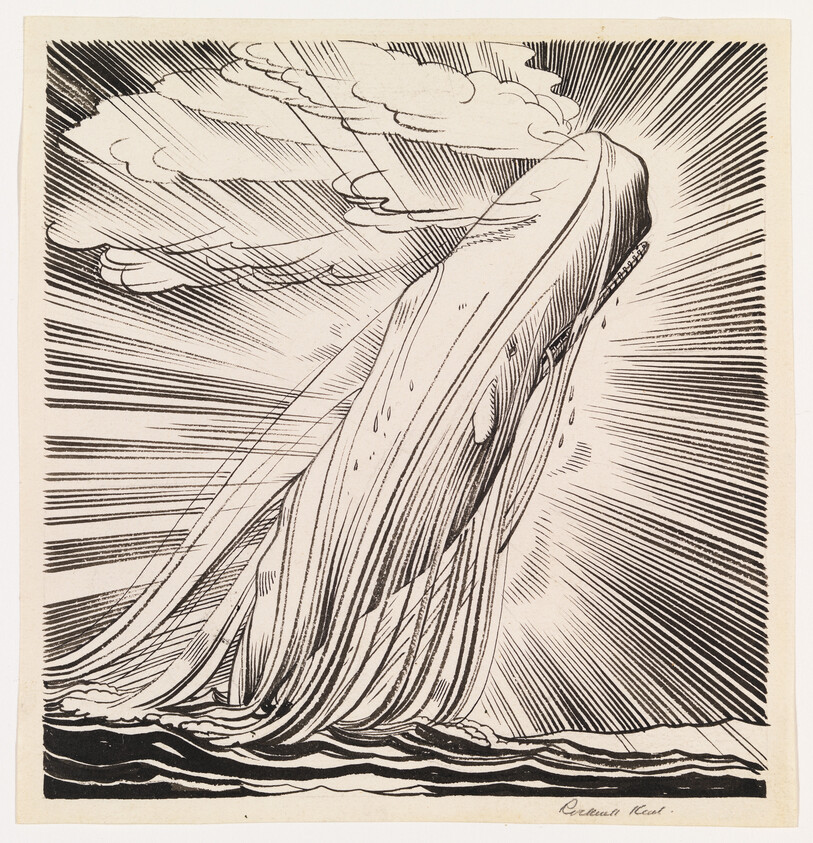
Rockwell Kent's ink drawing of the white whale surging through the sea at full power.
Rockwell Kent
A stylized black-and-white image of the white whale rising from the sea, drawn in Kent's bold modernist line.
Rockwell Kent, 1930
Ahab in the bow of his whaleboat hurls a harpoon into the white whale as the Pequod founders in the distance.
I. W. Taber, 1902
A right whale being harpooned by hunters in a whaling boat, with a second whale being flensed and blubber hauled aboard the ship in the background.
Ambroise Louis Garneray, 1835
A whale's tail lifts a capsized whaleboat as sailors tumble into the sea.
Rockwell Kent
Recommended Editions

Penguin Classics
2002
Andrew Delbanco's Penguin reads cleanly and his intro grounds the novel in antebellum America: slavery, manifest destiny, the whaling boom. Clean text without the freight of a critical apparatus.
Please support us by purchasing through these links, at no extra cost to you!
Notable Quotes
Call me Ishmael.
Screen & Stage
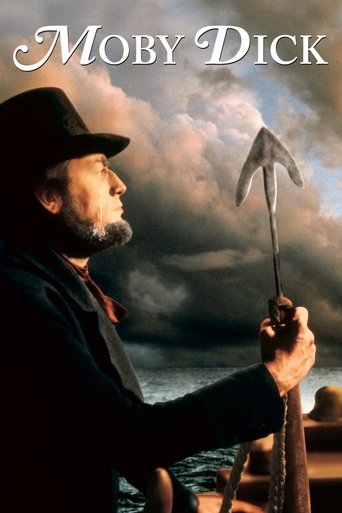
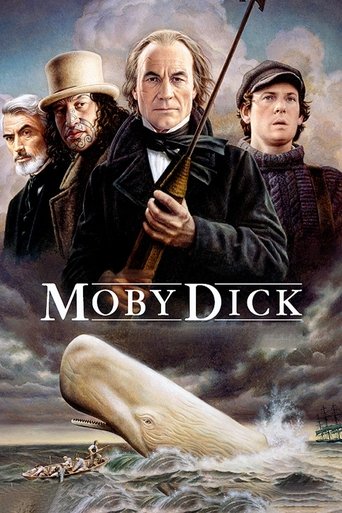
Posters via The Movie Database (TMDB)
- William Faulkner, American novelist, Nobel laureate, 1897–1962: "The book which I put down with the unqualified thought 'I wish I had written that' is Moby Dick."
- D.H. Lawrence, English novelist and critic, 1885–1930: "It is a great book, a very great book, the greatest book of the sea ever written."
- Albert Camus, French novelist and philosopher, Nobel laureate, 1913–1960: "One of the most overwhelming myths ever invented on the subject of the struggle of man against evil."
- Nathaniel Hawthorne, American novelist, 1804–1864: Hawthorne's praise so moved Melville that he replied with 'a sense of unspeakable security' at being understood — and dedicated Moby-Dick to him 'in token of my admiration for his genius.'
- Steve Jobs, Apple co-founder, 1955–2011: Counted Moby-Dick among his most beloved books, returning to it throughout his life.
- Orson Welles, director, actor, 1915–1985: Returned to Melville for decades — his 1955 stage Moby Dick — Rehearsed, Father Mapple in Huston's 1956 film, and an unfinished film he never let go.
- Barack Obama, 44th President of the United States, b. 1961: Obama has named Moby-Dick one of his two all-time favourite books, alongside Toni Morrison's Song of Solomon.
- William F. Buckley Jr., American conservative commentator and founder of National Review, 1925–2008: "To think I might have died without having read it."
- Frank Stella, American abstract painter and printmaker, 1936–2024: "The novel moves; you're going around the world, it's pretty wet, there are a lot of waves and motion."
- Cormac McCarthy, American novelist, 1933–2023: McCarthy named Moby-Dick his favorite novel.
- Harold Bloom, American literary critic, Yale, 1930–2019: "Moby-Dick is not a novel. It is a giant Shakespearean prose poem, quite deliberately."