
Read this if you…
- want the source for the lion's den, the fiery furnace, and the writing on the wall — three of the most-painted scenes in Christian art
- like apocalyptic literature: world empires as beasts, visions of the end, the Son of Man on clouds
- care about a Jewish exile story written to encourage Jews under Greek persecution — a coded protest book
Skip this if you…
- don't want to read explicitly religious/Christian texts
The lineage through Daniel
- The Merchant of Venice by William Shakespeare. Daniel shaped it. - Daniel judging Susanna — the wise young judge who turns a trial inside out — is the figure Shakespeare summons for the *Merchant of Venice* courtroom - Shylock hails Portia twice: "A Daniel come to judgment! Yea, a Daniel! O wise young judge" - Portia even tries the case under Daniel's Babylonian name, Balthasar — the borrowing runs that deep
- Moby-Dick or, The Whale by Herman Melville. Daniel shaped it. - Daniel 5's writing on the wall — "Mene, Mene, Tekel, Upharsin," the verdict that Belshazzar has been weighed and found wanting — becomes Melville's image for doom foreseen and unread - The Bible was Melville's foremost source, and *Moby-Dick* hangs the Pequod's fate on this scene - In the doubloon chapter, Starbuck watches Ahab and says "the old man seems to read Belshazzar's awful writing" — Daniel's prophecy of a kingdom already condemned
Depicted in Art
Daniel sits among nine life-size lions in a rocky den, hands clasped in prayer, his eyes turned up to a shaft of dawn light.
Peter Paul Rubens, 1615
A bearded creator god kneels in a fiery red sun, leaning down through clouds to measure the dark void below with a pair of golden compasses.
William Blake, 1794
Daniel stands with his back to the viewer in a shadowy underground pit, surrounded by quiet lions; a single beam of light falls from above.
Briton Rivière, 1872
Daniel stands among the lions at the pit's mouth, looking up to address the king above; the lions are calm and watchful around him.
Briton Rivière, 1890
Daniel stands at the center of a shadowy stone pit, the lions tame around his feet, light streaming down through a narrow opening above.
Gustave Doré, 1866
A vast columned hall opens onto Babylon at night; tiny figures recoil from a wall of fiery Hebrew letters as the city burns in the distance.
John Martin, 1820
Recommended Editions

King James Version
Oxford University Press · 1611
The most influential and commonly quoted translation in English. The prose rhythm everyone else is responding to, even modern translations.
Please support us by purchasing through these links, at no extra cost to you!
Notable Quotes
And this is the writing that was written, Mene, Mene, Tekel, Upharsin.
Screen & Stage
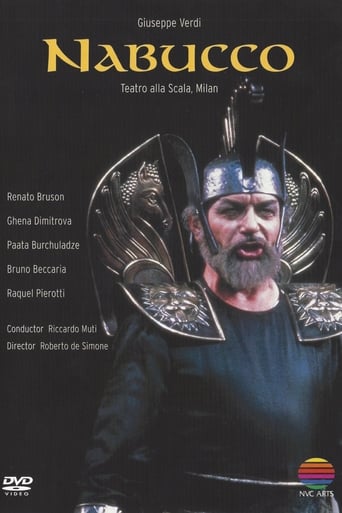
Nabucco
Opera · 1842
Giuseppe Verdi

Belshazzar's Feast
Opera · 1931
William Walton
Posters via The Movie Database (TMDB)
- Sir Isaac Newton, physicist & mathematician, 1642–1727: "And to reject his Prophecies, is to reject the Christian religion."
- St. Jerome, Church Father & translator of the Vulgate, c. 347–420: "None of the prophets has so clearly spoken concerning Christ as has this prophet Daniel."
- Martin Luther, Reformation theologian, 1483–1546: "From this we see what a splendid, great man Daniel was, before both God and the world."
- Flavius Josephus, Jewish historian, c. 37–100: "He had the esteem and applause both of the kings and of the multitude."
- Jesus of Nazareth, founding figure of Christianity, 1st century: "The abomination of desolation, spoken of by Daniel the prophet."
- John Calvin, Reformation theologian, 1509–1564: "What, at first sight, is more unbecoming, than that youths endued with almost angelic virtues should be the slaves and captives of a proud conqueror?"