
Faust, First Part
Read this if you…
- have already read dr faustus and want the more famous remake
- love the idea of making a deal with the devil
- want to read the most famous German work ever
- buy the idea that endless striving (never settling, never satisfied) is what makes a life worth living
Skip this if you…
- are expecting all the poetry to survive translation into english
- already know deal with the devil concept, and don't find it interesting
The  Take
Take
Step up from Marlowes Faustus, and interesting philosophical/theological premise
The lineage through Faust, First Part
- Job by Unknown. Faust, First Part built on it. - The 'Prologue in Heaven' is *Job*'s heavenly wager, transposed — God and the devil bargaining over one striving man - Goethe modeled the scene directly on Job's opening, down to the archaic, scriptural German that signals where it came from - Read Job first and *Faust*'s frame reveals itself: not a fresh invention but a deliberate reworking of the oldest argument about why a good man suffers
- Dr. Faustus by Christopher Marlowe. Faust, First Part built on it. - The puppet plays Goethe watched as a child trace straight back to Marlowe's *Dr. Faustus* - Marlowe's proud scholar bartering his soul is the seed; Goethe only met the actual English drama later, long after the legend had already shaped him - Read Marlowe to see the bargain in its rawest form — damnation as a closed deal — before Goethe reopens the question and lets Faust strive past it
- Hamlet by William Shakespeare. Faust, First Part built on it. - *Faust* is steeped in Shakespeare — Goethe called him one of the three writers who made him, and *Hamlet* is the play he reaches for - Gretchen's ruin is shaped on Ophelia's: the cast-off woman, the descent into madness, the brother who dies trying to avenge her - Read *Hamlet* first and the echoes ring clear — Ophelia's mad song in Mephistopheles' mouth, the graveyard turned to Faust's churchyard
- Macbeth by William Shakespeare. Faust, First Part built on it. - *Faust*'s 'Witch's Kitchen' is Goethe answering the *Macbeth* witches he praised — the cauldron scene was directly in his mind - Gretchen's madness borrows Shakespeare's signature image of guilt: the imagined bloodstain that won't wash off, straight out of Lady Macbeth's sleepwalk - Read *Macbeth* first and you'll catch how Goethe is reaching for the same theatrical power — witchcraft, conscience, a hand stained by murder
- The Brothers Karamazov by Fyodor Dostoevsky. Faust, First Part shaped it. - Goethe's tempter gets reborn in Russia — Dostoevsky read *Faust* in German at seventeen and never let it go - Ivan Karamazov is, by scholarly consensus, "a Russian Faust": the brilliant intellect who reasons his way to despair - And Ivan's devil-visitor descends straight from Mephistopheles — Dostoevsky strips the grand demon down to a threadbare gentleman in a checked coat
- The Interpretation of Dreams by Sigmund Freud. Faust, First Part shaped it. - Goethe's *Faust* became Freud's go-to source for naming the unnamable — he quotes it more than any other work in *The Interpretation of Dreams* - Most of those quotations come from Mephistopheles' mouth, the voice Freud reached for when describing how dreams disguise their meaning - A scholarly study traces "Die Traumdeutung" itself back to *Faust* — the play is woven through Freud's account of the dream-work
Depicted in Art
Faust and Margaret meet on a sunlit street, Faust raising his hat as she walks past, Mephistopheles watching from the shadows.
Alexander von Liezen-Mayer, 1876
An aged Faust slumps in his chair amid books and astrolabes, gazing toward an unseen vision.
Ary Scheffer, 1831
Marguerite descends church steps with a downcast face, parishioners receding behind her in the dim doorway.
Ary Scheffer, 1838
Gretchen kneels in a dim church interior among scattered worshippers, weighed down by the evil spirit's whispered accusations.
Enrico Fanfani, 1850
A scholar rises from his desk in a darkened study, transfixed by a luminous magic disc inscribed with letters that hovers at his window.
Rembrandt van Rijn, 1652
Marguerite plucks petals from a daisy beside a hesitant Faust in a leafy garden; Mephistopheles and Martha pass in the background.
Ary Scheffer, 1846
Faust and Mephistopheles race on horseback through a wild night sky, manes and cloaks streaming, in Vrubel's broken-mosaic style.
Mikhail Vrubel, 1896
Faust and Mephistopheles in an oak-paneled interior, the devil leaning over Faust's shoulder as the scholar studies a manuscript by candlelight.
Eugène Siberdt
Faust seated at a chess-like table across from a sharp-featured Mephistopheles, the devil leaning in over the board with a sly grin.
Anton Kaulbach
Faustus in his study at the moment of the pact, an austere robed figure of Mephistopheles standing over the seated scholar.
Jean-Paul Laurens
Recommended Editions

David Luke
Oxford University Press · 2008
David Luke's verse is the consensus English Faust. Supple meter that catches both the lyric stretches and the demonic mischief, with notes that help without burying the page.
Please support us by purchasing through these links, at no extra cost to you!
Notable Quotes
Two souls, alas, dwell in my breast, each one desiring to separate from the other.
Screen & Stage
 loose
loosePhantom of the Paradise
Film · 1974
Brian De Palma

Faust
Opera · 1859
Charles Gounod
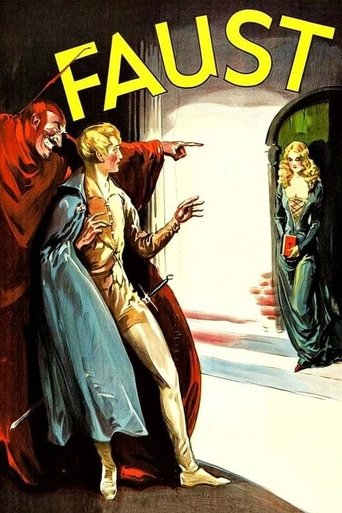
Faust
Film · 1926
F. W. Murnau
Posters via The Movie Database (TMDB)
- Nikola Tesla, inventor, electrical engineer, 1856–1943: Tesla had memorized Faust; the alternating-current motor came to him in a Budapest park in 1882 as he recited its sunset passage — "Watch me reverse it!" he cried, sketching the design in the dirt.
- Thomas Mann, German novelist, Nobel laureate, 1875–1955: "A man of God who, out of a presumptuous urge for knowledge, surrenders to magic, to the Devil."
- Ralph Waldo Emerson, American essayist, 1803–1882: "He flung into literature, in his Mephistopheles, the first organic figure that has been added for some ages."
- Friedrich Nietzsche, German philosopher, 1844–1900: "Goethe — no mere German, but a European event."
- Xi Jinping, General Secretary of the Chinese Communist Party, President of China, 1953–: Read Faust as a young man and, exiled to rural Shaanxi during the Cultural Revolution, walked thirty kilometres to borrow a copy — though he later told Angela Merkel he hadn't fully understood it.