
Faust, Part Two
Read this if you…
- want a mess of work, that's all over the place and hard to follow
- like Faust part 1 and want to finish it off
Skip this if you…
- are expecting it to be as good as part 1, not even close
- want a plot
- want something remotely coherent
The  Take
Take
Way too all over the place for me. Like part 1 much more. Super hard to follow and was hardly coherent
The lineage through Faust, Part Two
- The Iliad by Homer. Faust, Part Two built on it. - The woman at the center of the Helen act is Homer's Helen of Troy — the prize and the cause of the war the *Iliad* sings - Goethe, who memorized Homer young, threads the work with Homeric allusion and stages Helen's return from Troy to Sparta - Read the *Iliad* first and you arrive at Faust's marriage to Helen knowing exactly what she has already cost the world
- Metamorphoses by Ovid. Faust, Part Two built on it. - The old couple Philemon and Baucis in Act V come straight out of Ovid's *Metamorphoses* — Goethe learned the poem by heart as a boy and carried it to the end of his life - He keeps Ovid's names and their humble cottage, then twists the ancient parable of welcomed strangers into Faust's modernizing crime - Reading Ovid's gentle Book VIII version first makes Goethe's betrayal of it land — same couple, opposite fate
- The Divine Comedy by Dante Alighieri. Faust, Part Two built on it. - The heavenward finale — the choir of souls rising through celestial spheres, Gretchen as intercessor before the Mater Gloriosa — is Goethe modeling the close of *Faust* on Dante's *Paradiso* - That last line about the Eternal Feminine is held to be reminiscent of the *Comedy*'s final lines: the love that moves the sun and the stars - Read the *Paradiso* first and Faust's salvation stops being a surprise and becomes the answer to a five-century-old question about how a striving soul gets carried up
- The Odyssey by Homer. Faust, Part Two built on it. - The Sparta of Act III is Homer's Sparta — Menelaus's halls, where the *Odyssey*'s Book 4 sets Helen back among the living after Troy - Goethe steeped himself in the *Odyssey* (he tried to turn its Nausikaa episode into a play of his own), and that reading shapes Faust's journey toward Helen and into Hades - Read the homecoming books first and Act III stops feeling like a detour — it's Goethe answering Homer
- Thus Spoke Zarathustra by Friedrich Nietzsche. Faust, Part Two shaped it. - Goethe was Nietzsche's near-*Übermensch* — the figure he revered above all others in German culture - *Faust, Part Two* ends "the Eternal Feminine draws us upward"; Nietzsche takes that very line and turns its pull back toward the earth - *Zarathustra* alludes to *Faust* throughout — Nietzsche named the two works as the closest German literature has
- Middlemarch by George Eliot. Faust, Part Two shaped it. - George Eliot was one of Goethe's great English readers — she translated German and spent months in Weimar helping G. H. Lewes research his *Life of Goethe* (1855) - That immersion carried Goethe's moral seriousness into her own novels; *Middlemarch* breathes the same air, even if its closest structural debt is to *Wilhelm Meister* rather than *Faust*
Depicted in Art
Wagner and Mephistopheles bend over a glowing glass vial in which the tiny Homunculus has come to life in the laboratory.
Franz Xaver Simm, 1899
Mid-19th-century engraving of the alchemical creation scene: a luminous glass vial held aloft in a Gothic laboratory.
Faust and Helena stand together in classical drapery as their winged son Euphorion lifts into the air between them.
Friedrich Bruckmann, 1878
Faust reclines asleep while Mephistopheles conjures a swirling cloud of nude female figures spiralling through the air above him.
Luis Ricardo Falero, 1878
Recommended Editions

David Luke
Oxford University Press · 2008
Luke's Part Two is as good as his Part One, which matters more here because the second half goes full allegorical. The classical Walpurgis Night and Helen scenes stay navigable in his verse.
Please support us by purchasing through these links, at no extra cost to you!
Notable Quotes
The Eternal Feminine draws us onward.
Screen & Stage
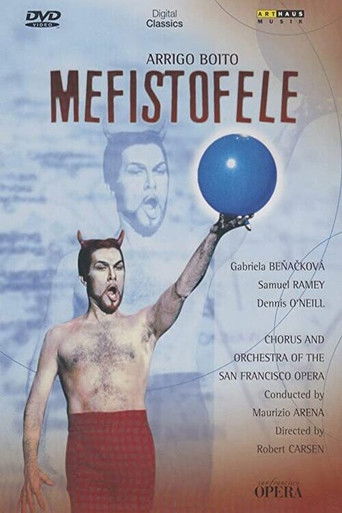
Mefistofele
Opera · 1868
Arrigo Boito

Scenes from Goethe's Faust
Opera · 1853
Robert Schumann
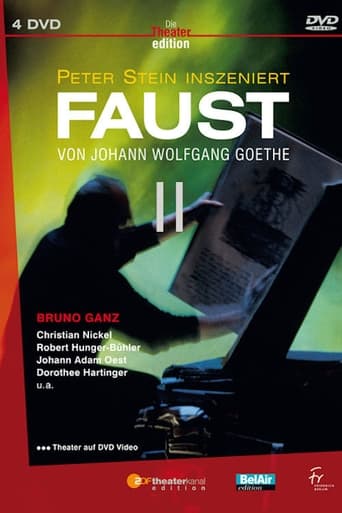
Johann Wolfgang von Goethe: Faust II
TV · 2001
Thomas Grimm
Posters via The Movie Database (TMDB)
- Nikola Tesla, inventor, electrical engineer, 1856–1943: Tesla had memorized Faust; reciting it in a Budapest park in 1882, he hit on the AC induction motor in a flash and drew the diagram in the sand.
- Thomas Mann, German novelist, Nobel laureate, 1875–1955: "The hero of our greatest literary work … surrenders to magic, to the Devil."
- Ralph Waldo Emerson, American essayist & transcendentalist, 1803–1882: "In his Mephistopheles, the first organic figure that has been added for some ages."
- Friedrich Nietzsche, German philosopher, 1844–1900: "Goethe is the last German for whom I feel any reverence."
- Xi Jinping, General Secretary of the Chinese Communist Party, President of China, 1953–: As an exiled youth in Shaanxi, Xi walked thirty kilometres to borrow Faust and read it until he knew it by heart.
- Harold Bloom, literary critic & Yale professor, 1930–2019: "Its grotesque and exuberant part two must be the most outrageous poem in the western canon."