Thus Spoke Zarathustra

Read this if you…
- want philosophy dressed up in poetic religious style writing (I find most of more modern philosophy insanely boring, this one wasn't)
- want a philosophy almost PURPOSELY negating all religion/philosophy that came before it
- are willing to look up stuff and take it super super slow
Skip this if you…
- won't spend a TON of time looking up analyses/summaries (it's an extremely difficult text)
- have an irrational aversion to him because people talk about him online too much
- find it annoying when contrarians mostly just poke holes in existing religions/philosophies
The  Take
Take
So somewhere after the ancients, philosophy writing becomes increasingly boring and analytical. Nietzche finally writes something poetic and interesting. It almost feels like he’s a contrarian looking for a coherent moral philosophy in the tiny cracks between religion and philosophy already written downAnd it’s incredible how coherent it is and yet how different it is from the well trodden paths. It’s remarkable to find enough new to have a full unique moral philosophy in the late 19th century.Tons of interesting ideas, particularly around creation being paramount and taking control of your own will. The poetic storytelling style of a prophet like figure makes it much more fun to read than raw philosophical argument.Maybe a little too anti-existing ideas for me to fully agree with it, but the project is well worth the exploration
The lineage through Thus Spoke Zarathustra
- The Gospels by Matthew. Thus Spoke Zarathustra built on it. - A parody you can only fully hear if you know the original — *Zarathustra* is a deliberate inversion of the Gospels - The prophet leaving at thirty, returning to the crowds, gathering disciples, being misunderstood: Nietzsche lifted the Gospel structure and prophetic cadence whole, then loaded it with the opposite gospel - Read the Gospels first and every borrowed beat lands as the calculated blasphemy he meant it to be
- The Republic by Plato. Thus Spoke Zarathustra built on it. - *Thus Spoke Zarathustra* is a conscious inversion of *The Republic* — Nietzsche the philologist knew exactly whose cave he was rewriting - Plato's prisoners climb *out* of the cave toward the sun; Zarathustra climbs *up* to his cave on the mountain, the allegory deliberately reversed - He even starts at thirty, the age Plato sets for the dialectic — read the *Republic* first and you'll see Nietzsche answering it line by line
- Faust, Part Two by Johann Wolfgang von Goethe. Thus Spoke Zarathustra built on it. - *Zarathustra* sets itself against *Faust* directly — Goethe was the one German Nietzsche held as a near-realization of the *Übermensch* - Goethe's closing "the Eternal Feminine draws us upward" is the line Nietzsche borrows and inverts, pulling the gaze down toward the earth and the eternal return - Read *Faust*'s ending first and you'll hear exactly what Nietzsche is answering
Depicted in Art
Original printed cover of the first edition of Part One — typographic title block on plain ground, no figure illustration, Schmeitzner's Chemnitz imprint at the foot.
1883
Three-quarter-length portrait of Nietzsche in a black overcoat at a railing, set against a turbulent yellow-orange Symbolist sky over a stylised mountain landscape.
Edvard Munch, 1906
An eagle in flight circles a coiled serpent against a stylised ground — Zarathustra's two companion animals from the Prologue.
Lena Hades, 1997
Nietzsche, recently released from the Jena clinic, seated on a white bench in the pergola of his mother's house in Naumburg, hands awkwardly overlapping.
Curt Stoeving, 1894
Zarathustra carries the heavy dwarf, the 'spirit of gravity,' up the mountain path before the vision of the gateway 'Moment.'
Lena Hades, 1997
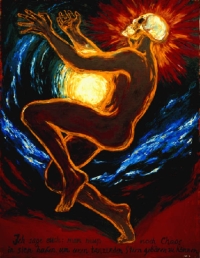
Swirling abstract chaos rendered in dark pigments, inscribed with Zarathustra's line 'Man muss noch Chaos in sich haben, um einen tanzenden Stern gebären zu können.'
Lena Hades, 2005
A blind round-headed figure stands frozen on an abstract ground, eyes hollowed — one of the 'last men' Zarathustra preaches against.
Lena Hades, 1997
Recommended Editions

Walter Kaufmann
Penguin Classics · 1978
Kaufmann pulled Nietzsche out of his Nazi appropriators in the mid-century, and his Zarathustra is still the one most readers know. Biblical cadence, alive to the parodies, more readable than the prose suggests it should be.
Please support us by purchasing through these links, at no extra cost to you!
Notable Quotes
God is dead. God remains dead. And we have killed him.
Screen & Stage
.png) loose
looseAlso sprach Zarathustra
Other · 1896
Richard Strauss
Posters via The Movie Database (TMDB)
- David Bowie, musician, 1947–2016: "I was still going through the thing when I was pretending I understood Nietzsche … It's pre-Fascist."
- William Butler Yeats, Irish poet, Nobel laureate, 1865–1939: "Nietzsche completes Blake and has the same roots."
- Carl Jung, Swiss psychiatrist, founder of analytical psychology, 1875–1961: "When I read Zarathustra for the first time as a student of twenty-three … I got a tremendous impression."
- Richard Strauss, German composer, 1864–1949: "I did not intend to write philosophical music or portray Nietzsche's great work musically."
- Hermann Hesse, German-Swiss novelist, Nobel laureate, 1877–1962: Hesse revered the prose music of Zarathustra and in 1919 answered it with his own homage, Zarathustra's Return.
- Martin Heidegger, German philosopher, 1889–1976: Heidegger devoted his summer-1937 lectures to 'The Convalescent' in Part III of Zarathustra, where eternal recurrence comes to speech.
- Sigmund Freud, Founder of psychoanalysis, 1856–1939: Nietzsche had a more penetrating knowledge of himself than any other man who ever lived or was likely to live.
- Henry Rollins, musician, author, 1961–: "Thus Spoke Zarathustra by Friedrich Nietzsche, the Kaufmann translation wowed me in my early 20's."