Read this if you…
- want context for pretty much the rest of Western political philosophy
- want the source of the Allegory of the Cave, Philosopher King
- like the thought experiment of desigining a Utopia's political system
- like philosophy Generally
Skip this if you…
- find elitist intellectual debate annoying
The  Take
Take
Just awesome rants on justice, the soul, politics, what matters in life.
The lineage through The Republic
- The Iliad by Homer. The Republic built on it. - The *Republic*'s most notorious move — banishing the poets — is aimed straight at Homer, and the *Iliad* supplies the evidence - Plato quotes its actual lines (Achilles defying the gods, the gods brawling) as the dangerous content to keep from the guardians - Knowing the poem first makes the prosecution land — you can hear exactly which passages Plato thinks are too beautiful and too false to be safe
- The Odyssey by Homer. The Republic built on it. - The poem Plato argues with for ten books, then exiles from his ideal city - Reading the *Odyssey* first lets you catch what the *Republic* is doing: the Myth of Er reworks Homer's underworld, and the banishment of poets targets lines like Achilles' ghost preferring slavery to death - Plato fights Homer because Homer is the rival teacher — the *Odyssey* is the moral education the *Republic* wants to replace
- Theogony/Works and Days by Hesiod. The Republic built on it. - *The Republic*'s Myth of Metals is Hesiod rewritten — the gold, silver, and bronze souls of the Noble Lie come straight from his myth of the golden, silver, and bronze races - Plato names and censors Hesiod in Book 2, then mines him in Book 3; reading the *Theogony/Works and Days* first lets you watch the theft and the twist - Hesiod's tale of decline becomes Plato's instrument of order — the same ladder of metals, repurposed to keep a city in its ranks
- The Oresteia by Aeschylus. The Republic built on it. - Aeschylus is one of Plato's chosen targets — Book 2 singles out the *Oresteia*'s poet for praising a justice prized only for its good name, the view the whole dialogue exists to refute - He's also expressly named among the tragedians banished from the ideal city - Reading the *Oresteia* first lets you hear exactly whom Plato is arguing against when he indicts the poets
- The Nicomachean Ethics by Aristotle. The Republic shaped it. - The book Aristotle spent twenty years in Plato's Academy absorbing — and then opened the *Ethics* by attacking - The *Republic*'s central metaphysics, the Form of the Good, is the exact target: Aristotle names it in Book 1.6 and dismantles it, arguing the good is too many different things to be one Idea - His teacher built ethics on a transcendent Form; Aristotle, in answering him, grounds it empirically instead — useless to a doctor or carpenter even if it existed, he says
- The Works of Cicero by Marcus Tullius Cicero. The Republic shaped it. - The blueprint for Cicero's *De Re Publica* — same title, same six-book span, same dialogue form, remade for Rome - Cicero capped his version with the *Dream of Scipio*, a direct adaptation of the *Republic*'s closing Myth of Er: where Plato sent a soul back from the afterlife with a vision of cosmic justice, Cicero sends Scipio - One of the cleanest cases of a Roman taking a Greek masterwork as a template and rebuilding it in his own idiom
- Leviathan by Thomas Hobbes. The Republic shaped it. - Hobbes engages Plato by name — in *Leviathan*'s thirty-first chapter he invokes "the Commonwealth of Plato" directly - He pins his own hope to Plato's: that civil disorder won't end until kings turn philosopher or philosophers turn king - The *Republic*'s founding question — how to design a commonwealth that actually holds — is the question *Leviathan* picks up two thousand years later
- The Consolation of Philosophy by Boethius. The Republic shaped it. - Plato's ideas outlived the classical world by walking into Boethius's death cell - In *The Consolation*, Boethius defends his political career by quoting the *Republic* outright — the maxim that states flourish only when philosophers rule or rulers turn philosopher - Lady Philosophy, the work's central figure, takes up the Socratic role straight from Plato's dialogues: she questions, corrects, and leads the prisoner to truth
- Thus Spoke Zarathustra by Friedrich Nietzsche. The Republic shaped it. - Nietzsche, a trained philologist, built *Zarathustra* as a deliberate reversal of Plato's philosopher-ruler - The cave is the tell: Plato's rulers ascend *out* of the cave into the light, while Zarathustra ascends *to* his cave on the mountain — the same image turned inside out - Even the detail of age echoes — Zarathustra begins at thirty, Plato's age for introducing rulers to dialectic
- Meditations by Marcus Aurelius. The Republic shaped it. - The ideal city the Roman emperor measured his own against — and let go of - Marcus Aurelius names *The Republic* outright: "do not expect Plato's *Republic*, but be content if the smallest thing goes on well" - Plato's perfect commonwealth becomes the impossible standard Marcus invokes only to set aside, so he can act in the imperfect empire he actually ruled
- Praise of Folly by Erasmus. The Republic shaped it. - Plato's most famous images become Erasmus's targets — affectionately - In *Praise of Folly*, Folly herself invokes the Allegory of the Cave, and the book closes by folding the cave into her own creed: the deluded prisoners are her votaries - Erasmus turns *The Republic*'s grandest claims — the philosopher-king, the world beyond the shadows — into the raw material of his ironic mock-encomium
- Self-Reliance and Nature by Ralph Waldo Emerson. The Republic shaped it. - Emerson ranked Plato above nearly every secular book — and *Self-Reliance* names him directly, praising Moses, Plato, and Milton for setting "at naught books and traditions" - The Platonist core — that the visible world is a shadow of eternal Ideas — becomes the engine of Emerson's idealism in *Nature* - He revered *The Republic* as a thing to think with, then reworked its metaphysics into an American gospel of the self
Depicted in Art
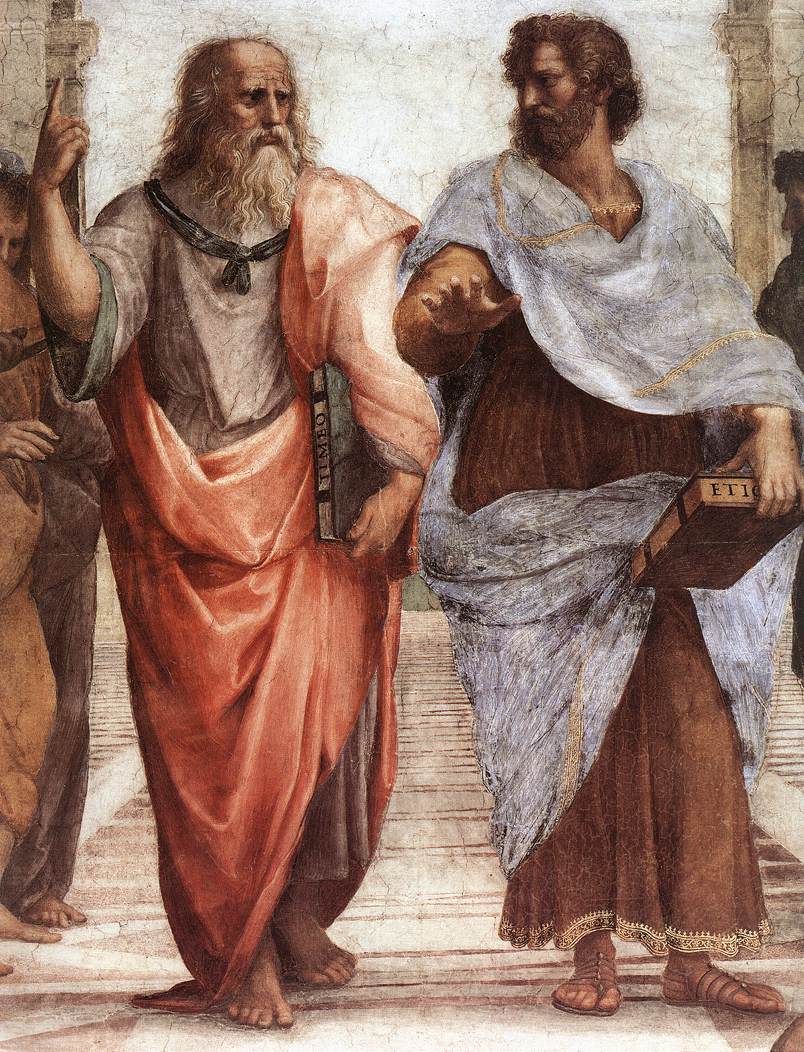
Aristotle, in blue and brown, walks beside Plato beneath classical arches; he gestures down toward the earth while Plato points up.
Raphael, 1511
Open-air Athenian scene at the festival of Bendis: Socrates in white robes converses with Polemarchus and Thrasymachus near a procession, a slave girl with tambourine and a passing charioteer placing the dialogue in its civic moment.
John La Farge, 1905
A cavernous hall split by a long wall topped with personifications (Cupid, Bacchus, Greed, Fame) whose shadows are cast on the back wall by a fire pot; bound viewers debate the shadows at right while a pair of philosophers in the light at left try to call them out.
Jan Saenredam (after Cornelis Cornelisz. van Haarlem), 1604
Seven togaed sages gathered under a tree, a globe-like object on a column at the center, with Athens and the Dipylon gate visible in the background.
Roman mosaicist (Pompeii)
A vast classical hall of philosophers; Socrates stands in olive-green robe at left, counting arguments on his fingers to a circle of listeners.
Raphael, 1511
Early Netherlandish reading of the cave: chained captives huddle before a wall of shadows in the foreground, with the bright mouth of the cave opening onto a sunlit landscape behind.
Michiel Coxie
Renaissance interior with a bust of Plato wreathed at center; Ficino, Lorenzo de' Medici, Pico della Mirandola and other humanists toast and recite around it in a staged Platoneia.
Luigi Mussini, 1867
Second Ribera Plato: an aged philosopher in coarse robes leans on a book, brow furrowed, in the same plain-sage idiom as the LACMA version.
Jusepe de Ribera, 1630
Recommended Editions
G.M.A. Grube, revised by C.D.C. Reeve
Hackett Publishing · 1992
Hackett's Grube/Reeve is the philosophy-department default for a reason. Clear prose, consistent terms, and Plato's argument actually tracks. If you're here for what the Republic says more than how it sings, this is the one.
Please support us by purchasing through these links, at no extra cost to you!
Notable Quotes
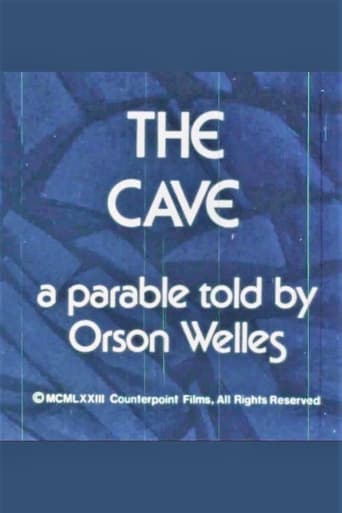
The myth of the cave: prisoners chained facing a wall, seeing only shadows, mistaking them for reality.
- Martin Luther King Jr., civil rights leader, 1929–1968: "Aside from the Bible, I would choose the works of Plato, and especially The Republic."
- Jean-Jacques Rousseau, philosopher, 1712–1778: "Plato's Republic is the finest treatise on education ever written."
- Alfred North Whitehead, mathematician & philosopher, 1861–1947: "The safest general characterization of the European philosophical tradition is that it consists of a series of footnotes to Plato."
- Ralph Waldo Emerson, essayist & poet, 1803–1882: "Out of Plato come all things that are still written and debated among men of thought."
- Cicero, Roman statesman & philosopher, 106–43 BCE: Cicero called Plato 'that god of ours' and built his own De Re Publica on the model of the Republic.
- Carl Sagan, astronomer, author of Cosmos, 1934–1996: Sagan put The Republic on his college reading list and returned again and again to its Allegory of the Cave.
- Iris Murdoch, novelist & moral philosopher, 1919–1999: Murdoch built her moral philosophy on the Republic's allegory of the cave — the soul's ascent from shadow toward the Good.

More by Plato
- 16Phaedo~385 BCPlatoHard·Quick·94 pagesInfluence89Popularity40Ancient GreecePhilosophyAncient Greek
- 36The Symposium~385 BCPlatoHard·Quick·109 pagesInfluence88Popularity40Ancient GreecePhilosophyAncient Greek
- 58The Republic~375 BCPlatoHard·Medium·300 pagesInfluence96Popularity72Ancient GreecePhilosophyAncient Greek
- 71Phaedrus~370 BCPlatoHard·Quick·176 pagesInfluence32Popularity39Ancient GreecePhilosophyAncient Greek
- 117Apology~399 BCPlatoHard·Quick·39 pagesInfluence90Popularity41Ancient GreecePhilosophyAncient Greek