Read this if you…
- want the Bible's purest grief — five poems mourning the burned-out ruins of Jerusalem
- like that it's written in acrostic form (each chapter walks through the Hebrew alphabet, grief made formal)
- care about the source of 'great is thy faithfulness' (Lam 3:23), sitting in the middle of one of the most devastating poems ever written
Skip this if you…
- don't want to read explicitly religious/Christian texts
The lineage through Lamentations
- The Complete English Poems by John Donne. Lamentations shaped it. - Donne didn't just allude to *Lamentations* — he translated the whole book into English verse, "The Lamentations of Jeremy, for the most part according to Tremellius" - It's a near-line-by-line rendering, worked from Tremellius's 1579 Latin, sitting in his collected poems beside the Holy Sonnets - The book's language of ruin and lament feeds the same grief Donne turns on his own soul in the devotional verse
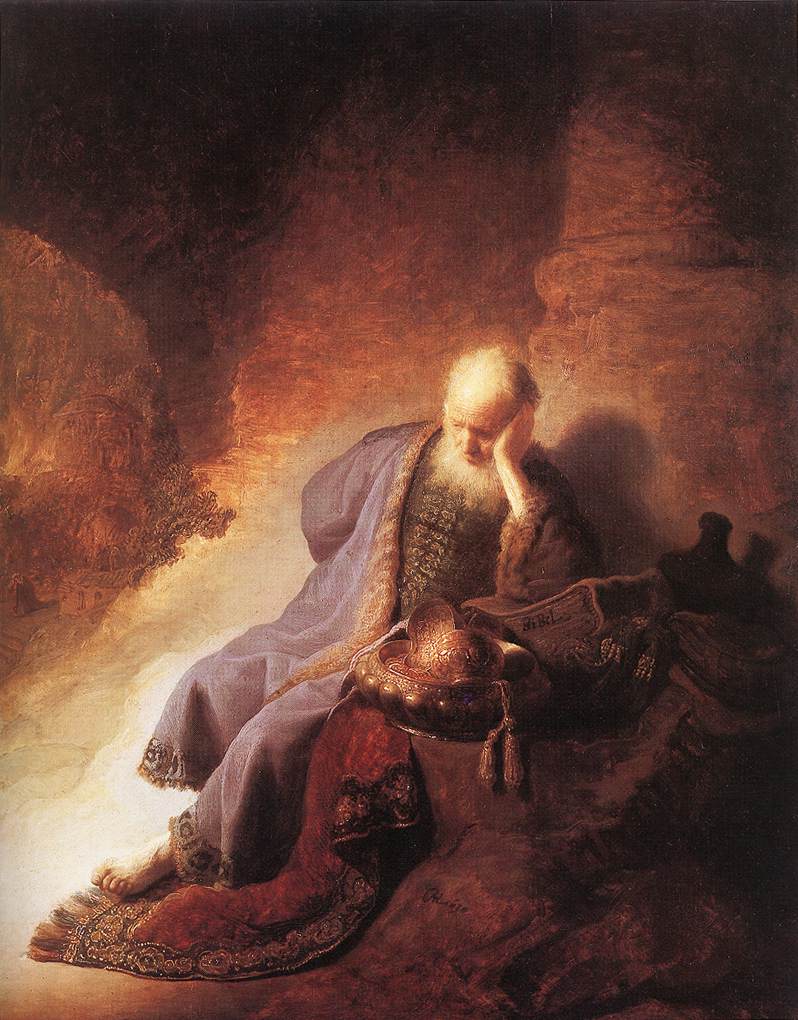
Depicted in Art
A monumental, white-bearded Jeremiah looms over the seated Baruch, who poises his quill above an open scroll to take down the prophecy.
Washington Allston, 1820
Jeremiah slumps on his marble throne, beard untrimmed, head sunk on one hand, gazing downward in brooding silence while two mourning women flank him.
Michelangelo Buonarroti, 1512
Jeremiah, robed and crowned with white hair, leans against a great Torah scroll as flame light from the burning city catches on the gold vessels piled beside him.
Rembrandt van Rijn, 1630
An aged Jeremiah leans his head on his hand, propped against a gleaming pile of temple gold, while Jerusalem burns dimly in the dark distance behind him.
Rembrandt van Rijn, 1630
A white-robed Jeremiah sits crumpled on a stone block amid colossal toppled columns and shadowed temple wreckage, head bowed into his hand.
Horace Vernet, 1844
Captive Israelites — a chained old harper, grieving women, children huddled against parents — sit by the rivers of Babylon under a great willow, instruments laid silent on the ground.
Eduard Bendemann, 1832
A wild-haired Jeremiah throws his head back and cries out, arms half-raised, surrounded by the rubble and smoke of the fallen city.
Ilya Repin, 1870
Recommended Editions

King James Version
Oxford University Press · 1611
The most influential and commonly quoted translation in English. The prose rhythm everyone else is responding to, even modern translations.
Please support us by purchasing through these links, at no extra cost to you!
Notable Quotes
It is of the LORD'S mercies that we are not consumed, because his compassions fail not. They are new every morning: great is thy faithfulness.
- Charles Spurgeon, English Baptist preacher, 1834–1892: "The one who has known what it is to prove that great faithfulness in great affliction."
- Robert Lowth, biblical scholar & Bishop of London, 1710–1787: "The most remarkable elegy extant, superior to any other poem in splendid, concentrated imagery."
- Kathleen M. O'Connor, Hebrew Bible scholar, Columbia Theological Seminary: "Lamentations' testimony is bitter, raw, and largely unhealed; its poems use 'wounded words' to illumine pain."
- Robert Alter, literary critic & Hebrew Bible translator, b. 1935: "The arresting images of a once glorious nation reduced to utter wretchedness."
- F. W. Dobbs-Allsopp, biblical scholar & literary theorist, Princeton Theological Seminary: The power of the lyric poems in Lamentations gives voice to pain and helps express what may otherwise seem inexpressible.