
Read this if you…
- want the OT's most novelistic narrative (Saul's tragic descent, David's rise, court intrigue)
- like complex, morally compromised heroes (David is the Bible's most human figure)
- care about the Bathsheba episode and Absalom's revolt as foundational father-son tragedy
Skip this if you…
- don't want to read explicitly religious/Christian texts
The lineage through Samuel
- Common Sense by Thomas Paine. Samuel shaped it. - Israel's demand for a king in 1 Samuel 8 became, 2,300 years later, the backbone of America's case against monarchy - Paine quotes the chapter at length in *Common Sense*, naming the prophet Samuel and Gideon, reading their warnings as God's own disapproval of government by kings - The Bible's oldest argument with monarchy, repurposed as a revolutionary pamphlet's opening salvo
- Selected Poems by John Dryden. Samuel shaped it. - Absalom's rebellion against King David in 2 Samuel 13-18 became the scaffold for the sharpest political satire in English verse - Dryden lifts Achitophel, David, and Absalom by name and maps them point-for-point onto Restoration politics in *Absalom and Achitophel* - The Bible's most painful father-and-son tragedy, repurposed as a coded attack on a real-world plot against the crown
Depicted in Art
A young, melancholy David holds out the severed head of Goliath at arm's length by the hair, his sword still in his right hand; Goliath's bloodied face stares back from the dark.
Caravaggio, 1610
David, mid-stride with his sling spinning, swings the giant's own sword down onto the prostrate, helmeted Goliath as the two armies watch from facing hillsides.
Gustave Doré, 1866
The young David, holding the head of Goliath aloft on a pole, leads a procession of musicians and singing women through a classical city gate.
Nicolas Poussin, 1632
An aging Saul in an embroidered turban sits weeping into the corner of a heavy curtain while the boy David, harp in his lap, plays to soothe him.
Rembrandt, 1655
Uriah, in rich Eastern dress, turns from the throne with a stricken face after being sent back to the front; David sits behind him in shadow, complicit and silent.
Rembrandt van Rijn, 1665
The aged prophet Samuel pours oil from a horn over the head of the kneeling shepherd boy David; Jesse and David's brothers crowd around in rich Venetian dress, sheep at the foreground.
Paolo Veronese, 1555
Recommended Editions

King James Version
Oxford University Press · 1611
The most influential and commonly quoted translation in English. The prose rhythm everyone else is responding to, even modern translations.
Please support us by purchasing through these links, at no extra cost to you!
Notable Quotes
How are the mighty fallen!
Screen & Stage
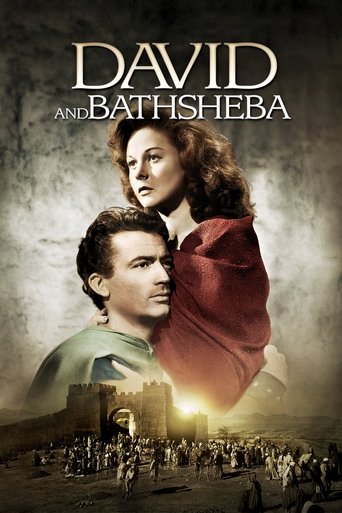
David and Bathsheba
Film · 1951
Henry King
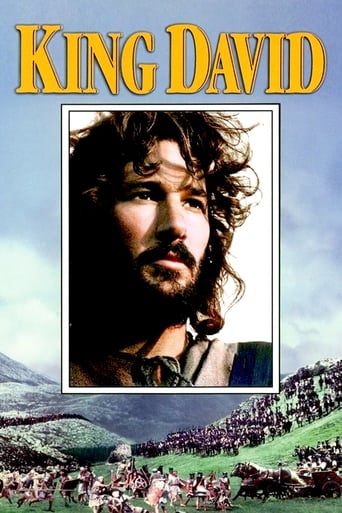
King David
Film · 1985
Bruce Beresford
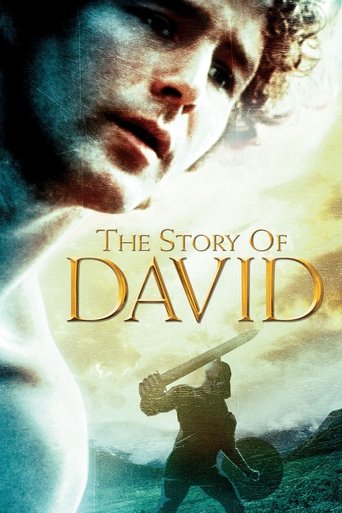
The Story of David
TV · 1976
Alex Segal
Posters via The Movie Database (TMDB)
- Erich Auerbach, philologist & literary critic, 1892–1957: "How fraught with background, in comparison, are characters like Saul and David!"
- Northrop Frye, literary critic, 1912–1991: "In the story of Saul … you have what comes nearest, I suppose, to being the one great tragedy of the Bible."
- Jean-Jacques Rousseau, philosopher & political theorist, 1712–1778: "This is what Samuel put strongly before the Hebrews … His Prince is the book of Republicans."
- Thomas Paine, political pamphleteer & revolutionary, 1737–1809: "That the Almighty hath here entered his protest against monarchical government is true, or the scripture is false."
- Robert Alter, literary critic & Bible translator, b. 1935: "The story of David is probably the greatest single narrative representation in antiquity of a human life."
- Gerhard von Rad, Old Testament scholar, 1901–1971: The Succession Narrative of David's court is the oldest specimen of genuine ancient Israelite history writing — the very beginning of historiography in the Western tradition.