Read this if you…
- want awesome Middle Eastern magical stories with genies and stuff
- want the original source for Aladdin, Sinbad, Ali Baba etc
- like stories within stories within stories within
- like the concept of a lady telling such a good story that she doesn't get murdered because the story is so good that her killer wants to hear more of the story rather than murder her
- bite sized short stories, no way to read them all, can come and go
Skip this if you…
- want 1 sustained narrative
- don't want highly sexual/adult content
- don't want to start something you will never fully finish (I have read hours and hours, and not close to ever finishing, but i have read "the highlights")
The  Take
Take
Best super old literature I ever read. Awesome mix of fairytale, fable, religious, love, fantasy, scheming murder. Love the story within a story within a story . I read the zipes Burton compilations, 1 and 2. Fantastic. Adult material and some crazy stuff in there
The lineage through The Arabian Nights
- The Count of Monte Cristo by Alexandre Dumas. The Arabian Nights shaped it. - Dumas gilded his revenge plot with your treasure-cave magic — the chapter where his hero claims his fortune is literally titled "Sinbad the Sailor" - The Count styles himself a Sinbad, gets called an Ali Baba on finding the cave, and his island retreat is praised as "something out of *The Arabian Nights*" - Through Galland's French *Mille et une nuits*, your tales gave the 19th-century novel its sense of fabulous, limitless wealth
- David Copperfield by Charles Dickens. The Arabian Nights shaped it. - Ackroyd calls the *Arabian Nights* arguably the most important of all literary influences on Dickens — and *David Copperfield* wears that debt on its sleeve - David names 'the Arabian Nights, and the Tales of the Genii' among the books that keep him alive in a bleak childhood (Ch. 4) - At Salem House the boys stage 'regular Arabian Nights,' with David cast as a small Scheherazade telling tales to survive the night (Ch. 7)
- Jane Eyre by Charlotte Brontë. The Arabian Nights shaped it. - Childhood reading for the Brontë children, pulled off their father's parsonage shelves - Charlotte folded the *Nights* into *Jane Eyre* directly — Jane names them among her own girlhood books, and their tales of genii and enchantment color how the novel imagines escape and transformation - The wonder-tale machinery that runs quietly under a Yorkshire governess's story
- Dracula by Bram Stoker. The Arabian Nights shaped it. - Scheherazade's dawn-broken frame tale gave Stoker a model for his fragmentary diary form - He has Harker write that his captivity "seems horribly like the beginning of the Arabian Nights, for everything has to break off at cockcrow" — a knowing nod across a thousand years
Depicted in Art
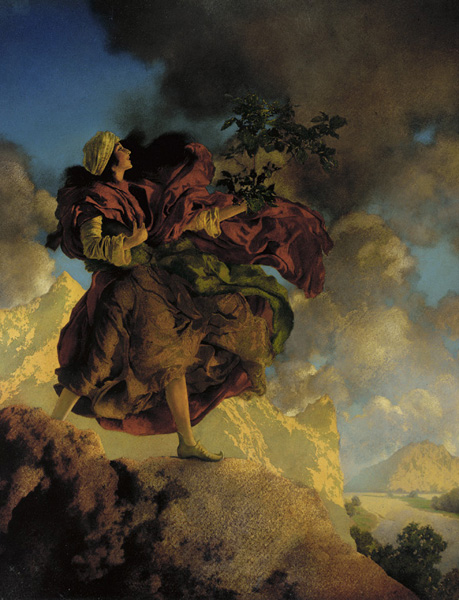
Parizade rides a white horse along a cliff path, the magical singing tree balanced before her against an immense sky.
Maxfield Parrish, 1906
The sleeping prince Camaralzaman and Badoura are laid side by side on a couch as the jinn and jinnia compare their beauty.
Edmund Dulac, 1913
Scheherazade reclines in a richly patterned Persian interior, beginning her nightly tale to the unseen sultan.
Edmund Dulac, 1907
Sindbad and his companions crouch behind rocks on a rocky shore, watching the one-eyed giant slumber by a fire.
Maxfield Parrish, 1907
Scheherazade leans in to address the king on a curtained bed; her sister Dinarzad waits at the foot.
Marie-Éléonore Godefroid
Ali Baba's brother Cassim stands trapped among heaped treasure inside the thieves' luminous cavern, the door sealed behind him.
Maxfield Parrish, 1909
Aladdin, kneeling in a torchlit underground vault, watches a vast genie unfurl into the cavern's vaulted dark.
Albert Letchford, 1897
The half-petrified king sits motionless on a marble throne, draped in robes, his lower body turned to black stone.
Maxfield Parrish, 1906
Recommended Editions

Richard Francis Burton, ed. Jack Zipes
Signet Classics · 1991
Jack Zipes selects from Burton's 1885 unexpurgated version and writes a folklorist's introduction that places the cycle in its actual history. You get Burton's ornate, rhythmic, lurid Victorian English without the 16-volume commitment.
Please support us by purchasing through these links, at no extra cost to you!
Notable Quotes
Open, Sesame!
Screen & Stage
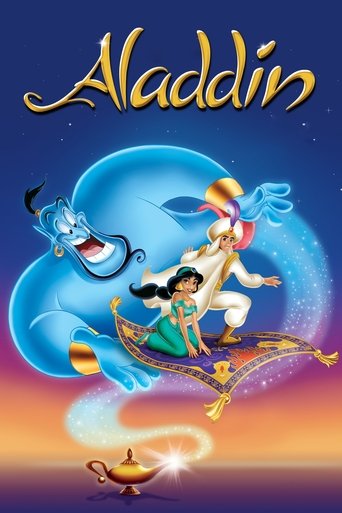 loose
looseAladdin
Film · 1992
John Musker
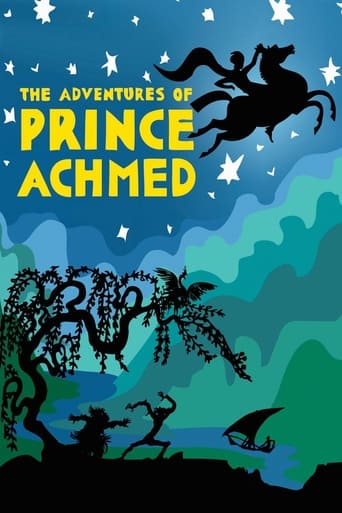
The Adventures of Prince Achmed
Film · 1926
Lotte Reiniger
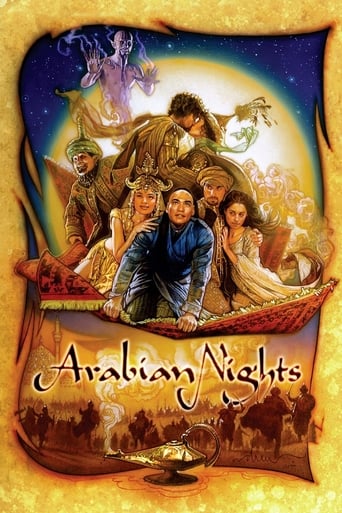
Arabian Nights
TV · 2000
Peter Barnes
Posters via The Movie Database (TMDB)
- Stendhal (Marie-Henri Beyle), French novelist, 1783–1842: Stendhal wished he could forget the Thousand and One Nights so he could read it again for the first time.
- Jorge Luis Borges, Argentine writer, poet & essayist, 1899–1986: "It is a book so vast that it is not necessary to have read it, for it is a part of our memory."
- William Wordsworth, English Romantic poet & Poet Laureate, 1770–1850: "A precious treasure had I long possessed, A little yellow, canvas-covered book, A slender abstract of the Arabian tales."
- Samuel Taylor Coleridge, English Romantic poet & critic, 1772–1834: "The Arabian Nights' tale of the merchant sitting to eat dates, throwing the shells aside, and lo! a genie starts up."
- W. B. Yeats, Irish poet & Nobel laureate, 1865–1939: Asked which six books had satisfied him most, Yeats placed the Arabian Nights second only to Shakespeare.
- Salman Rushdie, British-Indian novelist, b. 1947: Choosing the Nights for Desert Island Discs, Rushdie called it the one book that contains all other stories.
- Marcel Proust, French novelist, 1871–1922: In Time Regained, Proust likens his own great book to the Thousand and One Nights, casting himself as a Scheherazade writing against death.
- Henri Matisse, French painter & cut-out artist, 1869–1954: At eighty, bedridden, Matisse made a twelve-foot gouache cut-out, The Thousand and One Nights, embedding Scheherazade's Arabic dawn-refrain in the composition.
- Nikolai Rimsky-Korsakov, Russian composer, 1844–1908: "Separate, unconnected episodes and pictures from The Arabian Nights… the name connotes in everybody's mind the East and fairy-tale wonders."