
Vanity Fair

Vanity Fair
Read this if you…
- want a book where there are no good people
- like following people scheme their way through victorian society
- like a narrator who talks directly to reader, commenting on the characters
Skip this if you…
- need a hero
- want a novel that stays focused (lots of side characters and detours)
The  Take
Take
Very fun book where nobody is a hero, dragged on a little, and too much description of side characters stuff IMO. I liked the narrator style though
The lineage through Vanity Fair
- The Pilgrim's Progress by John Bunyan. Vanity Fair built on it. - The title is a quotation: Bunyan's *Pilgrim's Progress* invented *Vanity Fair* as the worldly snare on the pilgrim's road, and Thackeray made it his entire stage - Where Bunyan's fair was a hazard to be escaped en route to heaven, Thackeray drops the heaven and leaves only the fair — the inversion is the point - Reading Bunyan first shows you the moral frame Thackeray is satirizing; contemporaries already compared Becky to the pilgrim and the author to Faithful
- The History of Tom Jones, a Foundling by Henry Fielding. Vanity Fair built on it. - That intrusive, knowing narrator who keeps interrupting *Vanity Fair* to lecture you — Thackeray took the technique directly from Fielding's *Tom Jones* - He said as much, praising Fielding in his 1853 lectures on the eighteenth-century humourists; scholarship names *Tom Jones* as this book's structural and stylistic model - Read *Tom Jones* first and "A Novel Without a Hero" reads as the rebuttal it is — Thackeray rejecting the lovable scapegrace Fielding asked you to forgive
Depicted in Art
A jester in motley and cap-and-bells gazes into a cracked mirror — Thackeray's emblem for the novel's satirical premise.
William Makepeace Thackeray, 1848
A drawing-room vignette from Chapter 6 — Becky pursuing Jos under Amelia's roof at Russell Square.
William Makepeace Thackeray, 1848
A puppet-Becky perched on a tabletop carefully balances playing cards into a tottering house.
William Makepeace Thackeray, 1848
Becky in a domino mask presses up to a roulette table at a German spa, a gentleman whispering at her shoulder.
William Makepeace Thackeray, 1848
Becky hovers in a doorway clutching a small white object while Jos pleads with Dobbin in the foreground.
William Makepeace Thackeray, 1848
Recommended Editions

Penguin Classics
2003
Carey's Penguin keeps Thackeray's own illustrations, which matter more than people expect, and his introduction treats Becky Sharp as one of the great antiheroes in English fiction. The reading copy.
Please support us by purchasing through these links, at no extra cost to you!
Notable Quotes
I think I could be a good woman if I had five thousand a year.
Screen & Stage
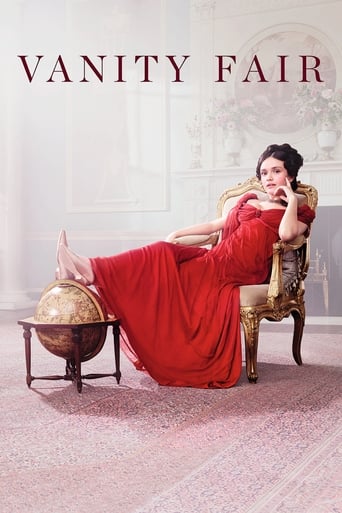
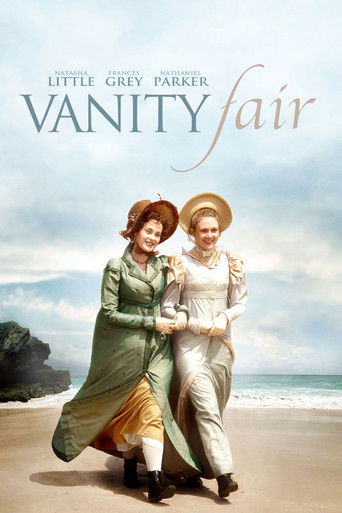
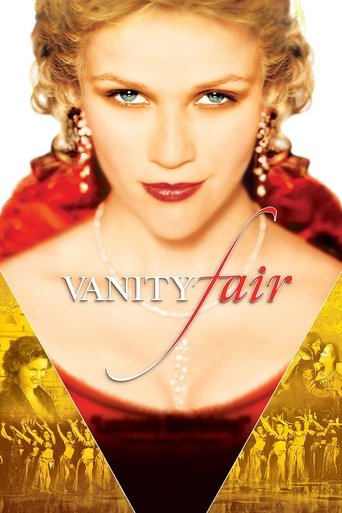
Posters via The Movie Database (TMDB)
- Michael Palin, actor, Monty Python; travel documentarian, 1943–: Chose Vanity Fair as his Desert Island Discs book (1979), then played Thackeray himself as the narrator of the 2018 ITV adaptation.
- Charlotte Bronte, English novelist, 1816–1855: "He resembles Fielding as an eagle does a vulture: Fielding could stoop on carrion, but Thackeray never does."
- Karl Marx, philosopher & political economist, 1818–1883: "[They have] issued to the world more political and social truths than all the professional politicians, publicists and moralists put together."
- Mira Nair, filmmaker, b. 1957: "Thackeray, being such a great outsider to his culture… created the same role of insider-outsider in Becky Sharp."