

Read this if you…
- want the 2nd most read book from 1678 thru the 1800s, unbelievably popular
- like allegories that are super obvious and on-the-nose, easy to understand
- are interested in protestant/christian classics generally - this one is a big deal
- want to know one of the most influential books on the Transcendentalist literary scene
Skip this if you…
- don't want explicitly religious/Christian/protestant writings
- don't like allegorys/symbolism that are OVERLY obvious (I like how obvious they are, but they are super obvious)
The  Take
Take
Some would say too on the nose, but it’s so on the nose it goes past that epithet. Slough of despond and vanity fair and that stuff was nice, even if the story as a whole was more religious than literary
The lineage through The Pilgrim's Progress
- The Gospels by Matthew. The Pilgrim's Progress built on it. - The source text Bunyan dramatizes — *The Pilgrim's Progress* turns the Sermon on the Mount into a road - Christian enters salvation through a 'strait' Wicket Gate taken line-for-line from Matthew 7:13-14, cited in Bunyan's own margins - Knowing the Gospels first lets you catch how much of the allegory is scripture made walkable — the prose Spurgeon called 'Bibline'
- Ephesians by Paul. The Pilgrim's Progress built on it. - Christian's armory comes straight out of Ephesians 6 - The helmet, breastplate, shield, and sword Christian is given before facing Apollyon are Paul's *whole armour of God* literalized — "completely armed from head to foot," as Bunyan puts it - Knowing Paul's passage first, you watch a metaphor get unpacked piece by piece into allegory
- Galatians by Paul. The Pilgrim's Progress built on it. - The argument that lets Christian's burden fall off - Bunyan quotes Galatians by name and stakes the start of the journey on its grace-not-works gospel — release comes from Christ, not from striving - He called Luther's commentary on this letter the book he treasured most after Scripture; read Galatians first and you see exactly why it set the terms
- Hebrews by Paul. The Pilgrim's Progress built on it. - The entire journey is a single verse expanded — Hebrews' 'strangers and pilgrims' seeking a lasting city - Bunyan's epigraph is Hebrews 13:14, his Palace Beautiful quotes Hebrews 11's roll-call of faith outright, and marginal citations thread the letter through every page - Read it first and Christian's pilgrimage reads as a deliberate dramatization of one chapter of the New Testament
- Revelation by John. The Pilgrim's Progress built on it. - The Celestial City is Revelation 21-22 made literal — Bunyan didn't invent his heaven, he furnished it from John's vision - The gold like clear glass, the gates of pearl, the river of life, God wiping away every tear: lifted from the text and set at the end of Christian's road - Read *Revelation* first and the destination stops being a vague glow — you arrive at the exact city John saw
- Ecclesiastes by Solomon. The Pilgrim's Progress built on it. - Vanity Fair isn't Bunyan's invention — he names the source inside the book, quoting Ecclesiastes' "vanity of vanities, all is vanity" - The Preacher's hard look at worldly pleasure as emptiness is what the whole episode dramatizes: a marketplace of nothing the faithful must walk through - Read *Ecclesiastes* first and you'll catch the borrowed line the moment you reach the Fair
- Psalms by David. The Pilgrim's Progress built on it. - Bunyan stages Christian's darkest passage as a literal walk through Psalm 23's 'valley of the shadow of death' — the verse is quoted right on the page - The escape from the Slough of Despond is Psalm 40:2 made into scenery: Help sets Christian on 'sound ground,' the psalm's 'feet upon a rock' - Bunyan cited the *Psalms* in his margins throughout; reading them first lets you hear the verses he's dramatizing into terrain
- Exodus by Moses. The Pilgrim's Progress built on it. - *The Pilgrim's Progress* is *Exodus* turned inward — the wilderness journey from slavery to the promised land, remade as one soul's pilgrimage to the Celestial City - Bunyan was so steeped in Scripture that Spurgeon said "if you cut him he would bleed Bible"; the allegory hands Christian Moses' rod and recalls the Red Sea crossing - Knowing the *Exodus* deliverance pattern first lets you see the scaffolding Bunyan built his entire allegory on
- Isaiah by Isaiah. The Pilgrim's Progress built on it. - Bunyan's marginal citations point you back to *Isaiah* again and again — he's not borrowing a mood, he's quoting a source - Christian's "filthy rags" (*Isaiah* 64:6) and the pit of Tophet (*Isaiah* 30:33) are lifted whole from the prophet - Read *Isaiah* and the allegory's imagery stops feeling invented and starts feeling inherited
- James by James. The Pilgrim's Progress built on it. - The Talkative episode is *James* 2 in allegorical dress — Faithful exposes the man who professes faith but lives without works - Bunyan cites *James* 1:27 by chapter and verse in his margin, and has Christian gloss "faith without works is dead" as "a dead carcass" - Read the epistle first and you'll catch exactly what Bunyan is testing when Talkative starts talking
- 2 Timothy by Paul. The Pilgrim's Progress built on it. - Mr. Valiant-for-Truth's dying words — *"My Marks and Scars I carry with me... that I have fought his Battles"* — are Paul's farewell from *2 Timothy* turned into a deathbed scene - Bunyan also captions the Interpreter's ideal preacher with the same verse, *"I have fought a good fight... I have kept the faith"* - Read Paul's letter first and you hear the original behind every soldier-of-faith note Bunyan strikes
- Genesis by Moses. The Pilgrim's Progress built on it. - Read the margins of *The Pilgrim's Progress* and you find *Genesis* everywhere — the apple of Eden, the "look not behind thee" of Sodom that becomes Christian's first command - Even the famous opening, "I dreamed a dream," leans on Joseph's dream sequence; knowing the source stories lets you catch Bunyan's allegory landing each beat
- Micah by Micah. The Pilgrim's Progress built on it. - The verse Christian wields against Apollyon — "when I fall I shall arise" — comes straight out of *Micah* 7:8, one of the marginal references Bunyan printed in 1678 - *Micah*'s vision of sinners trembling and hiding stands behind Bunyan's Day-of-Judgment imagery; the prophet supplied the language of dread and the promise of rising again
- Proverbs by Solomon. The Pilgrim's Progress built on it. - Bunyan turns *Proverbs* into dialogue — Christian throws its maxims (28:26, 3:5) at worldly advisers, weaponizing the book's plainspoken wisdom against bad counsel - The By-path Meadow detour dramatizes *Proverbs* 14:12 outright: the road that seems right but ends in death — read the proverb first and the trap reads as inevitable
- Little Women by Louisa May Alcott. The Pilgrim's Progress shaped it. - *Little Women* is *The Pilgrim's Progress* in a New England parlor — Alcott domesticates Christian's road to the Celestial City into four sisters' march toward growing up good - Bunyan's allegory is the explicit scaffolding: the March girls are each given a copy, the opening chapter is titled "Playing Pilgrims," and Alcott quotes him for chapter headings throughout - The pilgrim's burdens, the Slough of Despond, the steady climb — Alcott hands them all to Jo, Meg, Beth, and Amy as the moral architecture of childhood
- Vanity Fair by William Makepeace Thackeray. The Pilgrim's Progress shaped it. - Thackeray lifted his title straight from here — Bunyan's *Vanity Fair*, the worldly carnival Christian must pass through on the road to the Celestial City - *Vanity Fair* (1847) takes that allegorical fair and makes it the whole world, inverting Bunyan's City of God into a society with no city of God in sight - Early reviewers caught the debt on sight, reading Becky Sharp as a pilgrim and Thackeray as her Faithful — the borrowing was meant to be seen
- The Autobiography of Benjamin Franklin by Benjamin Franklin. The Pilgrim's Progress shaped it. - Bunyan was the first book Franklin ever bought — and the one he learned his craft from - Franklin singled out Bunyan as "the first that I know of who mix'd narration and dialogue," the very technique he'd later wield in his own life story - Franklin's allegorical journey, the soul's progress toward grace, becomes a secular journey toward self-improvement — the same shape, pointed at this world
- Jane Eyre by Charlotte Brontë. The Pilgrim's Progress shaped it. - The template Charlotte Brontë rebuilt as a worldly novel — *Jane Eyre* is a secularized pilgrimage, Bunyan's structure of trials and temptations recast as one woman's journey - Brontë alludes to *The Pilgrim's Progress* across her novels; Jane is, in effect, Bunyan's reader, walking his road in nineteenth-century dress - Read Bunyan first and *Jane Eyre*'s shape declares itself: every flight, refuge, and ordeal is a stage on the pilgrim's way
- Uncle Tom’s Cabin by Harriet Beecher Stowe. The Pilgrim's Progress shaped it. - Stowe poured Bunyan's mold into the most explosive novel of the 19th century - *Uncle Tom's Cabin* is a Calvinist allegory in Bunyan's shape — Tom's life retraces Christian's pilgrimage, the soul's salvation pursued through earthly tribulation and earthly hell - Even the method carries over: characters named for the virtues they embody, so the moral stakes are never in doubt
- The Scarlet Letter by Nathaniel Hawthorne. The Pilgrim's Progress shaped it. - Hawthorne was a lifelong Bunyan reader — he named his childhood cats Beelzebub and Apollyon after the demons here - *The Scarlet Letter* names *The Pilgrim's Progress* outright: Chillingworth's eyes flash with "that ghastly fire that darted from Bunyan's awful door-way in the hillside" - Bunyan's habit of making the inner spiritual life visible — sin and salvation as concrete objects — is the method Hawthorne turned into the great American symbol novel
- Middlemarch by George Eliot. The Pilgrim's Progress shaped it. - The Protestant text of Eliot's Midlands childhood, surfacing in her greatest novel a century and a half later - She quotes the trial of Faithful from Bunyan's Vanity Fair as the epigraph to *Middlemarch* Chapter 85 — one of the few she kept when she pruned the rest in later editions - A deliberate reach back to *The Pilgrim's Progress* to frame a moment of judgment and worldly disgrace
- The Adventures of Huckleberry Finn by Mark Twain. The Pilgrim's Progress shaped it. - Twain knew this book intimately — he owned Bunyan's complete works and a facsimile first edition, and titled his own travelogue *The Innocents Abroad, or The New Pilgrim's Progress* - In *Huckleberry Finn* he plants it by name in the Grangerfords' parlor, where Huck finds it "interesting, but tough" - It's a deliberate, barbed prop — the great book of Christian pilgrimage sitting in the home of a family that carries guns to church
- Bleak House by Charles Dickens. The Pilgrim's Progress shaped it. - Bunyan was a lifelong presence for Dickens — *Oliver Twist*'s subtitle "The Parish Boy's Progress" is a direct nod, and surveys put Dickens among the writers most shaped by him - That debt resurfaces in *Bleak House*: Esther's first chapter is simply titled "A Progress" - Her arc is a quiet moral pilgrimage, a passage through one symbolic bleak house after another — Christian's journey relocated to Victorian England
Depicted in Art
Christian sits alone reading the Bible, his back to his city, the burden of sin visible on his back as he begins his journey.
William Blake, 1824
Christian, sword raised, duels the winged demon Apollyon who straddles the path through the Valley of Humiliation.
William Blake, 1824
Giant Despair looms over the castle wall as Christian and Hopeful trespass in his grounds at Doubting Castle.
Byam Shaw, 1907
A despairing man sits caged in iron in the Interpreter's House, shown to Christian as a warning of the soul that has fallen past grace.
William Blake, 1824
Bunyan asleep in the den, the dream of the pilgrim journey rising above him as the frame for the whole allegory.
William Blake, 1824
Christian recoils as flames burst from Mount Sinai, terrified by the threats of the law before Evangelist redirects him.
William Blake, 1824
In the Interpreter's House, the despairing man sits caged in iron, shown to Christian as a soul past hope.
Frederick Barnard, 1890
An allegorical map laying out the whole pilgrim journey as geography — Slough of Despond, Vanity Fair, Doubting Castle, Delectable Mountains, Celestial City.
1821
Christian and Hopeful crest the Delectable Mountains and glimpse the Celestial City shining in the distance.
Byam Shaw, 1907
Recommended Editions

Penguin Classics
2008
Roger Pooley's Penguin prints both parts and explains why this allegory sat next to the Bible in English-speaking households for three centuries. Introduction puts Bunyan inside the radical Protestant world that produced him.
Please support us by purchasing through these links, at no extra cost to you!
Notable Quotes
As I walked through the wilderness of this world, I lighted on a certain place where was a den, and laid me down in that place to sleep; and as I slept, I dreamed a dream.
Screen & Stage
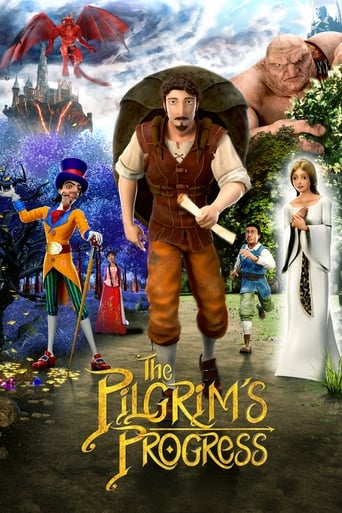
The Pilgrim's Progress
Film · 2019
Robert Fernandez

The Pilgrim's Progress
Opera · 1951
Ralph Vaughan Williams
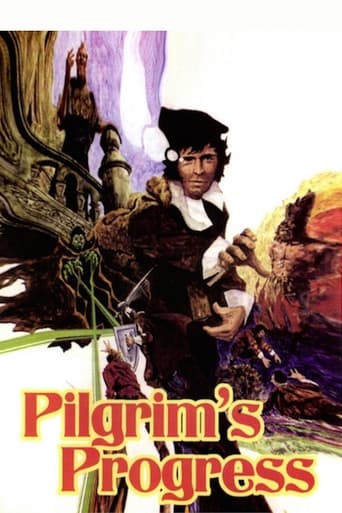
Pilgrim's Progress
Film · 1978
Ken Anderson
Posters via The Movie Database (TMDB)
- Benjamin Franklin, founding father, inventor, author, 1706–1790: "Honest John was the first that I know of who mix'd narration and dialogue; a method of writing very engaging to the reader."
- Samuel Johnson, critic & lexicographer, 1709–1784: "Was there ever yet anything written by mere man that was wished longer by its readers, excepting Don Quixote, Robinson Crusoe, and the Pilgrim's Progress?"
- Samuel Taylor Coleridge, poet & critic, 1772–1834: "I could not have believed beforehand that Calvinism could be painted in such exquisitely delightful colours."
- C. S. Lewis, literary scholar & novelist, 1898–1963: "Bunyan stands with Malory and Trollope as a master of perfect naturalness in the mimesis of ordinary conversation."
- Theodore Roosevelt, 26th President of the United States, 1858–1919: "In Bunyan's Pilgrim's Progress you may recall the description of the Man with the Muck-rake, the man who could look no way but downward."