Read this if you…
- want the Dickens book academics and critics love, and dont mind a convoluted plot
- really like extremely detailed satire on 1800s legal system/bureaucracy
Skip this if you…
- hate books with a million characters that are hard to remember
- don't like books that are confusing almost on purpose
The  Take
Take
Too many characters and takes half the book to get the hang of all of them, then it’s great for the second half but the climax was a little offf for me too. Since it’s dickens, still awesome characters and excellent descriptive varied prose, but this one felt a little too muddled given the length
The lineage through Bleak House
- Don Quixote by Miguel de Cervantes Saavedra. Bleak House built on it. - *Bleak House* names its source out loud — Lady Dedlock calls Jarndyce a "Don Quixote character," and Dickens was a lifelong Cervantes devotee - Esther's suitors map onto the old pattern: Woodcourt the sane knight, Guppy the comic Sancho, Esther herself a Dulcinea - Knowing *Don Quixote* first lets you hear Dickens reaching for it — the gentle, half-mad idealist is a figure he's borrowing, not inventing
- Jane Eyre by Charlotte Brontë. Bleak House built on it. - Esther Summerson's first-person narrative answers *Jane Eyre*, the recent novel whose success Dickens couldn't ignore - The shared arc gives it away — orphan, cruel aunt, governess's place, the pull toward marrying the master — Brontë's plot run through Dickens's hands - Read *Jane Eyre* first and Esther reads as a deliberate response: the same woman, a colder world
- The Pilgrim's Progress by John Bunyan. Bleak House built on it. - The title of Esther's opening chapter, "A Progress," is Dickens tipping his hand toward Bunyan - Dickens carried Bunyan all his life — he'd already saluted him in *Oliver Twist*'s subtitle — and Esther's arc runs as a pilgrim's passage through successive symbolic bleak houses - Reading Bunyan first reveals the older bones under the novel: a soul making moral progress through a fallen world
Depicted in Art
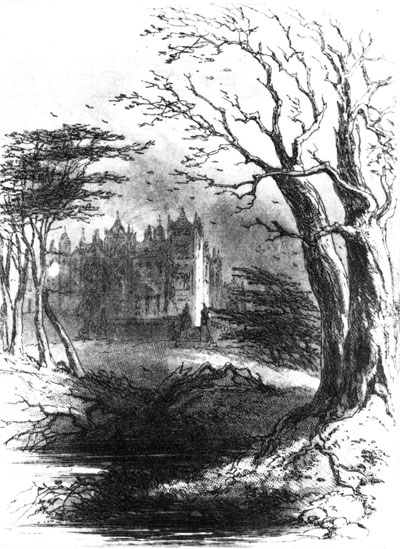
Chesney Wold seen across the flooded Lincolnshire flats, trees bent in the wind under a heavy sky — the novel's opening atmosphere of damp and gloom.
Hablot Knight Browne (Phiz), 1853
In a candlelit drawing room, the Lord Chancellor inspects the Jarndyce wards while Krook the rag-and-bottle merchant looks on.
Hablot Knight Browne (Phiz), 1853
The Dedlock family mausoleum stands closed under bare winter trees on the Lincolnshire estate, the resting place of Lady Dedlock at the novel's end.
Hablot Knight Browne (Phiz), 1853
The decaying, propped-up tenement court of Tom-all-Alone's looms over a back alley, ragged figures slumped in the rain-soaked passage.
Hablot Knight Browne (Phiz), 1853
Lady Dedlock, veiled and disguised, is led by the crossing-sweeper Jo to the locked iron gate of the pauper graveyard where Captain Hawdon lies buried.
Hablot Knight Browne (Phiz), 1853
The long, deserted stone terrace at Chesney Wold under heavy shadow, the legendary haunted path where Lady Dedlock's footsteps echo.
Hablot Knight Browne (Phiz), 1853
Recommended Editions

Penguin Classics
2003
Nicola Bradbury's Penguin handles the double narration well, Esther's voice against the present-tense omniscient, and lays out the Chancery satire without bogging down. The affordable complete reading edition.
Please support us by purchasing through these links, at no extra cost to you!
Notable Quotes
London. Michaelmas term lately over, and the Lord Chancellor sitting in Lincoln's Inn Hall. Implacable November weather. As much mud in the streets as if the waters had but newly retired from the face of the earth, and it would not be wonderful to meet a Megalosaurus, forty feet long or so, waddling like an elephantine lizard up Holborn Hill.
Screen & Stage
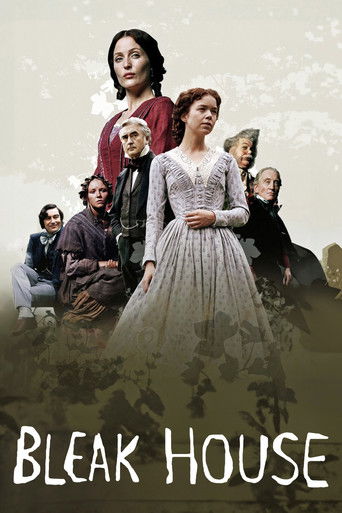
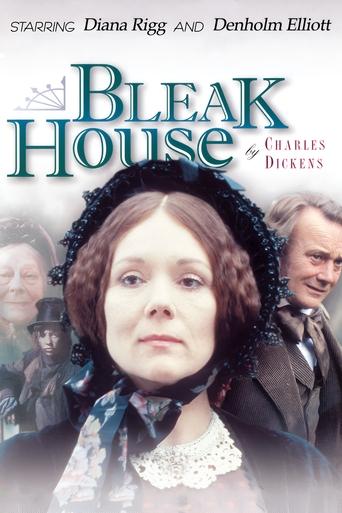
Posters via The Movie Database (TMDB)
- Vladimir Nabokov, Russian-American novelist, author of "Lolita", 1899–1977: "All we have to do when reading Bleak House is to relax and let our spines take over."
- Karl Marx, philosopher & political economist, 1818–1883: "The present splendid brotherhood of fiction-writers in England … issued to the world more political and social truths than … all the professional politicians, publicists and moralists put together."
- Queen Victoria, Queen of the United Kingdom, 1819–1901: "He had a large, loving mind and the strongest sympathy with the poorer classes."
- Leo Tolstoy, Russian novelist, 1828–1910: "Charles Dickens is the greatest novel writer of the 19th century."
- Chris Pine, American actor, 1980-: "I read Bleak House when I was like 14, and it always stayed with me."
- Harold Bloom, literary critic, Sterling Professor of Humanities at Yale, 1930–2019: "Bleak House, most critics now tend to agree, is his central work."
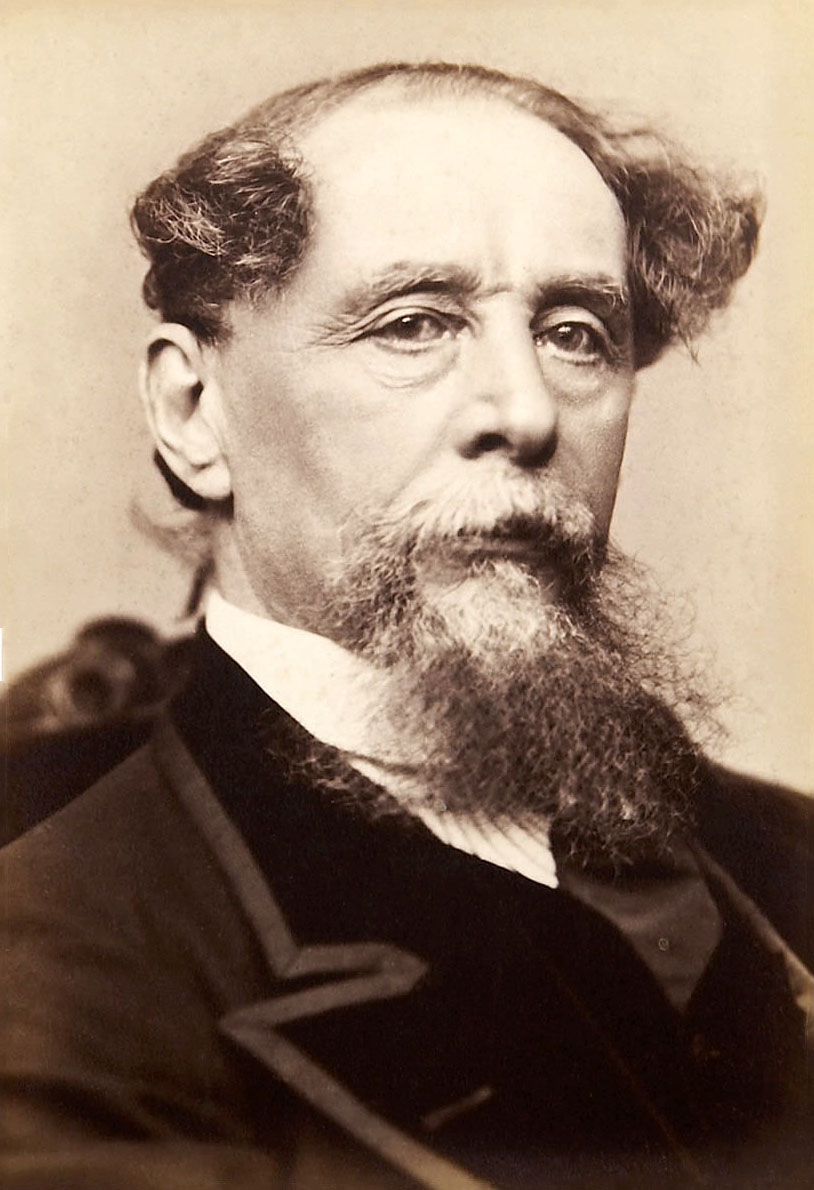
More by Charles Dickens
- 9David Copperfield1850Charles DickensEasy·Epic·1,024 pagesInfluence60Popularity65The Age of the NovelNovelEnglish
- 110A Tale of Two Cities1859Charles DickensEasy·Long·406 pagesInfluence59Popularity91The Age of the NovelHistorical FictionEnglish
- 171Bleak House1853Charles DickensEasy·Epic·945 pagesInfluence60Popularity64The Age of the NovelNovelEnglish
- 110A Tale of Two CitiesCharles Dickens1859The Age of the NovelEasyLong4065991Historical FictionEnglish