
Walden or, Life in the Woods

Read this if you…
- love writing about greatness of Nature for the soul
- like the "guy goes and builds cabin in woods and lives in it" thing
Skip this if you…
- didn't love emerson
- get bored of just a guy talking about living in a cabin in the woods
The  Take
Take
I just love the literary style of the Transcendentalists. At times, the actual story of his time at Walden can feel meandering and unimportant, but the constant melding of nature and spirituality into literary flourishes puts it over the top for me.Also makes me want to go to a national park
The lineage through Walden or, Life in the Woods
- Self-Reliance and Nature by Ralph Waldo Emerson. Walden or, Life in the Woods built on it. - *Walden* is Emerson's transcendentalism stepped down from the lectern into a one-room cabin - The self-reliance Emerson preached and the divinity he found in nature are exactly what Thoreau set out to *live* for two years - Read the essays first and *Walden* reads as their proof — the idea tested against woodsmoke, ice, and a bean field
- The Bhagavad Gita by Vyasa. Walden or, Life in the Woods built on it. - The philosophy Thoreau says he bathed his intellect in every morning at the pond - *Walden* quotes it by name and praises it again in the "Economy" chapter — Thoreau kept it as a constant companion in the woods - Read the *Gita* first and you hear its call to inward discipline and detachment running under Thoreau's whole experiment, mingling its Ganges with his pond water
- The Iliad by Homer. Walden or, Life in the Woods built on it. - The *Iliad* sits at the heart of *Walden*'s chapter on reading — Thoreau's case for meeting the great books in their original Greek - He alludes to Homer throughout: an "Iliad and Odyssey in the air, singing its own wrath and wanderings," Achilles and Patroclus surfacing in the bean-field - Walking into Homer's epic first shows you what Thoreau wanted from a book — something worth the labor of the original
- The Analects by Confucius. Walden or, Life in the Woods built on it. - One of the Eastern voices threaded through *Walden* — Thoreau quotes the *Analects* and its sister classics ten times, in his own renderings - Confucius's lines on true knowledge and on virtue swaying men like grass before the wind sit alongside Thoreau's own deliberate living - He'd steeped himself in the *Analects* a decade earlier, editing forty-plus Confucian passages for *The Dial*; reading it first reveals which of *Walden*'s aphorisms are Confucian in origin
- Ecclesiastes by Solomon. Walden or, Life in the Woods built on it. - *Walden* lifts *Ecclesiastes* 9:4 — "a living dog is better than a dead lion" — to insist the living present outweighs any dead, venerated past - Thoreau was "not inclined to quote the Old Testament," leaning on Hindu and Persian sources instead, so the borrowing is scattered and incidental rather than a backbone - A single sharp allusion, worth knowing for the way Thoreau bends scripture to his own argument
Depicted in Art
Soft crayon-and-graphite portrait of a clean-shaven young Thoreau in profile, made the year Walden was published.
Samuel Worcester Rowse, 1854
Bust portrait of Thoreau seated in a black frock coat, white shirt and black bow tie, with a neck beard and direct gaze.
Benjamin D. Maxham, 1856
Photograph of the small cove on Walden Pond closest to the cabin site, with quiet water and overhanging trees.
Full-size reconstructed cabin beside the parking area at Walden Pond State Reservation, with a bronze statue of Thoreau standing in front.
Surveyor's plan of Walden Pond drawn by Thoreau himself, with depths and shoreline measurements, as published with the 1854 first edition.
Henry David Thoreau, 1846
Page of Thoreau's heavily revised handwritten draft of Walden, with crossed-out passages and marginal additions in his hand.
Henry David Thoreau
Cropped engraving of the cabin alone, from the 1854 first-edition title page.
Sophia Thoreau, 1854
Recommended Editions
Princeton University Press
2004
Jeffrey Cramer's Princeton annotates every plant, bird, book, and reference Thoreau slides past. A familiar text becomes a different book once you can actually see what he was reading and looking at.
Please support us by purchasing through these links, at no extra cost to you!
Notable Quotes
The mass of men lead lives of quiet desperation.
Screen & Stage
 loose
looseWalden: Life in The Woods
Film · 2017
Alex Harvey
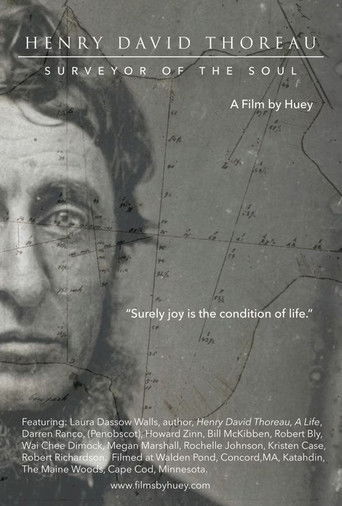
Henry David Thoreau: Surveyor of the Soul
Film · 2017
Huey
Posters via The Movie Database (TMDB)
- Don Henley, musician and environmental advocate, 1947-: Henley turned fandom into stewardship — founding the Walden Woods Project in 1990 and executive-producing the 2026 PBS Thoreau documentary.
- John Muir, Scottish-American naturalist, founder of the Sierra Club, 1838–1914: "No wonder Thoreau lived here two years. I could have enjoyed living here two hundred or two thousand."
- Robert Frost, American poet, four-time Pulitzer Prize winner, 1874–1963: "In one book … he surpasses everything we have had in America."
- E. B. White, American essayist, author of "Charlotte's Web," 1899–1985: "Walden, its serenity and grandeur unimpaired, still lifts us up by the ears."
- Ralph Waldo Emerson, American essayist and Transcendentalist; Thoreau's mentor, 1803–1882: "All American kind are delighted with Walden as far as they have dared to say."
- W. B. Yeats, Irish poet, Nobel laureate, 1865–1939: "I had still the ambition … of living in imitation of Thoreau on Innisfree."