
Read this if you…
- want the foundational text of Chinese thought
- like Short Philosphical quips/bits
- like philosophy that revolves more around conduct rather than metaphysics
Skip this if you…
- need a systematic rigorous defense of philosophical tenets
The  Take
Take
Confucius is the man, loves music, humility, family. Quick little sayings, easy read even if disjointed
The lineage through The Analects
- Walden or, Life in the Woods by Henry David Thoreau. The Analects shaped it. - Thoreau carried Confucius to the cabin — *Walden* quotes the *Analects* and the Confucian classics ten times over - He had already edited 'Sayings of Confucius' for *The Dial* in 1843, excerpting forty-plus passages, and rendered the lines himself from a French translation - The *Analects*' counsel — on what true knowledge is, on virtue bending lesser men like grass before the wind — becomes part of *Walden*'s moral spine
Depicted in Art
Half-length album-leaf portrait of Confucius in red ceremonial robes and ceremonial cap, the lead leaf of the 120-figure album.
Confucius, Laozi, and a red-robed Arhat seated together under a tree in animated philosophical conversation.
Ding Yunpeng
Frontal portrait of Confucius seated in dark robes, his characteristic long beard and bun reduced to a contemplative icon.
Kano Michinobu, 1784
Confucius bends to examine a wounded qilin captured by the King of Lu's hunters; attendants look on. Two years before his death.
Confucius hands an infant Buddha to a seated Laozi, an allegorical scene of the three traditions in dialogue.
Standing portrait of Confucius in flowing scholar's robes, beard sweeping to the chest, hands clasped in formal greeting.
Confucius seated on a low platform addressing a semicircle of attentive scholar-pupils in a hall.
Standing portrait of Confucius in court robes from a folio of great Confucian figures, Edo-period brushwork.
Kano Sansetsu, 1632
Seated portrait of Confucius in green and red robes against a plain ground, gouache on paper.
Recommended Editions
Edward Slingerland
Hackett Publishing · 2003
Slingerland's Hackett is the philosophy-classroom default. Each saying comes with two thousand years of Chinese commentary alongside it, so you see how the tradition itself argued about what Confucius meant.
Please support us by purchasing through these links, at no extra cost to you!
Notable Quotes
What you do not wish for yourself, do not do to others.
Screen & Stage
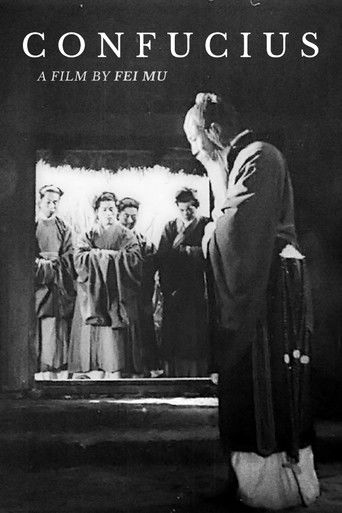
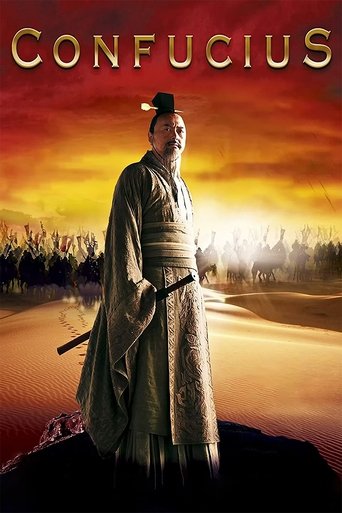
Posters via The Movie Database (TMDB)
- Bruce Lee, martial artist, actor, philosopher, 1940–1973: Kept the Analects in his personal library; its program of continuous self-cultivation runs through everything Lee taught.
- Voltaire, French Enlightenment philosopher, 1694–1778: "A wise man who is simple, unostentatious, free from imposture, who taught men to live happily."
- Gottfried Wilhelm Leibniz, German philosopher and mathematician, 1646–1716: "We need missionaries from the Chinese who might teach us the use and practice of natural religion."
- Ralph Waldo Emerson, American transcendentalist essayist, 1803–1882: Printed the Analects in The Dial's "Ethnical Scriptures" as wisdom fit to stand beside the Hebrew and Greek scriptures.
- Xi Jinping, President of China, 1953–: "Do not impose on others what you yourself do not desire."