
Read this if you…
- want just a super dark fucked up plot
- want to see if this is actually worse than Jane Eyre, or Groble is incorrect
Skip this if you…
- want a positive heartwarming light read
The lineage through Wuthering Heights
- King Lear by William Shakespeare. Wuthering Heights built on it. - The only secular work Brontë names in the whole novel — Lockwood's threats, he says, "smacked of King Lear," a wink at the play behind the book - Brontë was reading her father's Shakespeare as she wrote, and Heathcliff's revenge and storm-driven madness run on *Lear*'s engine: a great house wrecked by its own inheritance - Read the play first and Heathcliff reads less like a Gothic villain and more like Lear's heir — wronged, vengeful, raging at the weather
- Paradise Lost by John Milton. Wuthering Heights built on it. - Heathcliff descends from the Romantic Satan of *Paradise Lost* — proud, magnetic, beyond redemption — reaching Brontë through Byron's Manfred - The Brontës grew up on Milton; critics from Gilbert and Gubar onward read Catherine and Heathcliff against his Satan and Eve - Catherine's dream of exile from heaven draws on Milton's map of damnation — read him first and the novel's cosmic stakes come into focus
- Genesis by Moses. Wuthering Heights built on it. - The whole shape of *Wuthering Heights* — childhood innocence, a tempter, expulsion, exile — reworks the Eden story of *Genesis* - Brontë was steeped in Scripture from girlhood; the novel carries some 110 biblical references and stages its fall in a garden, apples and all - Reading *Genesis* first makes the paradise the lovers lose legible as the original one
Depicted in Art
A young woman in profile, hair pulled back, gaze averted — long held to be Emily Bronte though some scholars now argue it depicts Anne.
Patrick Branwell Bronte, 1833
Heathcliff in profile leans against the bare, gnarled trunk of a wind-battered tree, face tilted up to a stormy sky, alone on the moors.
Fritz Eichenberg, 1943
The title page of the original 1847 Thomas Cautley Newby edition, printed under Emily Bronte's pseudonym 'Ellis Bell'.
1847
The ruined stone farmhouse of Top Withens stands alone on a windswept moor under heavy sky, a single tree leaning beside it.
Steve Partridge, 2007
Recommended Editions

Penguin Classics
2002
Nestor's Penguin reads the novel through its nested narrators (Lockwood, Nelly Dean, and the question of who you trust) without flattening the gothic charge. Clean text, modern notes, easy to find.
Please support us by purchasing through these links, at no extra cost to you!
Notable Quotes
I am Heathcliff! He's always, always in my mind.
Screen & Stage
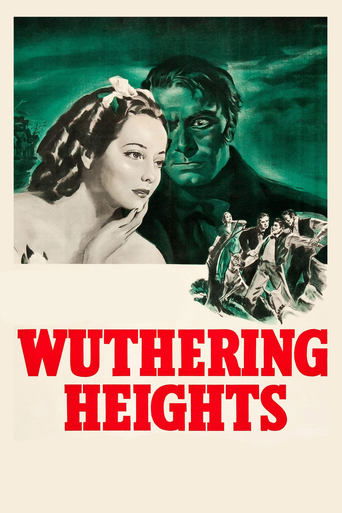
Wuthering Heights
Film · 1939
William Wyler
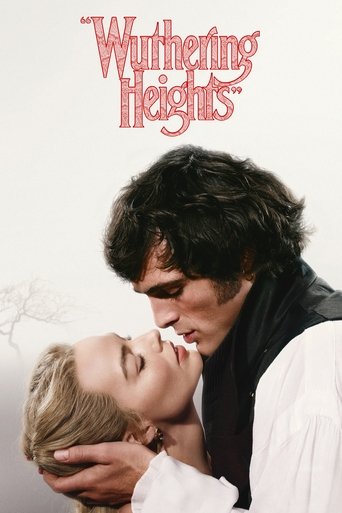
"Wuthering Heights"
Film · 2026
Emerald Fennell
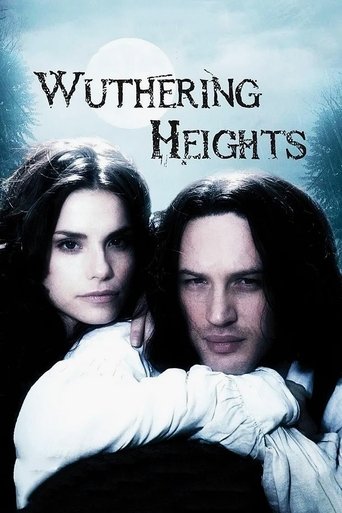
Wuthering Heights
TV · 2009
Coky Giedroyc
Posters via The Movie Database (TMDB)
- Stevie Nicks, singer-songwriter, Fleetwood Mac, 1948–: Named Wuthering Heights among her two all-time favourite books, alongside Jane Eyre.
- Virginia Woolf, Modernist novelist, 1882–1941: "Wuthering Heights is a more difficult book to understand than Jane Eyre, because Emily was a greater poet than Charlotte."
- Charlotte Bronte, Victorian novelist & Emily's sister, 1816–1855: "Wuthering Heights was hewn in a wild workshop, with simple tools, out of homely materials."
- Brian Cox, actor, 1946-: "One of the great stories. The quintessential obsessive love story. Truly amazing."
- Kate Bush, singer-songwriter, 1958–: "This young girl in an era when the female role was so inferior … coming out with this passionate, heavy stuff."
- Patti Smith, musician & poet, 1946–: "Emily was like a small volcano, dormant yet restlessly bubbling, and erupting through the words and actions of her chosen characters."
- Harold Bloom, Yale literary critic, 1930–2019: Enshrined Wuthering Heights in his Western Canon, reading Heathcliff as a Byronic, High Romantic hero.