
Gargantua and Pantagruel

Gargantua and Pantagruel
Read this if you…
- like fart jokes mixed in with high minded concepts
- want the most unhinged book of the Renaissance
- want an excessively fun carnivalesque writer
Skip this if you…
- don't like low brow humor
- aren't willing to do a little footnote reading/ looking stuff up
The  Take
Take
Hilarious mix of high minded and low brow. Tons of hilarious parts and some solid satire. It falls off books 4 and 5 but the thoroughly enjoyed the first 3, especially gargantua. Wouldn’t expect a book like this to exist from 1500s
The lineage through Gargantua and Pantagruel
- Praise of Folly by Erasmus. Gargantua and Pantagruel built on it. - Standing behind Rabelais's giants is Erasmus — in a 1532 letter Rabelais called him "my spiritual father and mother," owing everything to his writings - *Praise of Folly* supplied the satirical voice and the targets: pedants, hypocrites, the self-serious — Rabelais simply made it bigger, bawdier, and more riotous - Reading Erasmus first reveals the scholarly mischief underneath the toilet humor; this is humanist satire grown to giant size
- The Golden Ass by Apuleius. Gargantua and Pantagruel built on it. - *Gargantua and Pantagruel* descends from the ancient comic novel, and Apuleius is one of its named forebears - The *Golden Ass*'s grotesque, episodic, magic-soaked storytelling is the lineage Rabelais inherits — read it to see where his appetite for the lewd and the fantastical comes from
- Plutarch's Lives by Plutarch. Gargantua and Pantagruel built on it. - Rabelais read Plutarch closely — he quotes the *Lives* and the *Moralia* often enough that scholars list Plutarch among his core influences - The biographical exempla scattered through the giants' adventures come straight out of the *Lives*; Plutarch is the classical ballast under all the bawdy invention - Read it to see what a Renaissance humanist was mining when he reached for an ancient model
- The Life and Opinions of Tristram Shandy, Gentleman by Laurence Sterne. Gargantua and Pantagruel shaped it. - Sterne named Rabelais his favorite author and his master in humor — the line of descent is one he claimed openly in his letters - He warmed up by drafting a "Rabelaisian Fragment" right before he began *Tristram Shandy* — the giant's anarchic energy is the engine under the whole book - Rabelais even surfaces by name in the text: Walter Shandy warns Toby not to "look into Rabelais" — a wink at the source
- Gulliver’s Travels by Jonathan Swift. Gargantua and Pantagruel shaped it. - The grandfather of the satirical fantastic voyage — giants, grotesque scale, a loose-jointed romp through invented worlds - Two centuries later Swift drains the laughter dry and points the joke at humanity: Rabelais's giants become Brobdingnag, his appetite for the absurd becomes a scalpel - Coleridge's line says it best — Swift was *anima Rabelaisii habitans in sicco*, the soul of Rabelais living in a dry place
- The Hunchback of Notre-Dame by Victor Hugo. Gargantua and Pantagruel shaped it. - Hugo named Rabelais as one of his "three burlesque Homers" — with Ariosto and Cervantes — in the 1827 Preface to *Cromwell*, his Romantic manifesto on the power of the grotesque - Four years later he poured that aesthetic into Quasimodo: the grotesque and the sublime fused in a single body - And the Notre-Dame bells Quasimodo rings were first stolen by Rabelais's giant Gargantua — the line runs straight from the giant to the bell-ringer
Depicted in Art
The giant Gargantua looms over a table, fishing pilgrims out of his salad bowl and lifting one to his mouth.
Gustave Doré, 1873
The infant giant Pantagruel, chained in his crib, snaps the chains and crushes a bear that has wandered into the nursery.
Gustave Doré, 1873
The title page of the 1565 woodcut volume of Pantagrueline grotesques, with Breton's preface and the first grotesque figure.
François Desprez (attributed), 1565
A grotesque, Bosch-like hybrid figure — part human, part vessel, part insect — stands isolated against a blank ground.
François Desprez (attributed), 1565
King Louis-Philippe as a grotesque giant on a commode-throne, fed bags of gold by ladders of laborers while excreting honors below.
Honoré Daumier, 1831
Gargantua perches atop the towers of Notre-Dame and floods the Paris streets below with a torrent of urine; Parisians flee.
Gustave Doré, 1873
Recommended Editions

M.A. Screech
Penguin Classics · 2006
Screech spent his career on Rabelais and it shows. The jokes still land, the footnotes explain every scatological pun and theological dig that would otherwise sail past, and somehow the comedy doesn't die under the annotation.
Please support us by purchasing through these links, at no extra cost to you!
Notable Quotes
Do what you will.
Screen & Stage

Panurge
Opera · 1913
Jules Massenet
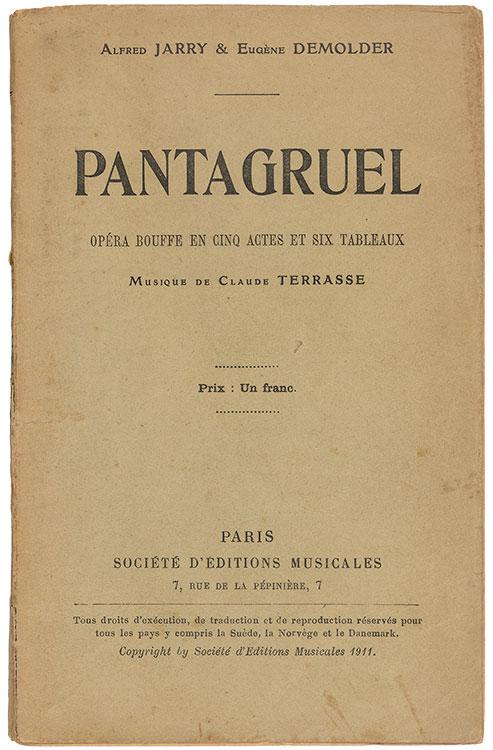
Pantagruel
Opera · 1911
Claude Terrasse
Also adapted: Gargantua (1993, tv)
Posters via The Movie Database (TMDB)
- Victor Hugo, French Romantic novelist & poet, 1802–1885: Hugo ranked Rabelais among the handful of supreme geniuses — Homer, Job, Isaiah, Dante, Cervantes, Shakespeare.
- Gustave Flaubert, French novelist, author of Madame Bovary, 1821–1880: "Sacro-saint, immense et extra-beau Rabelais — holy, immense and extra-beautiful Rabelais."
- Honoré de Balzac, French novelist, author of La Comédie humaine, 1799–1850: "le plus grand esprit de l'humanité moderne — the greatest mind of modern humanity."
- Aldous Huxley, English novelist & essayist, 1894–1963: "Rabelais loved the bowels which Swift so malignantly hated."