

Read this if you…
- are okay with tremendous digressions on why gothic architecture is superior to renaissance architecture
- want a book so good it saved a building
- want a warmup for Les Mis
- like very clear moral framework, Hugo wears his heart on his sleeve, very emotionally sweeping writing
Skip this if you…
- don't like Hugo's strong moral voice
- don't like simple characters
- don't like writers who launch lengthy digressions away from main plot (I love the digressions)
The lineage through The Hunchback of Notre-Dame
- Gargantua and Pantagruel by François Rabelais. The Hunchback of Notre-Dame built on it. - *The Hunchback of Notre-Dame* realizes the aesthetic Hugo credited to Rabelais — the grotesque-as-fecundity he praised in his 1827 Preface to *Cromwell*, naming *Gargantua and Pantagruel* alongside Ariosto and Cervantes - Quasimodo is that theory made flesh: the grotesque and sublime locked together, exactly the power Hugo found in Rabelais's giants - A wink for those who know — the cathedral bells Quasimodo rings were first carried off by Gargantua himself
- Esther by Unknown. The Hunchback of Notre-Dame built on it. - Hugo built this novel as a sly retelling of the Book of *Esther* — the assonance of Esther/Esmeralda is the tell - Both heroines carry two names and two identities; Hugo borrows Esther's court-and-outsider structure to lampoon monarchy and Church the way the original lampooned a Persian king's vanity - Read *Esther* first and the Festival of Fools reads as Ahasuerus's feast, the spectacle of beauty as the queen-search
Depicted in Art
Quasimodo, hulking and twisted, hunches in shadow inside Notre-Dame, his face contorted with the pain of his own ugliness.
Antoine Wiertz, 1839
Quasimodo, atop the cathedral, hurls a beam down on the truands storming the doors of Notre-Dame to free Esmeralda.
François-Nicolas Chifflart, 1876
Esmeralda lifts a flask of water to the chained Quasimodo at the pillory; a single tear runs down his face as a hostile crowd looks on.
Luc-Olivier Merson, 1903
Half-length portrait of Quasimodo glowering from atop the cathedral, the gargoyles of Notre-Dame breaking the skyline behind him.
Luc-Olivier Merson, 1889
Esmeralda holds a gourd of water to the chained Quasimodo's lips at the pillory in the place de Grève.
Gustave Brion, 1877
The young Quasimodo clambers along a gable of Notre-Dame, pulling ravens from a nest tucked under the stone.
Victor Masson, 1868
Esmeralda and Quasimodo together in the cathedral sanctuary, his deformed bulk beside her slight figure.
Antoine Johannot
Esmeralda on the scaffold among the crowd, the moment her trial chooses Gringoire as her husband to spare her hanging.
Henri Pille
The recluse Gudule rises before Tristan l'Hermite's soldiers, shielding her newfound daughter Esmeralda from arrest.
Louis Boulanger, 1831
Esmeralda spins in the parvis of Notre-Dame with her tambourine while Djali the goat dances at her feet.
Charles Voillemot, 1882
The whole of Notre-Dame from the south-east — spire, flying buttresses, and the twin west towers Quasimodo haunts. Hugo made the cathedral itself the novel's true protagonist.
Ali Sabbagh, 2017
The west façade from the empty parvis at dawn: the three carved portals, the Gallery of Kings, the great rose window, and the two bell-towers.
DXR, 2014
The apse and spire seen from across the Seine, the flying buttresses fanning out over the eastern end of the Île de la Cité.
Uoaei1, 2015
The three west portals and the Gallery of Kings, floodlit at night — the carved façade Hugo read like a book written in stone.
Benh Lieu Song, 2007
Recommended Editions

John Sturrock
Penguin Classics · 1978
Sturrock keeps every digression about Gothic architecture and medieval Paris that previous translators trimmed. Hugo's excess is the point, and the cathedral becomes a character because he wrote it that way.
Please support us by purchasing through these links, at no extra cost to you!
Notable Quotes
This will kill that. The book will kill the edifice.
Screen & Stage
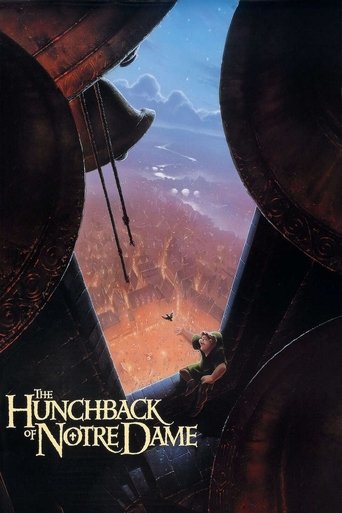
The Hunchback of Notre Dame
Film · 1996
Gary Trousdale
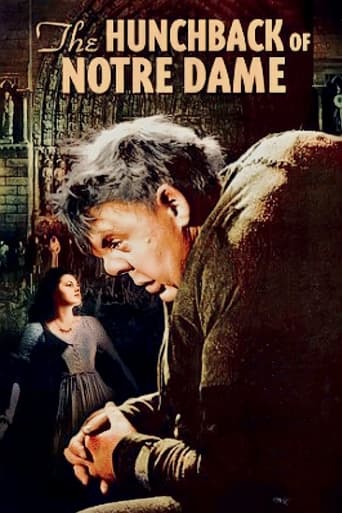
The Hunchback of Notre Dame
Film · 1939
William Dieterle
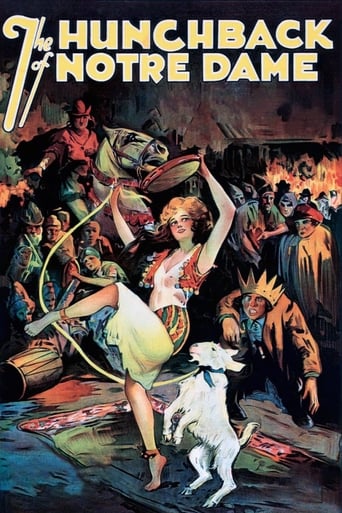
The Hunchback of Notre Dame
Film · 1923
Wallace Worsley
Posters via The Movie Database (TMDB)
- Danny Trejo, actor, 1944–: "In solitary confinement Trejo acted out The Hunchback to stay sane, identifying with Quasimodo: "The only difference is that he was innocent and I was actually a monster.""
- Alphonse de Lamartine, French Romantic poet & statesman, 1790–1869: "It is the Shakespeare of the novel; it is the epic of the Middle Ages."
- Fyodor Dostoevsky, Russian novelist, 1821–1881: The fundamental idea of all the art of the nineteenth century: the restoration of the man unjustly crushed by the weight of circumstances and social prejudice.
- Hector Berlioz, composer, 1803–1869: A genius, a powerful being, a colossus at once tender, pitiless, elegant, monstrous, hoarse, melodious, volcanic, caressing and contemptuous.