

Read this if you…
- love the theme of redemption
- love sweeping emotional symbolic writing (not complicated, but it hits hard)
- want Hugo's philosophizing on a variety of topics
Skip this if you…
- can't commit to one of the longest books ever
- have an instinctual aversion to anything french
- don't like simple characters and strong moral voice
The  Take
Take
One of my top books ever. Hugo’s mixture of describing the internal and external with such a glowing depth is miraculous. What a strong moral voice, without being preachy. Simplistic plot and characters but utterly compelling. Jean valjean is unreal awesome
The lineage through Les Misérables
- The Gospels by Matthew. Les Misérables built on it. - *Les Misérables* is a gospel parable stretched to novel length — Myriel's mercy toward Valjean is the unconditional grace of the Gospels made flesh - The whole moral architecture is derived from here: forgiveness over judgment, the redeemed sinner, mercy that outranks the law - Reading the Gospels first shows you exactly what Hugo is rewriting — and why the bishop's silver lands like a sacrament
- War and Peace by Leo Tolstoy. Les Misérables shaped it. - Tolstoy read and admired *Les Misérables* before writing *War and Peace*, and later named it the single book whose influence on him between ages 35 and 50 — his *War and Peace* years — was "enormous" - Hugo's model is right there in the finished novel: the vast historical canvas, the moral seriousness, the willingness to stop the story cold and address the reader on war, history, and the soul - Decades on he was still holding Hugo up — in *What Is Art?* (1898) he praised these novels as the real thing, model art
- Crime and Punishment by Fyodor Dostoevsky. Les Misérables shaped it. - Hugo was Dostoevsky's declared favorite — he translated Hugo into Russian himself and called *Les Misérables* superior to his own work - Valjean's accidental sinner reaching for redemption is the template *Crime and Punishment* runs in reverse, with a deliberate murderer in Valjean's place - The condemned-man material Hugo made his lifelong subject feeds straight into Raskolnikov
- The Brothers Karamazov by Fyodor Dostoevsky. Les Misérables shaped it. - Dostoevsky wrote the preface to the 1862 Russian translation of *Les Misérables*, calling Hugo's idea — the restoration of the fallen person, crushed by circumstance and prejudice — the fundamental thought of all 19th-century art - He reread Hugo across his whole career, and that conviction runs straight into *The Brothers Karamazov* - Hugo's machinery of social injustice and redemption-through-suffering becomes the moral engine of Dostoevsky's last novel
Depicted in Art
Engraved reissue of Bayard's Cosette portrait, the wide-eyed waif against a dark interior.
Émile Bayard, 1886
Gavroche, hat low, crouches between corpses outside the barricade gathering cartridges as bullets fly.
Adolphe Léon Willette, 1903
Young Cosette in a ragged smock, oversized broom in hand, looks out from the Thénardiers' inn at night.
Émile Bayard, 1862
Éponine, shot at the barricade, dies in Marius's arms after taking the musket-ball meant for him.
Fortuné-Louis Méaulle, after Émile Bayard, 1881
Valjean stands by candlelight beside the sleeping Bishop of Digne, an iron bar in hand and the silver chest open.
Émile Bayard, 1880
Colour lithograph poster: a tricolor-draped allegorical figure rallies a Paris crowd around the title.
Jules Chéret, 1886
Jean Valjean leads tiny Cosette away from the Thénardiers' inn through the dark winter forest.
Émile Bayard, 1880
Marius and Cosette meet in the wild garden of the house on the rue Plumet, clasped beneath the trees at dusk.
Fortuné-Louis Méaulle, after Émile Bayard, 1881
Recommended Editions

Christine Donougher
Penguin Classics · 2013
Donougher is the first translator who refused to cut anything. Waterloo, the sewer essay, the argot chapter, all of it, in natural English prose. If you want the whole book Hugo wrote, this is the only option.
Please support us by purchasing through these links, at no extra cost to you!
Notable Quotes
To love another person is to see the face of God.
Screen & Stage

Les Misérables
Stage · 1980
Claude-Michel Schönberg
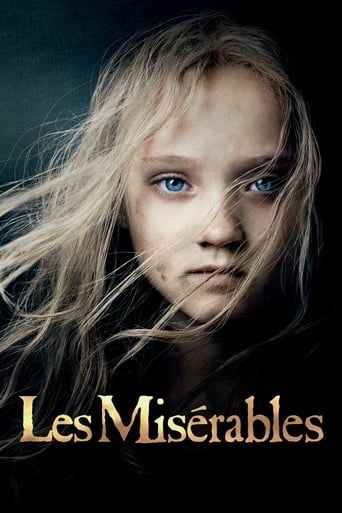
Les Misérables
Film · 2012
Tom Hooper
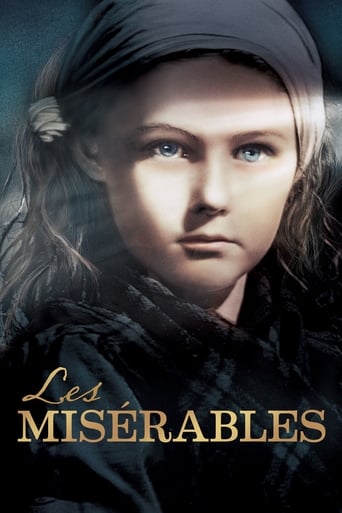
Les Misérables
Film · 1935
Richard Boleslawski
Posters via The Movie Database (TMDB)
- Leo Tolstoy, novelist, 1828–1910: "examples of the highest art, flowing from the love of God and the love of man."
- Upton Sinclair, American novelist (Pulitzer Prize), 1878–1968: "One of the half-dozen greatest novels of the world."
- Ayn Rand, novelist & philosopher, 1905–1982: "the greatest novelist in world literature."
- Fyodor Dostoevsky, novelist, 1821–1881: He ranked it above his own Crime and Punishment — the supreme drama of spiritual rebirth.
- Vincent van Gogh, Dutch Post-Impressionist painter, 1853-1890: "It's immensely beautiful, and I find the figure of Monseigneur Myriel sublime."
- Billy Beane, MLB executive, subject of Michael Lewis Moneyball (2003), b. 1962: Les Miserables is one of those books that just destroys you - you cannot put it down and you are a different person on the other side of it.
- Hugo Chávez, President of Venezuela, 1999–2013: "You want to meet Jean Valjean? Go to Latin America. There are many Jean Valjeans in Latin America."