
Read this if you…
- are genuinely interested in the realities and minutia of war
- want a book that has characters that have shockingly believable thoughts/desires etc. Tolstoy was a master of understanding humans
- are either reading the Tolstoys in order, or have already read and love Anna Karenina
- want a book where you leave knowing the writer is a genius and unreal observant
Skip this if you…
- can't commit to one of the longest books ever
- napoleonic warfare sounds boring (that's the war part)
- have a tough time with large lists of characters (i'd recommend writing down, looking up as you go to keep everything straight)
The  Take
Take
Tolstoy exudes comprehensive careful analysis throughout the breadth of human experience. Deeply knowledgeable and full of history, human quirks, nationalism, military realities, society, marriage , families, money etc. the characters are all extremely believable. The philosophical “point” was well argued even if he didn’t fully convince me, made me think. Clinical ability to translate obviously true observation to a believable narrative. He just goes and goes and goes and nothing feels forced at all
The lineage through War and Peace
- The Iliad by Homer. War and Peace built on it. - The model Tolstoy was reaching for — war rendered as the texture of a whole people's life - He praised Homer for grounding manners and customs in real historical event, and *War and Peace* is his attempt at the same on a national scale - Of all the books that shaped him, he named only Homer and the Bible as lifelong companions — read the *Iliad* and you stand where Tolstoy stood
- The Charterhouse of Parma by Stendhal. War and Peace built on it. - Borodino has a father, and it's Stendhal — Tolstoy avowed that he learned to write war from *The Charterhouse of Parma* - Stendhal's Waterloo gave him the method: battle as chaos seen from below, fragmentary and uncomprehended, never the clean map of the generals - Read Stendhal's Waterloo first and Tolstoy's whole antiheroic vision of war comes into focus — the irony was already there, waiting to be made epic
- Les Misérables by Victor Hugo. War and Peace built on it. - Tolstoy called *Les Misérables* the book whose influence on him in his *War and Peace* years was "enormous" — he read and admired it before he began - Hugo showed him the form: an epic that swallows a whole society and a whole war, pausing to argue history and morality directly with the reader - Read Hugo first and you meet the ambition Tolstoy answered — the panoramic, conscience-driven novel that *War and Peace* would take even further (Tolstoy held it up again as model art decades later)
- Confessions by Jean-Jacques Rousseau. War and Peace built on it. - The natural-man creed behind *War and Peace* is Rousseau's — Tolstoy worshipped the *Confessions*, read all twenty volumes, and wore a Rousseau medallion in place of a cross - Pierre's search for an honest, instinctive way to live and Karataev's untutored serenity both descend from the *Confessions*' faith in the uncorrupted self - Reading Rousseau first reveals the worldview Tolstoy absorbed whole and then dramatized across a thousand pages
- The Life and Opinions of Tristram Shandy, Gentleman by Laurence Sterne. War and Peace built on it. - When the narrator of *War and Peace* stops the war to lecture you on what really drives history, that habit traces back to Sterne - Tolstoy counted *Tristram Shandy*'s author as a formative influence and translated his work — the digressive, self-interrupting form is the acknowledged precursor to these philosophical excurses - Read Sterne first and Tolstoy's swerves stop looking like flaws and start looking like inheritance
- Eugene Onegin by Alexander Pushkin. War and Peace built on it. - Natasha Rostova has a mother: Pushkin's Tatiana, the heroine Tolstoy reread obsessively - The wounded-Andrei-sees-Natasha scene echoes a comparable moment in *Eugene Onegin* - Reading Pushkin first shows you the template Tolstoy was building on — the ardent, intuitive Russian heroine, before *War and Peace* made her epic
- Buddenbrooks by Thomas Mann. War and Peace shaped it. - From Tolstoy, Mann took the appetite for the sweeping epic and the almost painful observation of minute detail. _Buddenbrooks_, written at twenty-five, tracks four generations of a merchant family with the same patient breadth Tolstoy lavished on the Bolkonskys and Rostovs. - The kinship runs to structure: critics note how _Buddenbrooks_ opens on a homecoming party gathering the family's whole world, the way _War and Peace_ opens on Anna Pávlovna's soirée gathering society's.
Depicted in Art
Young Natasha Rostova at her debut ball, dancing on the floor in white as Petersburg society watches.
Leonid Pasternak, 1893
Natasha kneels at the bedside of the dying Prince Andrei in a peasant hut at Mytishchi after the retreat from Moscow.
Leonid Pasternak, 1893
Napoleon on horseback questions the captured Cossack servant Lavrushka on the road from Vyazma to Tsarev-Zaymische.
Leonid Pasternak, 1893
French soldiers execute Russian prisoners accused of arson against a wall in burning Moscow; Pierre stands among those condemned.
Leonid Pasternak, 1893
The boy hussar Petya Rostov falls from his horse, shot, during Denisov's partisan attack on a French convoy.
Nikolay Karazin, 1893
Nikolai, Natasha and Petya Rostov ride out with hounds across the autumn fields of Otradnoye for the wolf hunt.
Aleksey Kivshenko, 1893
Bedraggled French soldiers in rags trudge through a Russian winter landscape, escorted by armed peasants; one falls dead in the snow.
Illarion Pryanishnikov, 1874
Recommended Editions

Louise and Aylmer Maude
Oxford World's Classics · 1922
The Maudes were friends of Tolstoy's and translated under his eye. He called their English better than could be made. Dated in spots, but graceful, and probably the closest thing to a Tolstoy-approved version in print.
Please support us by purchasing through these links, at no extra cost to you!
Notable Quotes
Well, Prince, so Genoa and Lucca are now just family estates of the Buonapartes.
Screen & Stage
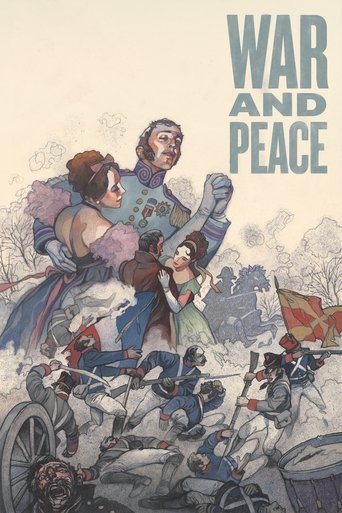
War and Peace
Film · 1968
Sergey Bondarchuk
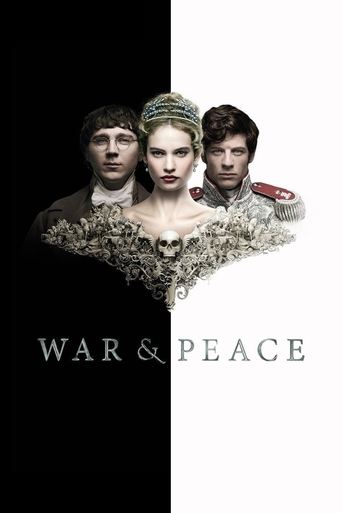
War and Peace
TV · 2016
Tom Harper
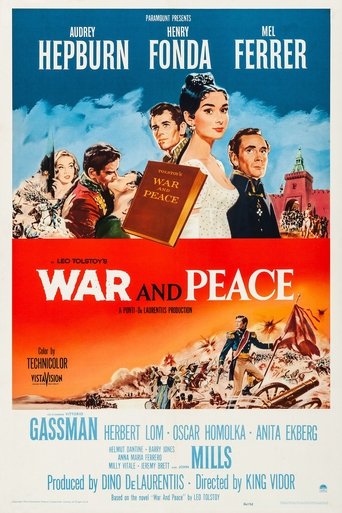
War and Peace
Film · 1956
King Vidor
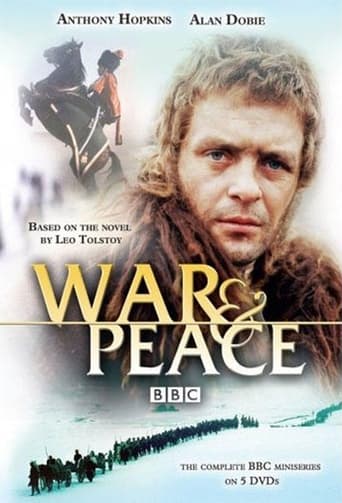
War & Peace
TV · 1972
David Conroy
Posters via The Movie Database (TMDB)
- Nelson Mandela, anti-apartheid leader, President of South Africa 1994–1999, 1918–2013: "One book that I returned to many times was Tolstoy's great work, War and Peace."
- Gustave Flaubert, French novelist, 1821–1880: "It's first-rate. What a painter and what a psychologist!"
- Virginia Woolf, British modernist novelist, 1882–1941: "There remains the greatest of all novelists—for what else can we call the author of War and Peace?"
- Ivan Turgenev, Russian novelist, 1818–1883: "one of the most remarkable books of our age"
- Ivan Goncharov, Russian novelist, author of Oblomov, 1812–1891: "This is positively what might be called a Russian Iliad."
- Anton Chekhov, Russian playwright & short-story writer, 1860–1904: "When literature possesses a Tolstoy, it is easy and pleasant to be a writer."
- Thomas Mann, German novelist, Nobel laureate, 1875–1955: It is the greatest war novel in the history of literature.
- Ernest Hemingway, American novelist, Nobel laureate, 1899–1961: I don't know anybody who could write about war better than Tolstoy did.
- George H.W. Bush, 41st President of the United States, 1924–2018: "An inspiring, lengthy treatise. I read it twice. It taught me a lot about life."
- Mikhail Dragomirov, Russian Imperial general & military theorist, 1830–1905: Its battle scenes are incomparable — an ideal manual for every officer's desk.

More by Leo Tolstoy
- 7Anna Karenina1877Leo TolstoyEasy·Epic·831 pagesInfluence76Popularity92The Age of the NovelNovelRussian
- 44The Death of Ivan Ilych1886Leo TolstoyEasy·Short·224 pagesInfluence52Popularity48The Age of the NovelNovelRussian
- 60War and Peace1869Leo TolstoyEasy·Epic·1,440 pagesInfluence76Popularity88The Age of the NovelHistorical FictionRussian