
Read this if you…
- want Tolstoy's best book
- like plots revolving around affairs
- want the most realistic characters ever (Tolstoy IS the most observant, perceptive writer I've read)
- liked the "Peace" part of War and Peace
Skip this if you…
- don't want to commit to a long book (still way shorter than war and peace)
- hate a book that's more about describing people moment to moment rather than crazy massive events
The  Take
Take
Tolstoy has the most realistic characters with the most realistic depictions of social, psychological and romantic phenomena I’ve ever seen. His descriptions are incredibly perceptive, largely non-judgemental, and almost always reveal a believable ulterior motive or cause to any event or action. His methodical approach to the events in anna karenina is purely clinical, and he never lets up. I’d say the entire plot line is less amazing than the consistent list of perfect observations of human nature if I had to define his superpower. The way he depicts the yearning of characters is just so real, not totally rational or irrational. Liked this one more than war and peace, the peace is more interesting!
The lineage through Anna Karenina
- Madame Bovary by Gustave Flaubert. Anna Karenina built on it. - The book *Anna Karenina* is arguing with — Tolstoy owned *Madame Bovary* (bound with *Othello*, both pinned to the adultery question) and called it, in 1892, justly famous - Scholarly consensus reads Tolstoy's novel as a deliberate response to Flaubert's - Read *Madame Bovary* first and Anna's tragedy reads as a rebuttal — the same act, weighed by a wholly different moral measure
- Romans by Paul. Anna Karenina built on it. - The epigraph — "Vengeance is mine; I will repay" — is Romans 12:19, and Tolstoy means it as the book's moral verdict, not decoration - Paul's distinction between human revenge and God's prerogative of judgment is the frame Tolstoy builds the novel inside - Read *Romans* first and the epigraph stops being a quotation and becomes the question the whole book is answering
- Eugene Onegin by Alexander Pushkin. Anna Karenina built on it. - Anna descends directly from Pushkin's Tatiana — Tolstoy's first heroine was even named for her - The book started with Pushkin: a stray prose fragment of his, reread in 1873, gave Tolstoy the push into the story - Read *Eugene Onegin* first and you meet the original Russian heroine caught between passion and the world's rules — Anna is her inheritor
- Middlemarch by George Eliot. Anna Karenina built on it. - Tolstoy owned *Middlemarch* and read it in Russian translation in the very years he was writing *Anna Karenina* - He counted George Eliot among the writers who shaped his great-novel period — the panoramic realism, the marriage as a moral proving ground - Eliot got there first; reading her makes Tolstoy's web of doomed and dutiful couples feel like a conversation, not a coincidence
- The Gospels by Matthew. Anna Karenina built on it. - *Anna Karenina* ends not with the affair but with Levin's Gospel-driven conversion — the Sermon on the Mount's call to live for God, not self - Tolstoy is wrestling centrally with this scripture; Karenin's bedside forgiveness and Levin's faith are both arguments worked out from it - Knowing the Sermon on the Mount first reveals that the love story is, at heart, a religious novel
- Buddenbrooks by Thomas Mann. Anna Karenina shaped it. - Tony Buddenbrook is Mann's North-German answer to Anna: a woman pushed into marriages of convenience and made the sacrificial lamb of her family's pride. Critics read her arc as a deliberate, more ironic echo of Tolstoy's tragic heroine. - Mann took Tolstoy as a formative master of observed detail and domestic tragedy, and the realist study of a woman ground down by the social machinery of marriage is a debt _Buddenbrooks_ owes directly to _Anna Karenina_.
Depicted in Art
A young woman in a dark dress sits in an armchair with clasped hands, gazing past the viewer.
Aleksei Mikhailovich Kolesov, 1885
Anna embraces her young son Seryozha on her clandestine visit to the Karenin house on his birthday.
Mikhail Vrubel, 1878
Vronsky kneels before a seated Anna, taking her hand as he pleads with her to leave Karenin.
Elmer Boyd Smith, 1899
A woman in nineteenth-century Russian dress sits in shadowed reverie, identified by the painter as Anna Karenina.
Heinrich Matveevich Manizer, 1904
Levin and Kitty stand close together in a domestic interior, the quiet center of the novel's second plot.
Elmer Boyd Smith, 1899
Anna in a low-cut gown with fur stole, earrings and tiara; behind her stand Vronsky and a country house.
Auke Anne Tadema
Vronsky's mare Frou-Frou plunges at the steeplechase, Vronsky bent over her neck as the crowd watches from the stands.
Nikolay Andreyevich Tyrsa, 1939
Recommended Editions

Rosamund Bartlett
Oxford World's Classics · 2014
Bartlett, a Tolstoy biographer, translates with a sense of the wider life around the book. Slightly less crisp than Schwartz, slightly warmer than P&V, and the notes are excellent.
Please support us by purchasing through these links, at no extra cost to you!
Notable Quotes
All happy families are alike; each unhappy family is unhappy in its own way.
Screen & Stage

Anna Karenina
Film · 2012
Joe Wright
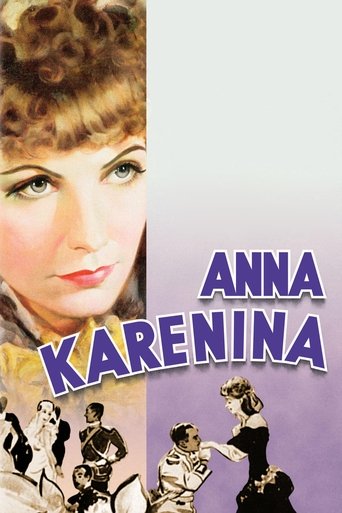
Anna Karenina
Film · 1935
Clarence Brown
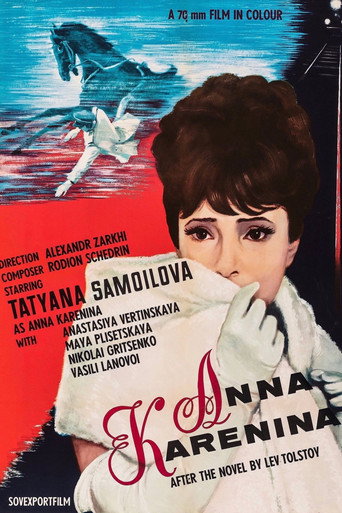
Anna Karenina
Film · 1967
Aleksandr Zarkhi
Posters via The Movie Database (TMDB)
- Bruce Springsteen, musician, 1949–: Names Anna Karenina among the books that shaped him, calling the great Russians so deeply psychological they hit him hard.
- Fyodor Dostoevsky, Russian novelist, 1821–1881: "Anna Karenina is sheer perfection as a work of art. No European work of fiction of our present day comes anywhere near it."
- Vladimir Nabokov, Russian-American novelist & critic, 1899–1977: "Though one of the greatest love stories in world literature, Anna Karenin is of course not just a novel of adventure."
- Thomas Mann, German novelist, Nobel laureate, 1875–1955: "The greatest social novel of world literature."
- William Faulkner, American novelist, Nobel laureate, 1897–1962: "Anna Karenina, Anna Karenina, and Anna Karenina."
- Virginia Woolf, English modernist novelist & critic, 1882–1941: "The greatest of all novelists — for what else can we call the author of War and Peace?"
- Maggie Gyllenhaal, actress, filmmaker, 1977–: Spent 120 hours narrating the audiobook and calls rereading it at different ages mind-blowing and earth-shattering each time.
- Jennifer Lawrence, American actress, Academy Award winner, b. 1990: "I started reading the same chapters over and over. You fall in love with the characters; you grow up with them."
- Oprah Winfrey, American media mogul & television host, b. 1954: "It's one of the greatest love stories of all time."
- Harold Bloom, Yale literary critic, 1930–2019: "His strongest character, Anna Karenina, has profound strains of Shakespeare in her, for which Tolstoy, who loves her, will not forgive her."

More by Leo Tolstoy
- 7Anna Karenina1877Leo TolstoyEasy·Epic·831 pagesInfluence76Popularity92The Age of the NovelNovelRussian
- 44The Death of Ivan Ilych1886Leo TolstoyEasy·Short·224 pagesInfluence52Popularity48The Age of the NovelNovelRussian
- 60War and Peace1869Leo TolstoyEasy·Epic·1,440 pagesInfluence76Popularity88The Age of the NovelHistorical FictionRussian