
Eugene Onegin

Read this if you…
- want the foundational text of Russian Literature
- want short Russian classic
Skip this if you…
- are expecting russian poetry to fully survive translation to English
- don't care about reading the OG Russian author that started the whole literary scene
The  Take
Take
Despite this being apparently famously hard to translate, I found it easily readable and still seemed poetic with a unique voice I think was pushkins. Lots of great small quips. The plot as a whole isn’t THAT great but verse to verse is great
The lineage through Eugene Onegin
- Dead Souls by Nikolai Gogol. Eugene Onegin shaped it. - Pushkin literally handed Gogol the plot — the scheme of buying up dead serfs came from him in the mid-1830s - His novel-in-verse is the formal blueprint for Gogol's "poema": the wandering authorial digressions, the social X-ray, the narrator's eye for *poshlust* all start here - The fountainhead of the Russian novel passing the torch to its first great prose comedy
- Crime and Punishment by Fyodor Dostoevsky. Eugene Onegin shaped it. - For Dostoevsky this was scripture — in his 1880 Pushkin Speech he called *Onegin* the place where "real Russian life is embodied with creative power and perfection" - Onegin is the original Russian "superfluous man": brilliant, restless, useless — the type Dostoevsky would turn into his intellectual antiheroes - Raskolnikov's clever paralysis starts here, in Pushkin's bored aristocrat
- Oblomov by Ivan Goncharov. Eugene Onegin shaped it. - The whole sad pedigree of the Russian _superfluous man_ starts with Onegin: the gifted, educated nobleman who cannot be bothered to do anything with himself, and Pushkin's bored aristocrat is the seed Goncharov grows to monstrous, unforgettable proportions. - Where Onegin at least gets up and travels and duels, Goncharov asks the crueler question — what if the type just never got out of bed? Oblomov is Onegin with the energy switched off, the prototype taken to its logical, dressing-gowned conclusion.
- Anna Karenina by Leo Tolstoy. Eugene Onegin shaped it. - Pushkin's Tatiana is the seed of Tolstoy's Anna — Tolstoy even named his heroine "Tatiana" in the earliest drafts before the woman became her own - The proximate spark was Pushkin too: Tolstoy reread a Pushkin prose fragment in March 1873 and the novel poured out - One Russian masterpiece handing the next its central woman and its opening momentum
- War and Peace by Leo Tolstoy. Eugene Onegin shaped it. - Tatiana, Pushkin's heroine, is the acknowledged forebear of Tolstoy's Natasha Rostova - Tolstoy revered Pushkin and reread him obsessively — "Never have I admired Pushkin so much" - The Russian novel's most beloved heroine begins here, in verse, decades before *War and Peace* gave her a sequel in prose
- Fathers and Sons by Ivan Turgenev. Eugene Onegin shaped it. - Pushkin was an inescapable idol for Turgenev — who helped unveil the poet's statue in 1880, alongside Dostoevsky - The "superfluous man" Pushkin created in Onegin is the type Turgenev reworks in Bazarov and Odintsova: gifted, modern, and quietly stranded
- Devils by Fyodor Dostoevsky. Eugene Onegin shaped it. - Pushkin invents the type Dostoevsky would spend a career anatomizing — the bored, duel-provoking Russian aristocrat who cannot love - Dostoevsky called *Eugene Onegin* "the very first beginnings of our agonising consciousness," the seed of his 1880 Pushkin Speech - In *Devils*, Stavrogin is Onegin gone colder — the next, crueler iteration of the man Pushkin first drew
Depicted in Art
Snow-covered forest clearing at dawn: Lensky has just fallen, pistol arm outflung, while Onegin stands stricken in dark coat with his own pistol still raised; the seconds hover faintly at the edge of the frame.
Ilya Repin, 1899
Two slender figures lean on the embankment railing of the Neva by night, the Peter and Paul fortress silhouetted across the water — Pushkin himself with his fictional creation Onegin.
Alexander Pushkin, 1824
Tatiana on a snowy bank watches a grotesque banquet of monsters presided over by Onegin — the climax of her prophetic dream in the deep woods.
Ivan Volkov, 1891
A scene from the country chapters in the Samokish-Sudkovskaya color manner — landscape and figure work in the polished 1908 edition style.
Elena Samokish-Sudkovskaya, 1908
Tatiana flees through a winter forest of snow-laden firs, a great bear lumbering after her — the Chapter 5 dream sequence rendered in moody, impressionist tones.
Konstantin Korovin, 1899
Tatiana and Onegin face each other in a garden or drawing-room setting in the rich Style Moderne palette — costume, posture and lighting in the Belle Époque manner.
Elena Samokish-Sudkovskaya, 1908
Recommended Editions

James Falen
Oxford World's Classics · 1995
Falen is the consensus best rhymed Onegin in English. Keeps Pushkin's fourteen-line stanza and the masculine/feminine rhyme pattern intact, and reads as English verse rather than as a translation.
Please support us by purchasing through these links, at no extra cost to you!
Notable Quotes
My uncle—high ideals inspire him; but when past joking he fell sick, he really forced one to admire him— and never played a shrewder trick.
Screen & Stage

Eugene Onegin
Opera · 1879
Pyotr Ilyich Tchaikovsky

Onegin
Opera · 1965
John Cranko
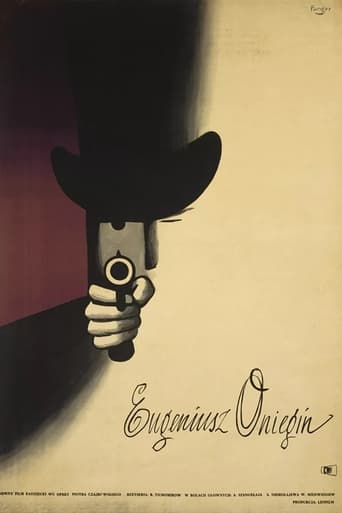
Eugene Onegin
Film · 1959
Roman Tikhomirov
Posters via The Movie Database (TMDB)
- Pyotr Ilyich Tchaikovsky, composer, 1840–1893: "The richness of the poetry, the humanity and simplicity of the subject, embodied in Pushkin's inspired verse."
- Fyodor Dostoevsky, Russian novelist, 1821–1881: "A tangible and realistic poem, in which real Russian life is embodied with a creative power and a perfection such as had not been achieved before Pushkin."
- Vladimir Nabokov, Russian-American novelist & translator, 1899–1977: "Pushkin's composition is first of all and above all a phenomenon of style."
- Leo Tolstoy, Russian novelist, 1828–1910: It was a stray Pushkin prose fragment that set him writing Anna Karenina — and his heroine first bore the name of Onegin's Tatiana.
- Ralph Fiennes, actor, Schindler's List / The English Patient, 1962–: Transfixed by the poem as a young actor, he played Onegin in his sister Martha's 1999 film and has returned to Pushkin throughout his career — the story of a man who throws away love and spends his life knowing it.