

Read this if you…
- want the first great Russian novel (both Tolstoy + Dostoevsky read it)
- want a Russian novel more comic than serious (satirical of russian society)
- are okay with an unfinished work
Skip this if you…
- are expecting it to be as good as tolstoy/dostoevsky/fathers and sons
- don't want to do some quick research on historical societal context
The  Take
Take
Great quips and descriptions, the detailed distinct characters were awesome, the overarching theme of political fraud and dead souls is great. Very pumped for more Russian classics. Loved the guy who has no main interests, loved the gossip around town, loved the guy who spilled the beans but then told chichirov to leave town just in time.
The lineage through Dead Souls
- Eugene Onegin by Alexander Pushkin. Dead Souls built on it. - Gogol got the central idea from Pushkin himself — the dead-serfs plot was Pushkin's gift - *Dead Souls* calls itself a "poema" because *Eugene Onegin* showed the way: digression, social satire, and a narrator who names Russia's vulgarity for what it is - Reading Pushkin first reveals the mold Gogol poured his cracked, comic Russia into
- The Divine Comedy by Dante Alighieri. Dead Souls built on it. - *Dead Souls* was conceived as a Russian *Divine Comedy* — Chichikov's tour through a gallery of damned landowners is its Inferno - Gogol wrote it in Rome, modeling a three-part ascent on Dante's Inferno–Purgatorio–Paradiso; only the first, the descent into vice, was ever finished - Read the *Commedia* first and Gogol's grand plan declares itself — the catalog of the damned was meant to climb toward redemption that never came
- Don Quixote by Miguel de Cervantes Saavedra. Dead Souls built on it. - *Dead Souls* is *Don Quixote* transplanted to the Russian road - Gogol built Chichikov's journey on Cervantes' model — Pushkin gave him the plot precisely so he could run a Quixote-style picaresque across the provinces; critics set the result squarely between Cervantes and Le Sage - Read the Don first and you'll see the machinery: the episodic road, the deluded traveler, the country laid bare one absurd encounter at a time
- Crime and Punishment by Fyodor Dostoevsky. Dead Souls shaped it. - Dostoevsky knew *Dead Souls* by heart — by his own account he read it aloud all night - Gogol's St. Petersburg, where a man drifts through the city in a feverish daze, is the soil *Crime and Punishment* grows from - A single Gogol passage all but conjures Raskolnikov wandering the Haymarket — twenty years before Dostoevsky wrote him
- Oblomov by Ivan Goncharov. Dead Souls shaped it. - Gogol's _Dead Souls_ launched the 'natural school' of Russian realism, and the young Goncharov was one of its members — Manilov, Gogol's sugary, idle, perpetually-daydreaming landowner, is the soft clay out of which Oblomov is later sculpted. - Goncharov takes Gogol's comic minor type — the dreaming squire who plans grand improvements and accomplishes nothing — and gives it a whole novel and a national diagnosis.
- Devils by Fyodor Dostoevsky. Dead Souls shaped it. - Gogol invented the satirical key Russian fiction would borrow for a century — the chronicling narrator, the grotesque comedy of a provincial backwater - *Dead Souls* is the direct ancestor of *Devils*: Dostoevsky stages his town's political chaos in exactly Gogol's mode, the social portraiture turned dark and absurd - Dostoevsky knew the book intimately — he read it aloud with friends again and again, by his own record — and you can hear it in everything Dostoevsky's small-town grotesques do
Depicted in Art
Two provincial ladies whisper conspiratorially over tea, trading the gossip that will spread Chichikov's scandal through the town.
Alexander Agin, 1847
Portrait of the wretched miser Plyushkin in rags, gaunt and suspicious, clutching at himself.
Pyotr Boklevsky, 1895
Half-length portrait of the smooth, plump Chichikov, smirking under sleek brown hair, the picture of provincial polish.
Pyotr Boklevsky, 1895
Chichikov negotiates with the suspicious widow Korobochka in her cluttered country parlor over the price of her dead serfs.
Alexander Agin, 1847
Chichikov makes his entrance at the provincial governor's ball, gliding through clusters of dancing couples in the gaslit hall.
Pyotr Sokolov, 1915
Chichikov sits stiffly while Nozdryov sprawls beside him, gesturing wildly mid-tirade as the visit careens toward disaster.
Mechislav Dalkevich, 1901
The blustering braggart Nozdryov leans in over a table to harangue Chichikov, who recoils with diplomatic alarm.
Alexander Agin, 1847
Portrait of the swaggering Nozdryov, whiskered and grinning, mid-boast.
Pyotr Boklevsky, 1895
Recommended Editions

Robert A. Maguire
Penguin Classics · 2004
Maguire's English is as eccentric as Gogol's Russian, which is what the book needs. The digressions and grotesque portraits land as digressions and grotesques, not as a sanded-down 19th-century novel.
Please support us by purchasing through these links, at no extra cost to you!
Notable Quotes
Russia, whither art thou speeding? Answer me! She gives no answer.
Screen & Stage
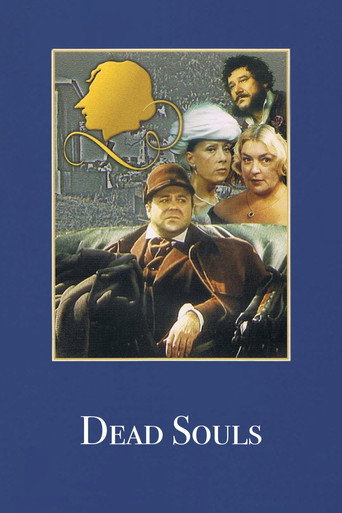
Dead Souls
TV · 1984
Mikhail Schweitzer
_02_(cropped).jpg)
Dead Souls
Opera · 1977
Rodion Shchedrin
Posters via The Movie Database (TMDB)
- Bill Hader, actor, SNL / Barry, 1978–: Named Dead Souls among his favorite books in the New York Times 'By the Book' interview (2014).
- Mel Brooks, filmmaker & comedian (Blazing Saddles, The Producers), b. 1926: "Dead Souls is a masterpiece. I love Gogol's great eye for idiot behavior."
- Vladimir Nabokov, novelist & critic, 1899–1977: "Chichikov himself is merely the ill-paid representative of the Devil, a traveling salesman from Hades."
- Alexander Pushkin, poet, "father of Russian literature," 1799–1837: God, how sad our Russia is.
- Leo Tolstoy, novelist (War and Peace, Anna Karenina), 1828–1910: "Gogol has tremendous talent and a beautiful heart."
- Marc Chagall, painter (illustrated Dead Souls, 96 etchings, 1923–1948), 1887–1985: "He was the first surrealist expressionist in Russia."
- Harold Bloom, literary critic, Yale professor, 1930–2019: Bloom placed Dead Souls in the Western canon among the great books of the age.