
Read this if you…
- want to read a hugely famous satire even though it's overrated
- want a guy generally hating on humanity
Skip this if you…
- don't like satire that's way too obvious
- are hoping its as good as Gargantua + Pantagruel (read that one first)
The  Take
Take
More boring and basic than expected, the horse nation was the best part but was not a fan of the the first 3 parts
The lineage through Gulliver’s Travels
- Gargantua and Pantagruel by François Rabelais. Gulliver’s Travels built on it. - The wild, riotous ancestor of Gulliver's giants-and-islands satire - Rabelais supplied the form Swift inherited — the voyage among strange peoples, the comedy of scale — but where Rabelais overflows with appetite, Swift goes cold and surgical - Coleridge fixed the lineage in a phrase: Swift was *anima Rabelaisii habitans in sicco* — the soul of Rabelais dwelling in a dry place. Read Rabelais and you hear what got dried out
- Robinson Crusoe by Daniel Defoe. Gulliver’s Travels built on it. - *Gulliver's Travels* is in large part a send-up of *Robinson Crusoe* and the solemn traveler's tale Defoe had made fashionable - That jab at travelers who detail every meal "as if the readers were personally concerned whether we fared well or ill" is a direct dig at Crusoe's earnest provision-keeping - Knowing Defoe's straight-faced castaway first sharpens every parody — you see exactly what Swift is laughing at
- Candide by Voltaire. Gulliver’s Travels shaped it. - Voltaire read *Gulliver's Travels* in English the year it appeared, met Swift in London, and called him "the Rabelais of England" - Swift's recipe — a credulous traveler whose wanderings expose the follies of philosophy — runs straight into Voltaire's contes philosophiques (Zadig's Big- and Little-Endian quarrel borrows directly) - *Candide* perfects the satirical-traveler form Swift had handed him, this time aimed at Leibnizian optimism
- The Life and Opinions of Tristram Shandy, Gentleman by Laurence Sterne. Gulliver’s Travels shaped it. - *Gulliver's Travels* set the standard for English learned-wit satire that Sterne would build on a generation later - The two are routinely paired as the great prose satires of the English 18th century — Swift's the model, *Tristram Shandy* the wild extension
- Devils by Fyodor Dostoevsky. Gulliver’s Travels shaped it. - Swift's satiric image of Gulliver opens one of the great Russian novels: on its first page, Dostoevsky likens the deluded liberal Stepan Trofimovich to Gulliver back from Lilliput - A man "grown so accustomed to consider himself a giant" that he shouts at passers-by to get out of his way — Swift's deflating comedy borrowed to set the mocking tone of *Devils*
Depicted in Art
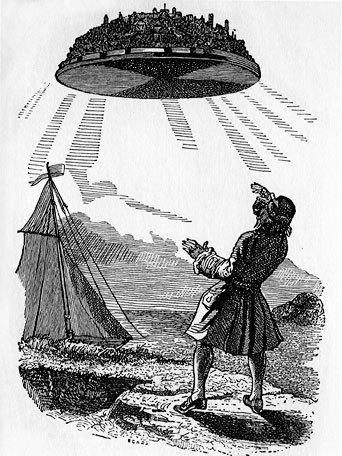
The flying island of Laputa hangs in the sky above a tiny Gulliver on the ground, casting an enormous shadow.
J.J. Grandville, 1838
Tiny Lilliputian troops parade in formation between Gulliver's spread legs as he stands astride them like a colossus.
Paul Gavarni
Gulliver kneels and gestures in deferential explanation before a gathering of rational horses in a clearing.
Sawrey Gilpin, 1769
A giant King holds the tiny Gulliver in his palm and inspects him with a spyglass; the figures are caricatured as George III and Napoleon.
James Gillray, 1803
Three giant scholars in academic robes examine the tiny Gulliver on a table, debating his nature.
Paul Gavarni, 1862
Gulliver lies bound on his back as Lilliputian soldiers climb across his chest and a courtier on horseback rides up his torso.
1727
The tiny Gulliver bows on a tabletop before the seated Queen of Brobdingnag and her enormous court.
Charles Robert Leslie, 1835
Gulliver stands by his small boat on the shore, looking back as the Houyhnhnms watch him depart.
Sawrey Gilpin, 1769
Gulliver stands in conversation with a noble horse-master while other Houyhnhnms graze and observe in a pastoral landscape.
J.J. Grandville, 1838
Recommended Editions

Penguin Classics
2003
Robert DeMaria's Penguin restores the text the Victorians censored, so the satire reads as nasty as Swift wrote it. Introduction is sharp on the politics behind each voyage.
Please support us by purchasing through these links, at no extra cost to you!
Notable Quotes
I cannot but conclude the bulk of your natives to be the most pernicious race of little odious vermin that nature ever suffered to crawl upon the surface of the earth.
Screen & Stage
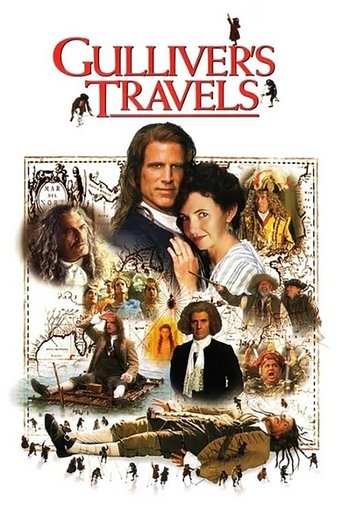
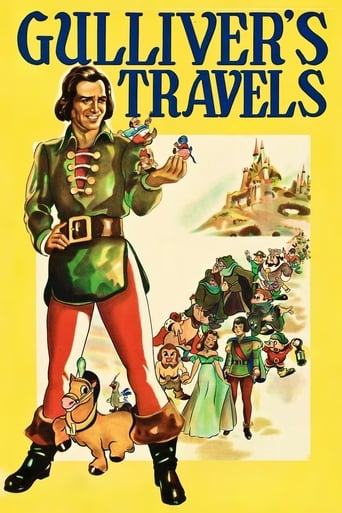
Posters via The Movie Database (TMDB)
- Neil deGrasse Tyson, American astrophysicist and science communicator, 1958-: Gulliver's Travels changed Tyson's life; he says he thinks about it "all the time" and "can't shake" its influence.
- Samuel Johnson, English critic and lexicographer, 1709–1784: "A production so new and strange that it filled the reader with a mingled emotion of merriment and amazement."
- Samuel Taylor Coleridge, English Romantic poet and critic, 1772–1834: "Swift was anima Rabelaisii habitans in sicco — the soul of Rabelais dwelling in a dry place."
- Voltaire, French Enlightenment writer, 1694–1778: Swift is the Rabelais of England — and the better for it.
- John Adams, 2nd President of the United States, 1735–1826: "The vast prospect of Mankind … has Sickened my very Soul, and almost reconciled me to Swifts Travels among the Yahoo's."
- Stanley Kubrick, American film director, 1928-1999: Dr. Strangelove keeps Gulliver's Travels in view — its doomsday bomber's target is Swift's Laputa.
- Hayao Miyazaki, Japanese filmmaker and animator, 1941-: Miyazaki's Castle in the Sky takes its floating island Laputa straight from Swift's Gulliver's Travels.
- George Orwell, English novelist and essayist, 1903–1950: "If I had to make a list of six books to be preserved when all others were destroyed, I would certainly put Gulliver's Travels among them."