

Read this if you…
- want basically the first English novel
- like deserted on an island stories, and want the OG
- like a book where he pretended it was like a true story to sell books
- want a short and easy enlightenment book, probably the easiest one to read
Skip this if you…
- find the castaway story overdone at this point, and don't care about the OG
- want a fast moving plot
The  Take
Take
Easy to follow, easy to understand crusoes mindset. Best part was his utter solitude and just Friday. Super simple language and nothing groundbreaking, but nailed the castaway concept
The lineage through Robinson Crusoe
- Psalms by David. Robinson Crusoe built on it. - Crusoe's conversion is the *Psalms* breaking into the story - At his lowest, Defoe has him open the Bible to Psalm 50:15 — "Call upon me in the day of trouble, and I will deliver" — the "powerful words" that turn a survival tale into a spiritual one (Psalm 27:14 follows) - That single verse earned the nickname "Robinson Crusoe's Psalm"
- Gulliver’s Travels by Jonathan Swift. Robinson Crusoe shaped it. - The castaway-survival tale Swift set out to skewer — *Gulliver's Travels* reads as a deliberate parody of Crusoe and the whole earnest traveler's-tale genre - Crusoe's loving inventories of food and provisions are exactly what Gulliver mocks: "other travellers fill their books, as if the readers were personally concerned whether we fared well or ill" - Defoe played the shipwreck straight; seven years later Swift weaponized the same form into satire
- Treasure Island by Robert Louis Stevenson. Robinson Crusoe shaped it. - Defoe's castaway is the ancestor of every marooned man in adventure fiction, and Stevenson sends one of his own to the same fate. Ben Gunn is _Crusoe_ run through a comic filter: a sailor left alone on an island who grows half-mad on goat meat and solitude, dressed head to foot in goatskin and forever talking of Providence. - Stevenson openly counted _Robinson Crusoe_ among his sources in his essay _My First Book_, where he tallied his debts to Defoe alongside Poe and Irving. The desert-island grammar Defoe invented in 1719 is the inheritance _Treasure Island_ both honors and ransacks.
- David Copperfield by Charles Dickens. Robinson Crusoe shaped it. - The book on the lonely boy's shelf — *Robinson Crusoe* is one of the novels young David inherits in Chapter 4, the reading that keeps him alive - It was Dickens's own childhood reading too, and *David Copperfield* is his first novel told in the first person — the autobiographical *I* that Defoe pioneered - Read the original solitary survivor's account, then watch a Victorian boy survive on it
- Confessions by Jean-Jacques Rousseau. Robinson Crusoe shaped it. - Defoe's solitary survivor became a self-image other men reached for — in his *Confessions* Rousseau calls himself "another Robinson Crusoe," arranging his 21-day quarantine in the lazaretto - Rousseau had already crowned *Robinson Crusoe* the one book his Emile may read — "the most felicitous treatise on natural education" - The castaway alone with his ingenuity became the template for the self-sufficient modern self
Depicted in Art
Crusoe stands on a rise in goatskin clothing carrying his musket, axe, and tattered umbrella — the iconic full-length survivor portrait.
N.C. Wyeth, 1920
The shipwreck — Crusoe's vessel breaking up in heavy seas, the source of his castaway exile.
Crusoe in goatskin garb on the island shore with Friday at his side — a late 19th-century German children's-book reading of the pair.
Carl Offterdinger
Crusoe washed ashore on a storm-tossed beach beside the wreckage of his vessel, the surviving sailor confronting the empty coast.
Thomas Sully
Crusoe and Friday at the campfire on the island — the survival routine after Friday's rescue.
Walter Paget, 1896
The original 1719 frontispiece — Crusoe standing on his island in goatskin clothing, holding muskets, the prototype of every later portrait.
1719
Recommended Editions

Penguin Classics
2003
John Richetti's Penguin is the everyday reading copy. Introduction handles both the birth-of-the-novel claim and the colonial uncomfortable bits without scolding the book.
Please support us by purchasing through these links, at no extra cost to you!
Notable Quotes
It happened one day, about noon, going towards my boat, I was exceedingly surprised with the print of a man's naked foot on the shore, which was very plain to be seen on the sand. I stood like one thunderstruck, or as if I had seen an apparition.
Screen & Stage
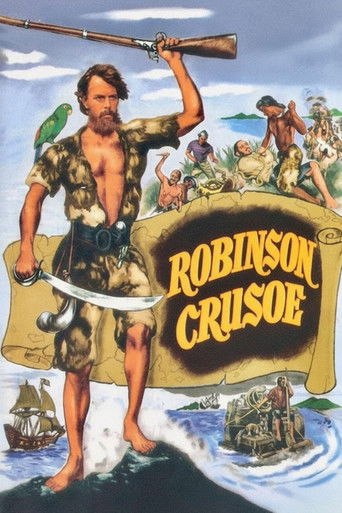
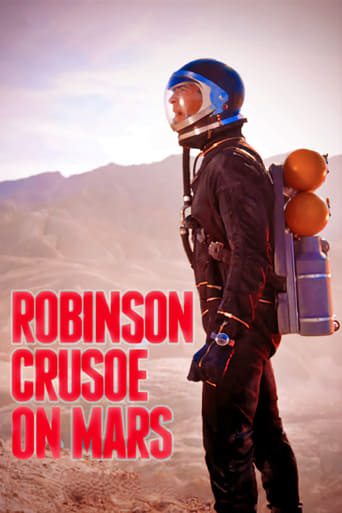
Posters via The Movie Database (TMDB)
- Mel Brooks, filmmaker, comedian, 1926–: "Maybe my favorite book. Even though Crusoe is adrift on a lonely island, he never loses his faith."
- Wilkie Collins, novelist, 1824–1889: "Such a book as Robinson Crusoe never was written, and never will be written again."
- Samuel Johnson, critic & lexicographer, 1709–1784: "Was there ever yet anything written by mere man that was wished longer by its readers, excepting Don Quixote, Robinson Crusoe, and The Pilgrim's Progress?"
- Jean-Jacques Rousseau, philosopher, 1712–1778: "There is one book which supplies the best treatise on an education according to nature… it is Robinson Crusoe."
- Virginia Woolf, novelist & critic, 1882–1941: "It is a masterpiece, and it is a masterpiece largely because Defoe has throughout kept consistently to his own sense of perspective."
- Robert Louis Stevenson, novelist, 1850–1894: "Crusoe recoiling from the footprint… has been printed on the mind's eye for ever."
- Samuel Taylor Coleridge, poet & critic, 1772–1834: "Crusoe is the universal representative, the person for whom every reader could substitute himself."
- James Joyce, novelist, 1882–1941: "The true symbol of the British conquest is Robinson Crusoe."
- Hayao Miyazaki, filmmaker, Studio Ghibli co-founder, 1941–: Selected Robinson Crusoe for his personal exhibition of 50 essential books for children (Iwanami Shoten, 2010).