
Tess of the D’Urbervilles
 Thomas Hardy1891
The most savage of Hardy's attacks on Victorian sexual hypocrisy and the cruelty of the social order.
Read this if you…
- like a book that's absurdly tragic and sad
- like the topic of "bad things happen to good people"
Skip this if you…
- need some sort of redemption or positivity
- don't like adult/dark plots (don't want to give it away, but it aint for kids, ill put it that way!)
The  Take
Take
Incredibly depressing and definitely along the same lines of an aeschylean tragedy, but just incredibly well done Victorian version of one. The rural imagery and the cathartic coincidental suffering and pagan themes are very interesting. Bad things happen because of luck, pride, internalized social customs etc. all wrapped up in one idea of “fate”
The lineage through Tess of the D’Urbervilles
- Prometheus Bound by Aeschylus. Tess of the D’Urbervilles built on it. - Hardy ends the novel by quoting Aeschylus — "the President of the Immortals (in Aeschylean phrase) had ended his sport with Tess" — his own rendering of a line from *Prometheus Bound* - It recasts Tess's destruction as the idle sport of an indifferent, cruel god, the Greek tragic frame snapped shut over a Victorian story - Read Aeschylus first and the final sentence stops being a flourish — it's Hardy reaching back across two and a half millennia for a god worth blaming
- The Origin of Species by Charles Darwin. Tess of the D’Urbervilles built on it. - The intellectual bedrock under *Tess* — Hardy called himself "among the earliest acclaimers" of *The Origin of Species* and attended Darwin's funeral - Tess is destroyed by heredity and indifferent chance: Darwin's struggle for existence reimagined as the doom of one country girl - Read Darwin first and Hardy's cruelty makes sense — there is no providence in this novel, only the blind, ruthless nature *The Origin* described
- Paradise Lost by John Milton. Tess of the D’Urbervilles built on it. - *Tess of the D'Urbervilles* casts its seduction as Eve's fall, with Alec as Milton's Satan - Hardy makes the debt unmissable — Alec names himself 'the other old one, come to tempt you,' and the text quotes Satan's seduction of Eve from *Paradise Lost* (9.626-31) - Read Milton first and Tess's ruin reads as a fall from Eden into a world with no redemption waiting — the Eden gone, only the Satan left
- Jane Eyre by Charlotte Brontë. Tess of the D’Urbervilles built on it. - *Tess* reads as Hardy's darker answer to *Jane Eyre* — the same question of what a woman can claim for herself, set against Brontë's more hopeful reply - Brontë gave Jane hard-won autonomy and even resurrected the saintly, fated Helen Burns into meaning; Hardy revisits both and strips out the mercy - Read *Jane Eyre* first and Tess's tragedy sharpens — you can feel exactly which promises of the earlier novel Hardy refuses to keep
- Sons and Lovers by D.H. Lawrence. Tess of the D’Urbervilles shaped it. - Hardy was, by Lawrence's own account, his master and principal influence. The year after this novel he wrote the book-length _Study of Thomas Hardy_ (1914), brooding over Hardy's heroines as he worked out his own theory of art. - The Wessex machinery turns up in the Midlands: a landscape that conditions its people, and the flesh-versus-spirit split Lawrence read in Hardy's women. Paul Morel torn between the spiritual Miriam and the sensual Clara is Lawrence reworking that dichotomy in his own terms.
- Howards End by E.M. Forster. Tess of the D’Urbervilles shaped it. - Hardy gave Forster the model for bringing the poetic charge of the English countryside into the novel. _Howards End_ — the farmhouse, the wych-elm, the land that 'feels ours' against the encroaching commercial sprawl — follows Hardy's quest to make rural England carry myth and meaning. - Forster singled out Tess herself in _Aspects of the Novel_ as the one Hardy character who 'conveys the feeling that she is greater than destiny,' the exception to his complaint that Hardy bent his people to the plot. Tess stayed with him.
Depicted in Art
Angel Clare rises from his seat in the dairy and crosses the room toward Tess, drawn to her with sudden emotional urgency.
Joseph Syddall, 1891
Joan Durbeyfield bends over a steaming washtub in the cramped Marlott cottage, her young children clustered around her, as the family's poverty is established.
Hubert von Herkomer, 1891
Drawn by the sound of Angel's harp, Tess lies back in the rank, overgrown garden at dusk, lost in the music among the tall weeds.
Ernest Borough Johnson, 1891
Tess stands among the pails and cattle in the muddy yard of Talbothays Dairy, newly arrived to work for Dairyman Crick.
Joseph Syddall, 1891
On their wedding night Tess sinks to her knees at Angel's feet, hands clasped in supplication, begging his forgiveness after confessing her past.
Ernest Borough Johnson, 1891
Angel Clare descends the dairy-house stairs in his shirt-sleeves and spreads his arms across the stairway, blocking the passage.
Daniel A. Wehrschmidt, 1891
Recommended Editions

Penguin Classics
2003
Tim Dolin's Penguin uses the 1912 Wessex text, Hardy's last word, with the rape scene and the unbaptized baby restored where earlier printings softened them. The reading edition to use.
Please support us by purchasing through these links, at no extra cost to you!
Notable Quotes
Justice was done, and the President of the Immortals, in Aeschylean phrase, had ended his sport with Tess.
Screen & Stage
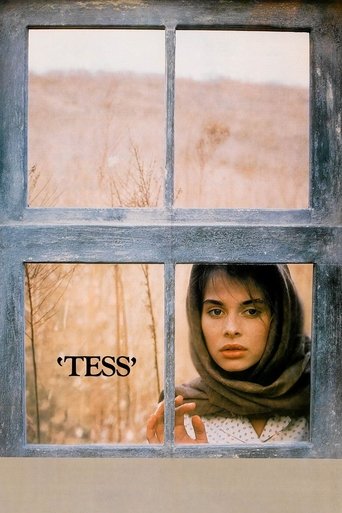

Posters via The Movie Database (TMDB)
- Virginia Woolf, novelist & critic, 1882–1941: "If we are to place Hardy among his fellows, we must call him the greatest tragic writer among English novelists."
- Roman Polanski, filmmaker, b. 1933: "It's one of the greatest novels ever written. It's a great love story."
- D.H. Lawrence, novelist & critic, 1885–1930: An early champion of Hardy who devoted a book-length study to the tragic life-force surging beneath the Wessex novels.
- Sharon Tate, actress, 1943–1969: Gave Polanski the novel and urged him to film it; he made Tess in 1979 and dedicated it to her.