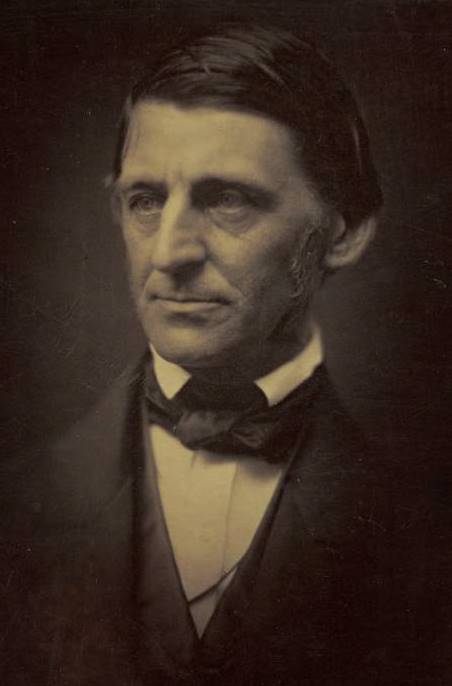
Ralph Waldo Emerson
1803–1882 · United States
“A foolish consistency is the hobgoblin of little minds.”
Peak-work percentile in the canon.
The lineage through Ralph Waldo Emerson
Drew From(5)
who shaped Ralph Waldo Emerson
- The book the young Emerson read and felt "as if he had himself written" — the kinship that shaped his voice
- Montaigne's habit of trusting his own mind over inherited authority is the skepticism Self-Reliance turns into a creed
- Emerson named Montaigne directly in his "Montaigne; or, the Skeptic" — read the Essays first to see where Emerson's confidence in the self was born
via Paradise Lost
- Emerson names Milton outright in Self-Reliance — one of the trio (with Moses and Plato) he holds up as a man who set books and traditions at naught and trusted his own thought
- Paradise Lost is the work that earned Milton that place: the great act of one mind composing its own cosmos
- Read it first and you see what Emerson is pointing at — self-reliance isn't a slogan here, it's Milton's whole posture
via The Republic
- Emerson's idealism — the world as a veil over eternal forms — is Plato refitted for nineteenth-century America
- Self-Reliance names him outright, and Emerson read The Republic as one of the few books worth setting all other books aside for
- Read Plato first and Nature's shimmering metaphysics stops feeling like mysticism — it's the cave allegory, transplanted
via Plutarch's Lives
- When Emerson reaches for a measure of the self-reliant great man, he reaches for "Plutarch's heroes" — the Lives were his lifelong bible for heroes
- Self-Reliance invokes "Plutarch's age" as its benchmark for greatness; the ancient biographies are the standard Emerson is holding the modern individual against
- Read Plutarch first and you hear exactly what Emerson means by a life worth admiring
- Emerson's most provocative lines are Exodus inverted — "write on the lintels of the door-post, Whim" is a deliberate, irreverent flip of the blood-on-the-doorpost command from Exodus 12
- He twists the holy-ground moment too, turning "take the shoes from off their feet" into proof that the divine is within, not above
- Self-Reliance needs the scripture standing behind it: the shock lands only once you hear the sacred original he's overwriting
Inspired(1)
who Ralph Waldo Emerson shaped
- This is the program; Walden is the experiment that runs it
- Emerson laid out the doctrine — trust yourself, find the divine in nature — and his protégé Thoreau went to the woods to live it out
- Thoreau built his cabin on land Emerson owned; the philosophy and the man were that close
Portraits
The most-reproduced portrait photograph of Emerson, by the famous Boston daguerreotypists Southworth & Hawes (George Eastman House collection) — the steady, side-lit head everyone associates with the mature essayist.
Southworth & Hawes, 1857
Three-quarter charcoal portrait of Emerson at 43, hair already thinning, gaze set above the viewer.
Eastman Johnson, 1846
Famous Quotes
“A foolish consistency is the hobgoblin of little minds, adored by little statesmen and philosophers and divines.”
“Trust thyself: every heart vibrates to that iron string.”
“To be great is to be misunderstood.”
“I become a transparent eyeball; I am nothing; I see all.”
About Ralph Waldo Emerson
American essayist, lecturer, philosopher, and poet who led the transcendentalist movement. His essays Nature and Self-Reliance championed individualism, nonconformity, and the divinity of the natural world. He mentored Thoreau and Whitman, and his optimistic vision of human potential helped define American intellectual identity.