Read this if you…
- like the idea of flying to heaven on a giant dung beetle
- are trying to read every single play of Aristophanes, because this one is pretty weak
Skip this if you…
- haven't read every other greek play already
The  Take
Take
This one was pretty meh, and a little too on the nose. The only good part was flying on the dung beetle. I guess it’s interesting to see even then hating war and the military industrial complex basically, but not that funny compared to some other Aristophanes I have read
The lineage through Peace
- The Iliad by Homer. Peace built on it. - Aristophanes assumes you know your Homer — *Peace* names him twice and quotes the *Iliad* outright - Trygaeus wields a line of Homer's against the warmongers, while a soldier's son recites the epic's militaristic verses to show war still owns the young imagination - The *Iliad* behind you, the comedy's tug-of-war over Homer's legacy — peace vs. war, both claiming the poet — lands as the joke Aristophanes meant
Depicted in Art
Greek title page reading 'Aristophanous komodiai ennea' — the first printed edition of Aristophanes' nine comedies, with Peace listed among them, in Venetian Greek type.
Aldus Manutius (printer); Markos Mousouros (editor), 1498
A double-headed marble herm: Aristophanes facing one direction, Menander the other — the masters of Old and New Comedy joined back-to-back as a single sculptural object.
The stone semicircle of seats and orchestra of the Theatre of Dionysus on the south slope of the Acropolis, the actual ancient venue where Peace took second prize at the Dionysia of 421 BC.
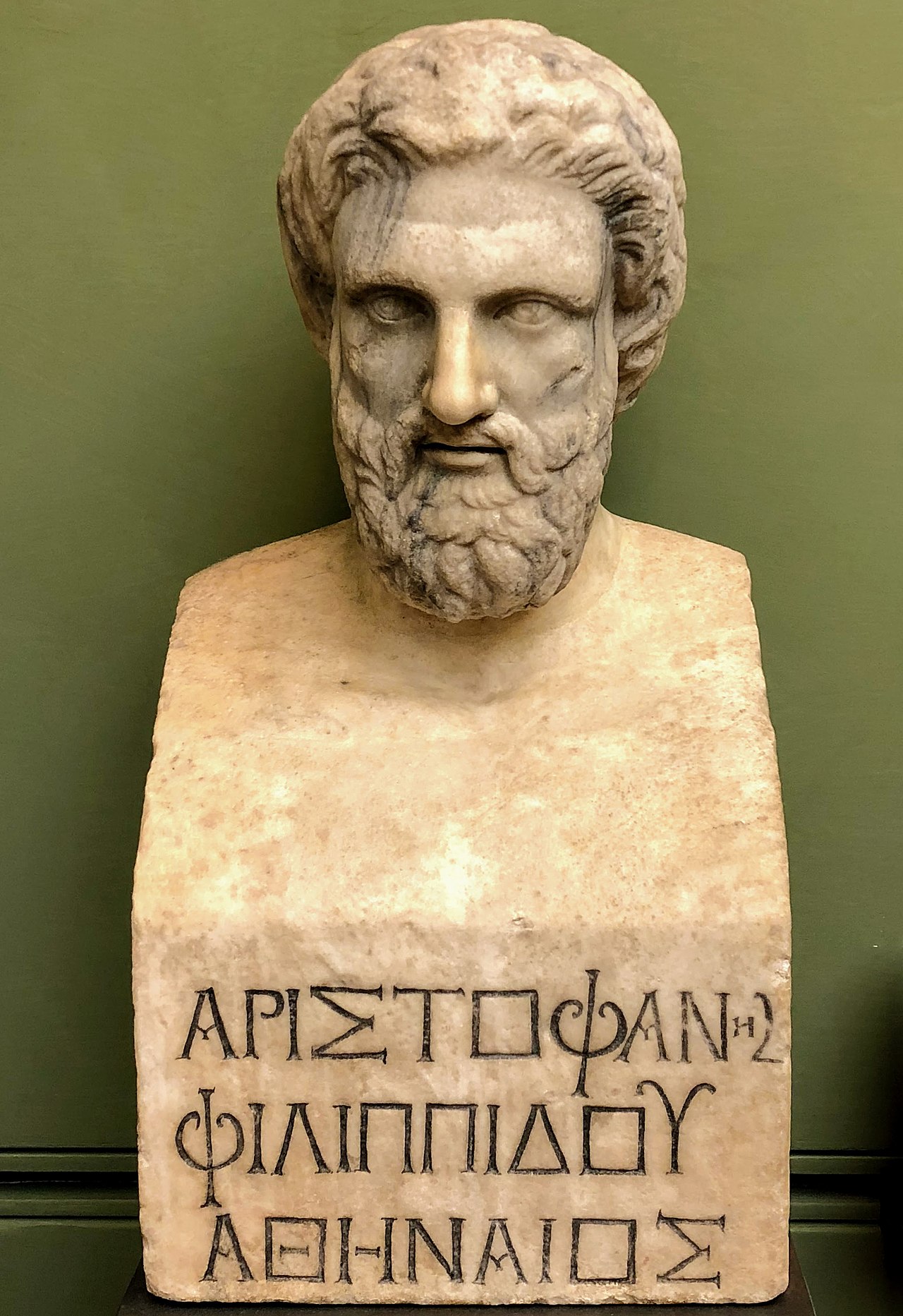
A bearded marble head of Aristophanes mounted on a herm, mouth slightly open as if mid-speech; inscribed in Greek 'Aristophanes, son of Philippides, the Athenian'.
Engraved marble bust of the comic poet Aristophanes
Recommended Editions

Jeffrey Henderson
Harvard University Press · 1998
Henderson's Loeb edition, facing-page Greek. For a comedy this dense with Athenian politics, having the leading Aristophanes scholar of the generation walking you through it is the difference between getting the jokes and not.
Please support us by purchasing through these links, at no extra cost to you!
Notable Quotes
Gently, gently, go easy, beetle; don't start off so proudly, or trust at first too greatly to your powers; wait till you have sweated, till the beating of your wings shall make your limb joints supple. Above all things, don't let off some foul smell. I adjure you; else I would rather have you stay right in the stable.
Screen & Stage
 loose
looseDer Frieden
Stage · 1962
Peter Hacks / Benno Besson
Posters via The Movie Database (TMDB)
More by Aristophanes
- 22The Clouds423 BCAristophanesHard·Quick·89 pagesInfluence68Popularity4Ancient GreeceComedyAncient Greek
- 121Wasps422 BCAristophanesHard·Quick·91 pagesInfluence25Popularity2Ancient GreeceComedyAncient Greek
- 126Lysistrata411 BCAristophanesHard·Quick·79 pagesInfluence66Popularity52Ancient GreeceComedyAncient Greek
- 136The Frogs405 BCAristophanesHard·Quick·114 pagesInfluence68Popularity4Ancient GreeceComedyAncient Greek
- 169The Acharnians425 BCAristophanesHard·Quick·75 pagesInfluence24Popularity2Ancient GreeceComedyAncient Greek
- 198The Birds414 BCAristophanesHard·Quick·104 pagesInfluence26Popularity3Ancient GreeceComedyAncient Greek
- 200Peace421 BCAristophanesHard·Quick·80 pagesInfluence24Popularity2Ancient GreeceComedyAncient Greek