
Read this if you…
- want to read Aristophanes talk about Aeschylus and Euripides
- like Dionysus (the party/theater god) as a character
- want to explore what the point of art/poetry is/should be
Skip this if you…
- haven't read Aeschylus or Euripides (they are main characters)
The  Take
Take
Second favorite Aristophanes after the clouds. Team Aeschylus all the way. The slave and Dionysus switching scene was great and the debate between Euripedes and Aeschylus was great
The lineage through The Frogs
- Medea by Euripides. The Frogs built on it. *The Frogs* sends Dionysus to the underworld to judge a contest between the long-dead Aeschylus and the freshly-dead Euripides for the throne of tragedy. Aristophanes parodies Euripides without mercy — the fussy prologues, the talky realism, the boundary-pushing voice behind heroines like *Medea*. Euripides loses to Aeschylus, but the joke only lands because the audience could recite *Medea* from memory.
- The Oresteia by Aeschylus. The Frogs built on it. - Aristophanes resurrects Aeschylus to defend the *Oresteia* in person - The *Frogs*' great poetry contest turns on it — Euripides cross-examines the trilogy's prologue word for word, and the play's torchlight finale mirrors the *Oresteia*'s - Reading Aeschylus first lets the joke land: you have to know the grandeur being put on trial to enjoy watching it defend itself
- The Persians by Aeschylus. The Frogs built on it. - When Aristophanes wants to caricature Aeschylean gravity, he reaches straight for *The Persians* - Dionysus parodies its dirge over the dead Darius, the chorus's wailing and all — the joke only lands if you've felt how heavy that lament is - Aeschylus's own boast here, that *The Persians* made Athens hungry for victory, is quoted back to him in the poets' contest
- The Iliad by Homer. The Frogs built on it. - The poetry contest at the heart of *The Frogs* runs on Homer: Aeschylus claims his spirit "took its impress from Homer" and lists the heroes he dramatized - Aristophanes parodies Homeric verse directly — the contest amalgamates passages from the *Iliad* — and patterns the whole scene on the legendary Contest of Homer and Hesiod - The jokes land harder with the *Iliad* behind you: *The Frogs* assumes you already know the epic it's measuring its tragedians against
- Theogony/Works and Days by Hesiod. The Frogs built on it. - When *The Frogs* draws up its roll-call of poets who actually did the world good, Aeschylus names Hesiod and praises *Works and Days* for teaching the farmer's calendar - The play's central agon — two poets weighed against each other — is built on the old Contest of Homer and Hesiod tradition - Knowing Hesiod first lets you hear the reverence under the comedy: this is what Aristophanes thinks a useful poet looks like
Depicted in Art
Greek title page reading 'Aristophanous komodiai ennea' — the first printed edition of Aristophanes' nine comedies, with Peace listed among them, in Venetian Greek type.
Aldus Manutius (printer); Markos Mousouros (editor), 1498
A masked, costumed comic actor playing Xanthias stands beside a small statuette of Heracles set on a column.
Seated Nike Painter, -340
Cast in costume staging Aristophanes' Frogs in an open ravine on the Trinity College grounds in Toronto.
C. B. Kenrick, 1902
Stylised Art Nouveau frogs arranged as a theatrical poster motif for a London production of Aristophanes' comedy.
Leon Solon, 1896
Byzantine manuscript folio carrying the Greek text of The Frogs surrounded by dense marginal scholia.
1362
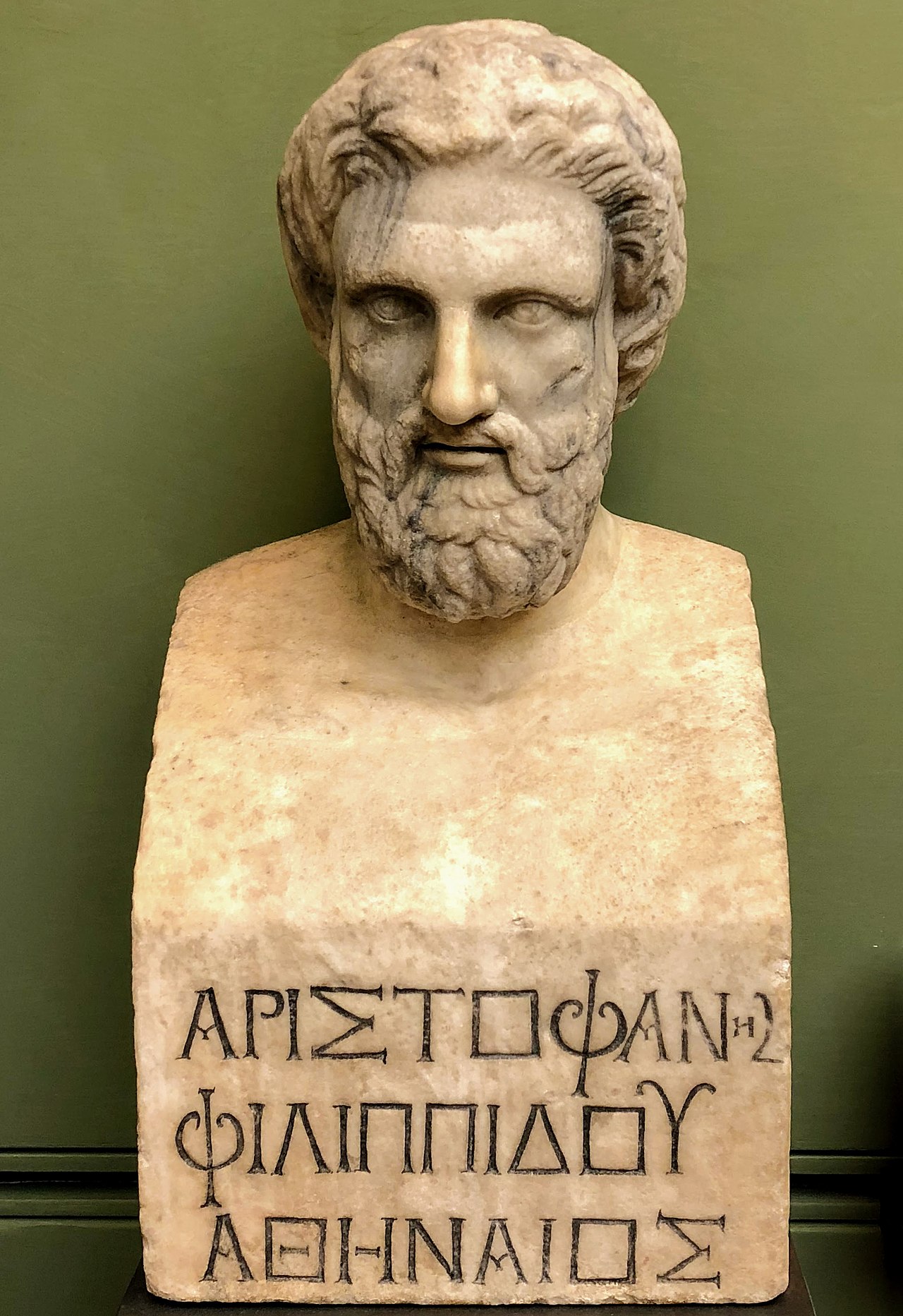
Engraved marble bust of the comic poet Aristophanes
Recommended Editions
Peter Meineck
Hackett Publishing · 1998
Meineck makes Dionysus and Xanthias work as a comic pair, and the contest between Aeschylus and Euripides still gets laughs in English. Built to be spoken, which is what Frogs needs.
Please support us by purchasing through these links, at no extra cost to you!
Notable Quotes
Brekekekex koax koax!
Screen & Stage
 loose
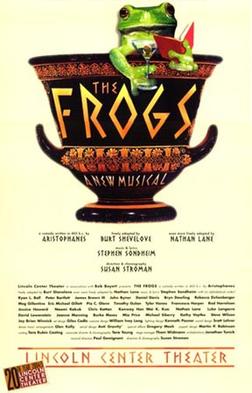
looseThe Frogs
Stage · 2004
Stephen Sondheim, Nathan Lane
Posters via The Movie Database (TMDB)
- Plato (attributed), philosopher, c. 428–348 BCE — epigram traditionally ascribed to him: The Graces, seeking a shrine that would not fall, found the soul of Aristophanes.
- Heinrich Heine, German poet & essayist, 1797–1856: "The most harrowing forms of human madness Aristophanes exhibits only in the laughing mirror of wit."
- Stephen Sondheim, composer and lyricist, 1930-2021: Turned Aristophanes' Frogs into a musical — Dionysos descends to the underworld to retrieve a playwright who might save civilization.
- Nathan Lane, actor and playwright, 1956-: Revised the book and starred as Dionysos in the 2004 Broadway production, recasting it as a crisis comedy about saving civilization.
More by Aristophanes
- 22The Clouds423 BCAristophanesHard·Quick·89 pagesInfluence68Popularity4Ancient GreeceComedyAncient Greek
- 121Wasps422 BCAristophanesHard·Quick·91 pagesInfluence25Popularity2Ancient GreeceComedyAncient Greek
- 126Lysistrata411 BCAristophanesHard·Quick·79 pagesInfluence66Popularity52Ancient GreeceComedyAncient Greek
- 136The Frogs405 BCAristophanesHard·Quick·114 pagesInfluence68Popularity4Ancient GreeceComedyAncient Greek
- 169The Acharnians425 BCAristophanesHard·Quick·75 pagesInfluence24Popularity2Ancient GreeceComedyAncient Greek
- 198The Birds414 BCAristophanesHard·Quick·104 pagesInfluence26Popularity3Ancient GreeceComedyAncient Greek
- 200Peace421 BCAristophanesHard·Quick·80 pagesInfluence24Popularity2Ancient GreeceComedyAncient Greek