

Read this if you…
- want unbelievably dirty/sexual/trashy/degenerate plots
- are okay with a fragmentary text — only the middle survives (but the stories within are nuts)
Skip this if you…
- don't like dirty content - this one is seriously degenerate material
- need a complete book (only fragments survive)
The  Take
Take
Totally bonkers, crazy dude, pretty funny stuff
The lineage through The Satyricon
- The Odyssey by Homer. The Satyricon built on it. - The *Satyricon* is a mock-epic, and the *Odyssey* is the thing it mocks - Encolpius is the anti-Odysseus: hounded not by Poseidon but by the wrath of Priapus, washing up among con men instead of monsters, meeting a temptress named Circe - Read Homer first and every parody lands — the *Satyricon* assumes you know the grandeur it's deflating
- The Symposium by Plato. The Satyricon built on it. - Trimalchio's feast is a parody, and the *Symposium* is the thing it's parodying - Petronius models Habinnas's late, drunken intrusion on Alcibiades crashing Plato's banquet — knowing the original makes the joke land - Read Plato's elegant drinking party first and the *Satyricon*'s squalid one reads as deliberate desecration, not just chaos
Depicted in Art
Trimalchio, the bloated freedman, sprawls in the bath surrounded by slaves and attendants after his banquet.
Norman Lindsay, 1922
The widow of Ephesus, abandoning her vigil at her husband's tomb, embraces the soldier who has seduced her in the crypt.
Norman Lindsay, 1922
A scene from Trimalchio's dinner party — diners reclining as the host's grotesque entertainments unfold.
Norman Lindsay, 1922
A scene from the Satyricon — a louche moment of the novel's wandering, dissolute trio.
Georges-Antoine Rochegrosse, 1902
Another scene from the Satyricon's picaresque sequence as illustrated for the Tailhade edition.
Georges-Antoine Rochegrosse, 1902
Encolpius and Giton, the novel's young protagonists, in a Roman street scene.
Georges-Antoine Rochegrosse, 1902
The widow yields to the soldier with a kiss in her husband's burial chamber.
Wenceslas Hollar, 1666
Recommended Editions
Sarah Ruden
Hackett Publishing · 2000
Ruden's Petronius is loud, vulgar, and unembarrassed, which is exactly the register the Latin asks for. Trimalchio's feast lands as both funny and grotesque, the way it apparently did in Nero's Rome.
Please support us by purchasing through these links, at no extra cost to you!
Notable Quotes
For with my own eyes at Cumae I saw the Sibyl hanging in a bottle, and when the boys said to her: 'What do you want, Sibyl?' she replied: 'I want to die'.
Screen & Stage
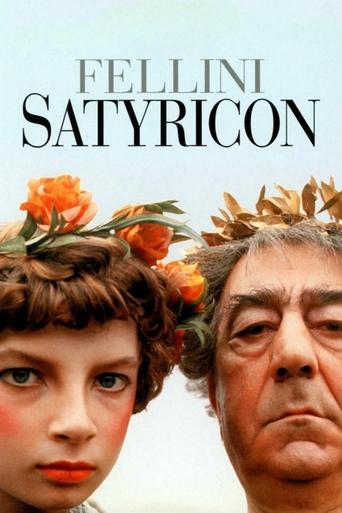
Posters via The Movie Database (TMDB)
- Tacitus, Roman historian, c. 56–120 CE: "Nero thought nothing charming or elegant in luxury unless Petronius had given it his approval."
- Federico Fellini, Italian filmmaker, 1920–1993: Fellini conceived his Satyricon as 'science fiction of the past' — examining ancient Rome like a documentary about Martians.
- Gore Vidal, novelist & essayist, 1925–2012: "My origins are in Petronius and Apuleius, two writers no American journalist has ever read."