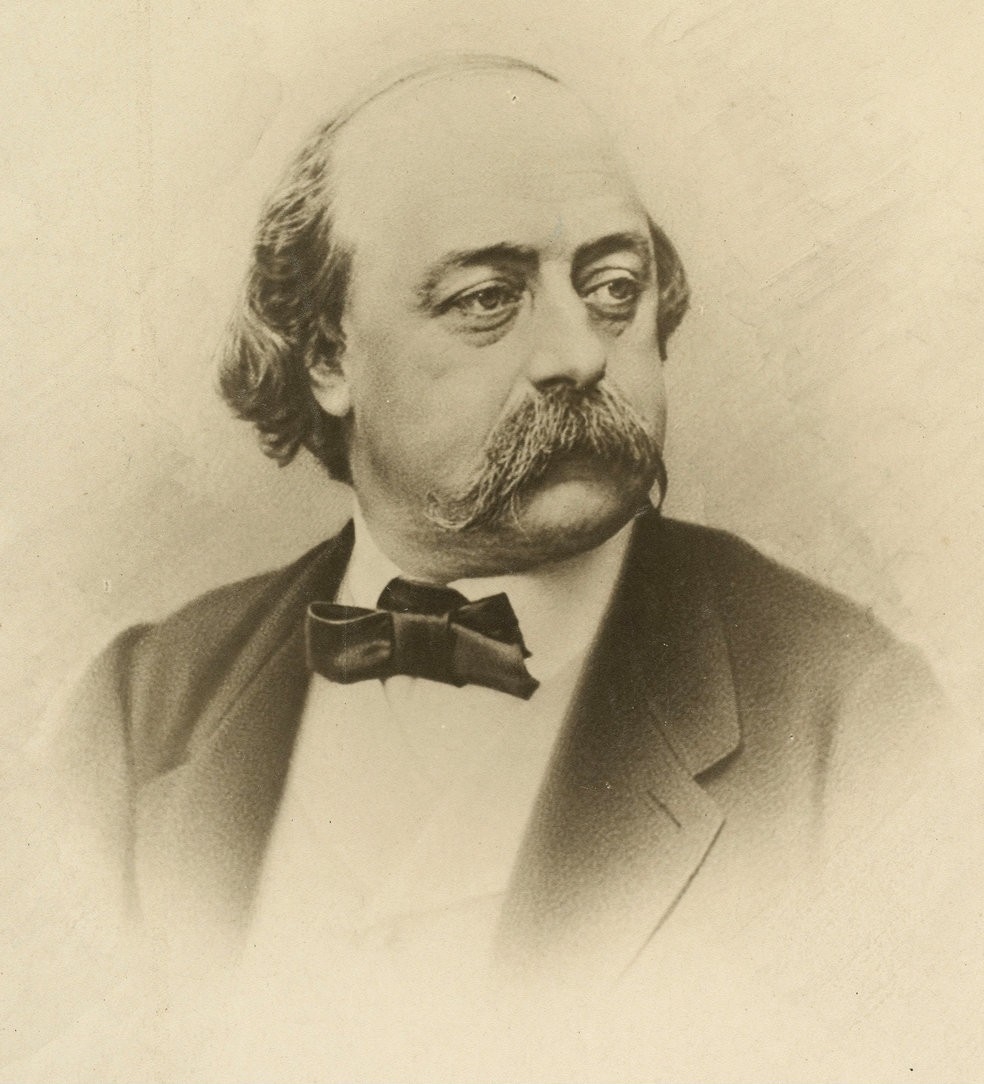
Gustave Flaubert
1821–1880 · France
“Human speech is like a cracked kettle on which we tap crude rhythms for bears to dance to, while we long to make music that will melt the stars.”
Peak-work percentile in the canon.
The lineage through Gustave Flaubert
Drew From(2)
who shaped Gustave Flaubert
via Don Quixote
- Madame Bovary descends straight from Don Quixote — Flaubert knew it by heart before he could read, and called it the book he found his origins in
- Cervantes' great subject — a mind ruined by the wrong books — is Emma's whole tragedy, the romances of chivalry swapped for the romances of love
- A full study (Soledad Fox Maura's Flaubert and Don Quijote) traces the direct shaping; reading the Don first reveals the bloodline behind Emma's delusion
- A Sentimental Education applies Voltaire's anatomy of human stupidity within Flaubert's realist register — he read Candide roughly a hundred times and called it one of his "sacred books"
- Voltaire's bêtise, sped through a picaresque, becomes Frédéric's slow drift through a real and disappointing world
- Read Candide first and the ending lands harder: "cultivate your garden" is the bright original that Flaubert dims into resignation
Inspired(3)
who Gustave Flaubert shaped
- Ford Madox Ford called this the supreme novel — he claimed you had to read A Sentimental Education fourteen times to grasp it, and he could recite whole sections from memory
- He preferred Flaubert's frustrated, sidelong story of passion here to Madame Bovary — and built The Good Soldier in its image
- Flaubert's oblique method, never stating the feeling head-on, became the blueprint for Ford's English impressionism a generation later
via Anna Karenina
- The adultery novel Tolstoy answered back — he owned a copy bound together with Othello, the two filed under the same question
- He wrote his wife in 1892 that Madame Bovary "has great merits and is, not without reason, famous"
- Scholars read Anna Karenina as a deliberate polemic with Flaubert: the same fall, judged on entirely different terms
via Buddenbrooks
- Buddenbrooks is Flaubert's style crossing into German: Mann enters his characters' minds with the affective exposition and recurring leitmotif he learned from Madame Bovary, transplanted to a North-German merchant world.
- Tony Buddenbrook is the explicit counterpart to Emma Bovary, a woman undone by marriages she did not choose, though Mann grants her irony and survival where Flaubert offered Emma only the clinical cruelty of the trap.
Famous Quotes
“human speech is like a cracked tin kettle, on which we hammer out tunes to make bears dance when we long to move the stars.”
“She wanted to die, but she also wanted to live in Paris.”
“She wished at the same time to die and to live in Paris.”
“Yes, perhaps. That was the best time we ever had.”
About Gustave Flaubert
French novelist whose obsessive pursuit of le mot juste (the perfect word) made him a pioneer of literary realism. Madame Bovary, his masterpiece, was prosecuted for obscenity upon publication. He lived a reclusive life devoted entirely to his art, spending weeks perfecting single pages, and his exacting standards influenced every serious novelist who followed.
Gustave Flaubert, Ranked
According to