
Read this if you…
- want the most famous Greek tragedy, full stop
- love poetic irony
- loved the movie oldboy (the korean one)
- like really horrific, fucked up plots
Skip this if you…
- need a happy ending
- don't like disgusting/horrible things happening
The  Take
Take
Classic book about fate and horror undeserved. Free will vs destiny, and why he had the worst god damn luck. How quickly things can change
The lineage through Oedipus Rex
- The Seven Against Thebes by Aeschylus. Oedipus Rex built on it. - The Theban stage was Aeschylus's before it was Sophocles's — *Seven Against Thebes* (467 BCE) predates *Oedipus Rex* by nearly forty years - Sophocles drew on Aeschylus's Theban plays in shaping his own cycle; reading the elder version first shows you the inherited material he was reworking - The earlier treatment of the doomed house behind Sophocles's masterpiece
- The Odyssey by Homer. Oedipus Rex built on it. - The Oedipus myth's earliest written form is in the *Odyssey* (Book 11, Epicaste in the underworld) — Sophocles dramatized a story Homer had already fixed in writing - Tiresias, the blind seer who knows the truth Oedipus can't bear, comes straight out of Homer's Nekyia - Reading the *Odyssey* first shows you the raw myth before Sophocles turned it into a tragedy of a man uncovering himself
- Poetics by Aristotle. Oedipus Rex shaped it. - When Aristotle defines the perfect tragedy in the *Poetics*, *Oedipus Rex* is the play he reaches for again and again as his example - Its great hinge — the moment recognition and reversal strike at once, as Oedipus learns who he is and is destroyed by knowing — is Aristotle's textbook case of ideal plot construction (Ch. 11) - Sophocles wrote the drama; Aristotle, a generation later, turned it into the standard every tragedy after would be measured against
- The Interpretation of Dreams by Sigmund Freud. Oedipus Rex shaped it. - A 2,300-year-old tragedy gave a 20th-century theory its name - Freud saw *Oedipus Rex* staged in the 1880s and 90s, and the play's grip on him became the seed of "the Oedipus complex" - In *The Interpretation of Dreams* he names the play, quotes it — "It is the fate of all of us..." — and argues its power proves the desire is universal
Depicted in Art
The Sphinx leaps onto Oedipus's chest with claws extended, eye to eye; a king's crown and a corpse's foot lie below them as Oedipus stares back unflinching.
Gustave Moreau, 1864
A dying Oedipus raises his sightless face skyward, hands clasped, as Antigone and Ismene weep at his side just before his mysterious end at Colonus.
Bénigne Gagneraux, 1784
The blind, white-bearded Oedipus thrusts out his arm to curse the cowering Polynices; Antigone and Ismene try to restrain him.
Henry Fuseli, 1786
A nude Oedipus leans forward calmly to answer the riddle of the Sphinx, who crouches in shadow in a rocky pass; a discarded foot of an earlier victim lies at the lower edge.
Jean-Auguste-Dominique Ingres, 1808
Antigone leads the blind Oedipus by the hand through a barren landscape, his staff in his other hand, both barefoot exiles bound for Colonus.
Aleksander Kokular, 1825
The newly blinded Oedipus, blood on his face, gropes his way out of the palace as horrified Thebans recoil; based on the actor Mounet-Sully in the role.
Pierre-Auguste Renoir, 1895
Antigone in white drapery leads her blind father gently along a rocky path, Oedipus's bowed head and outstretched staff catching the light.
Christoffer Wilhelm Eckersberg, 1812
Oedipus strikes down the old king Laius at the crossroads where three roads meet, the moment of the unwitting parricide that drives the play's revelation.
Joseph Blanc
Oedipus turns away from Jocasta's hanged body slumped on the bed as their children cling to him; the moment immediately after the catastrophe is discovered.
Alexandre Cabanel, 1843
Recommended Editions

Robert Fagles
Penguin Classics · 1982
The Three Theban Plays volume puts Oedipus Rex alongside Antigone and Oedipus at Colonus, with Knox's introduction as the through-line. Fagles's version works read aloud, which matters for a play, and the recognition scene still hits clean.
Please support us by purchasing through these links, at no extra cost to you!
Notable Quotes
Count no man happy till he dies, free of pain at last.
Screen & Stage
 loose
looseOldboy
Film · 2003
Park Chan-wook
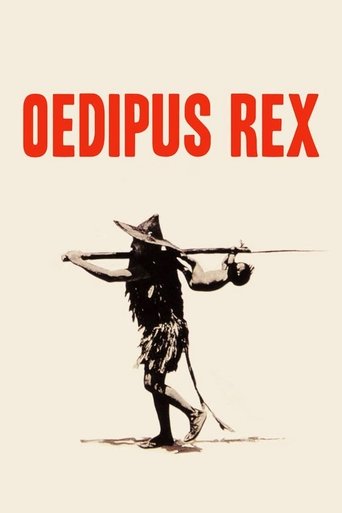
Oedipus Rex
Film · 1967
Pier Paolo Pasolini

Oedipus rex
Opera · 1927
Igor Stravinsky
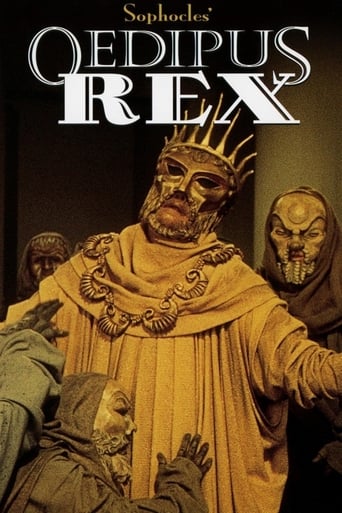
Oedipus Rex
Film · 1957
Tyrone Guthrie
Posters via The Movie Database (TMDB)
- Sigmund Freud, founder of psychoanalysis, 1856–1939: "His destiny moves us only because it might have been ours."
- Aristotle, Greek philosopher, 384–322 BCE: "The best form of recognition is coincident with a Reversal of the Situation, as in the Oedipus."
- Samuel Taylor Coleridge, English Romantic poet & critic, 1772–1834: "Upon my word, I think the Oedipus Tyrannus, the Alchemist, and Tom Jones the three most perfect plots ever planned."
- Friedrich Nietzsche, German philosopher, 1844–1900: "Sophocles understood Oedipus as the noble man who, in spite of his wisdom, is destined to error and misery."
- Pier Paolo Pasolini, Italian filmmaker & poet, 1922–1975: "That is the thing in Sophocles that inspired me the most: the contrast between total innocence and the obligation to know."
- Bernard Knox, Anglo-American classicist, 1914–2010: Oedipus the King is the dramatic masterpiece of the Greek theatre.

More by Sophocles
- 10Oedipus Rex~429 BCSophoclesHard·Quick·79 pagesInfluence94Popularity68Ancient GreeceTragedyAncient Greek
- 73Antigone441 BCSophoclesHard·Quick·75 pagesInfluence86Popularity68Ancient GreeceTragedyAncient Greek
- 144Oedipus at Colonus401 BCSophoclesHard·Quick·132 pagesInfluence30Popularity7Ancient GreeceTragedyAncient Greek
- 149Philoctetes409 BCSophoclesHard·Quick·94 pagesInfluence28Popularity6Ancient GreeceTragedyAncient Greek
- 151Women of Trachis~450 BCSophoclesHard·Quick·68 pagesInfluence28Popularity5Ancient GreeceTragedyAncient Greek
- 153Ajax~440 BCSophoclesHard·Quick·79 pagesInfluence29Popularity6Ancient GreeceTragedyAncient Greek
- 187Electra~410 BCSophoclesHard·Quick·84 pagesInfluence30Popularity6Ancient GreeceTragedyAncient Greek