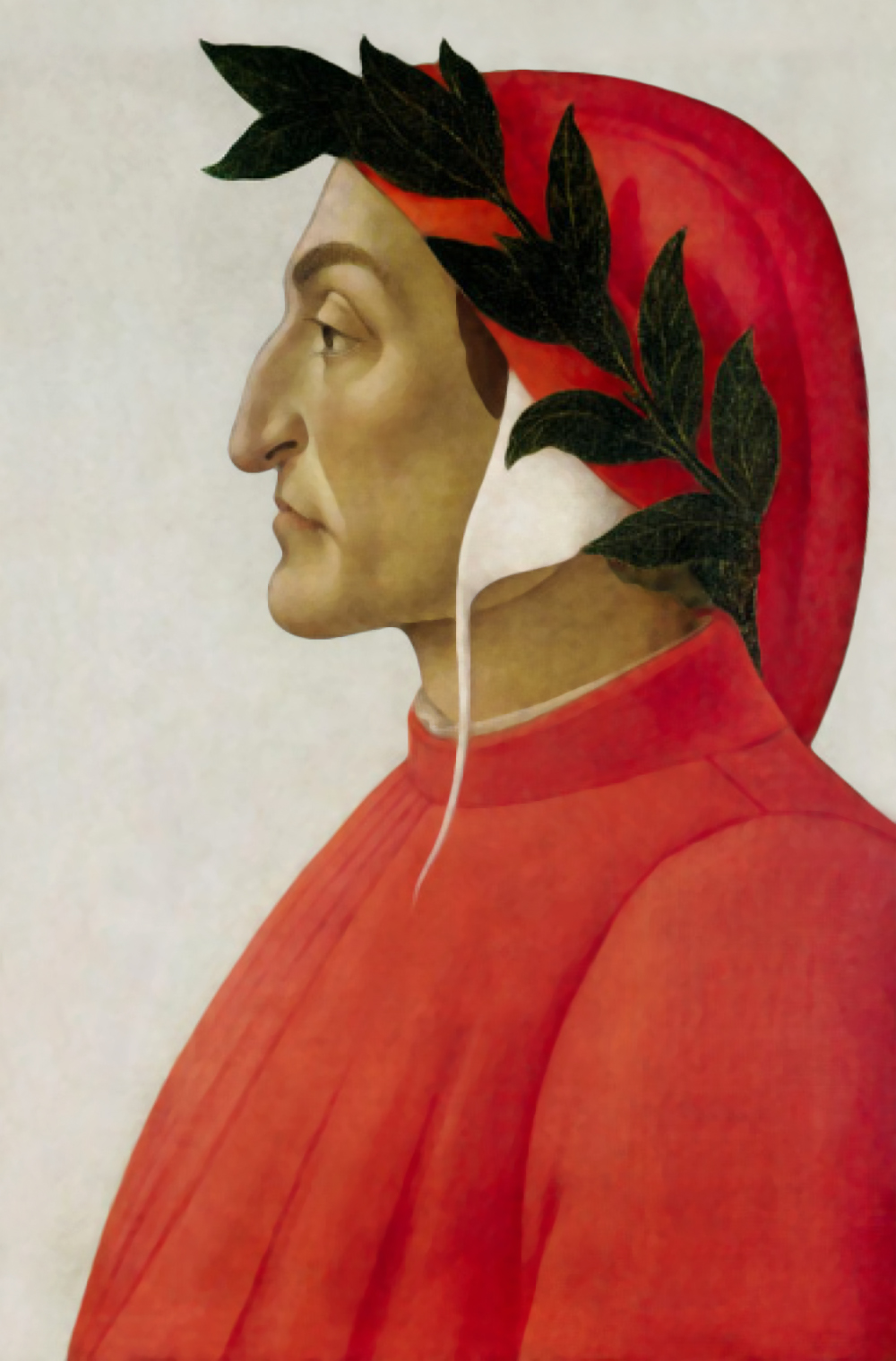
Dante Alighieri
1265–1321 · Italy
“Abandon all hope, ye who enter here.”
Peak-work percentile in the canon.
The lineage through Dante Alighieri
Drew From(11)
who shaped Dante Alighieri
via The Aeneid
- Virgil isn't just an influence here — he's a literal character, Dante's guide through two-thirds of the journey
- Dante names him lo mio maestro e 'l mio autore and used the Aeneid as the base for the Comedy's underworld, its history, and its mythology
- Read the Aeneid first and you'll recognize the architecture Dante is standing on — the descent among the dead, reimagined as a Christian afterlife
via Metamorphoses
- Ovid is everywhere in Dante — after Virgil, no poet feeds the Comedy more, and Dante seats him in Limbo with the greats (Inferno IV)
- Inferno XXV's thieves-into-serpents is Dante competing with Ovid directly, claiming to surpass the Metamorphoses' transformations
- Read Ovid first and you'll hear the contest: Dante didn't just borrow the art of metamorphosis, he set out to beat its master
- Dante read the Consolation in grief after Beatrice died, and it shows: the figure who guides and instructs the sufferer is Boethius's invention before it's Virgil or Beatrice
- He names Boethius directly, setting him among the blessed in the Heaven of the Sun (Paradiso X)
- Read it first and the Commedia's whole architecture — a troubled soul led through ascending instruction toward truth — reveals its template
- Dante's Hell isn't arranged by whim — it's Aristotle's Ethics turned into geography
- In Inferno 11, Virgil stops to explain the architecture and cites the Ethics (Book VII) outright: incontinence, malice, and bestiality, ranked into the descending circles
- Read the relevant pages of Aristotle first and the whole structure of the Inferno clicks — you'll see why the lustful suffer less than the violent, and the fraudulent less than the traitors
- Before Dante's ascent comes Paul's — the mystic caught up to the third heaven of 2 Corinthians 12
- Dante invokes him by name at the threshold: "I am not Aeneas, I am not Paul" — the two men who went and came back
- Reading Paul first shows you the seed of the Paradiso's whole architecture: the hierarchy of heavens, the vision a living man isn't supposed to survive
via Revelation
- The Earthly-Paradise pageant in Purgatorio 29 is built point-for-point on John's Revelation — the seven candlesticks, the twenty-four elders, the four winged beasts
- Scholars call the scene "unintelligible without knowledge of the Apocalypse"; the celestial rose of Paradiso draws on the same vision
- Read Revelation first and Dante's strangest pageant decodes itself — every figure in the procession is a citation
- When Virgil explains the structure of Hell in Inferno Canto 11, he's reciting Cicero
- The violence-versus-fraud division that organizes the lower circles comes straight from De Officiis I.xiii.41 — "injustice by force or by fraud, fraud the more hateful"
- Dante steeped himself in Cicero — De Amicitia, De Officiis, the Somnium Scipionis — and his moral system is Roman Stoicism turned Christian; reading Cicero first shows you the scaffolding under the poetry
via 2 Maccabees
- Purgatory itself stands on 2 Maccabees — Dante's entire mechanism of the living praying for the dead traces to 2 Macc 12:43-46
- Heliodorus, beaten by a horseman for robbing the temple, surfaces in Purgatorio XX as an exemplum of avarice; reading the source scene first makes Dante's shorthand land
- One of the lesser-read books behind the Comedy — but the one that justified Dante's middle realm existing at all
- When Eden's procession arrives in Purgatorio XXIX, Dante stops to name his source — "read Ezekiel" — and models the four winged creatures on Ezekiel 1
- The chariot vision "by Chebar's flood" is the template for the Comedy's strangest pageant
- Reading Ezekiel first gives you the picture Dante assumes you already have; he diverges from it on just one detail (the number of wings, following Revelation)
- The Psalms aren't background in the Comedy — they're sung aloud as Dante climbs, the Miserere and the Asperges me the literal voice of penitence in Purgatorio
- Dante singled out one above all: in his Letter to Cangrande he names Psalm 114, "In exitu Israel," as the template for how his whole poem means on four levels at once
- Know the Vulgate Psalms and Purgatory stops being silent — you hear what the souls are chanting and why Dante built his method on it
via Confessions
- Dante's ascent from the dark wood to the beatific vision runs on the arc Augustine pioneered: error, grace, reformation, told from inside the soul
- The Confessions is the master pattern here — the first-person conversion story, the reading-to-redemption movement that Beatrice completes in Dante what a flawed text begins
- Read alongside the Aeneid it stands behind the whole poem: Virgil supplies the underworld, Augustine supplies the converting self that walks through it
Inspired(9)
who Dante Alighieri shaped
via Dead Souls
- Gogol planned Dead Souls as a Russian Divine Comedy — three parts mapped onto Inferno, Purgatorio, and Paradiso
- The novel we have is the Inferno: a gallery of damned provincial landowners, a catalog of vice with no redeemed soul in sight
- He wrote it in Rome with Dante's trilogy before him, looking to the Commedia for the moral arc he meant to complete
- Chaucer read his Dante closely — and named him for it
- The Monk's Tale lifts the starving Ugolino straight out of Inferno XXXIII, crediting "the grete poete of Ytaille / That highte Dant"; Dante surfaces again in the Wife of Bath's and Friar's Tales
- The House of Fame goes further, parodying the Commedia's very architecture — the surest sign a poet has absorbed a book is that he can play with it
via The Decameron
- Boccaccio copied the Commedia out by hand, wrote Dante's biography, and lectured on the poem publicly — he's the man who first called it "Divine"
- His Decameron is built as the earthbound mirror: 100 tales answering Dante's 100 cantos, a "human comedy" beside the sacred one
- Where Dante climbs from Hell to Heaven, Boccaccio stays among the living — the architecture is borrowed, the subject deliberately worldly
via Canzoniere
- Dante's vernacular masterpiece showed Petrarch that serious poetry could be written in Italian, not Latin — the spark behind the Canzoniere
- Petrarch took up Dante's terza rima for his Triumphs
- The relationship was charged: in a letter (Familiares 21.15) Petrarch felt the need to disclaim any jealousy of his great predecessor
via Middlemarch
- Eliot read Dante in the original Italian, and the Comedy runs under Middlemarch as a recurring figure for moral growth earned through suffering
- Chapter 19 — the start of Dorothea's Roman honeymoon — opens with an epigraph from Purgatorio VII, the slothful soul resting cheek on palm
- Click through to see Dante set beside Eliot's other chapter-heads (Shakespeare, Donne, Milton, Chaucer), the company she builds her novel from
- Dante's Inferno is the architecture Conrad reaches for when realism runs out
- Marlow names the grove where the dying crawl off "the gloomy circle of some Inferno" — a Congo descent borrowing Dante's geography of the damned
- The structure carries: critics from Feder onward map Marlow's journey upriver onto Dante's circles of Hell
via The Jungle
- Sinclair turns Packingtown into a modern Inferno — and names Dante to make sure you can't miss it
- The fertilizer workers leaving Durham's "looked like Dante, of whom the peasants declared he had been into hell"
- Jurgis's ruin reads as a descent through the circles: the Comedy gives the stockyards a measure of damnation no muckraking report could
via Faust, Part Two
- The Comedy doesn't just end with Heaven — it ends with a soul carried upward through graded spheres of light toward a feminine intercessor, and that ascent is the template Goethe reaches for to close Faust, Part Two
- Faust's redemption rises through the Mountain Gorges to the Mater Gloriosa just as Dante rises through the Paradiso to Beatrice and the Virgin
- Goethe's famous last line — the Eternal Feminine drawing us upward — echoes the Comedy's closing image of the love that moves the sun and the other stars
- Verne's documented sources name the Inferno outright — the descent toward the Earth's core re-stages Dante's downward spiral as 19th-century geology
- What was medieval damnation becomes a scientific adventure: Axel's plunge is read as a Dantean katabasis, a living man journeying below and coming back up
Famous Quotes
“In the middle of the journey of our life, I found myself within a dark wood where the straight way was lost.”
“The Love that moves the sun and the other stars.”
“Midway upon the journey of our life I found myself within a forest dark, for the straightforward pathway had been lost.”
“The Love which moves the sun and the other stars.”
About Dante Alighieri
Dante Alighieri was born into a minor noble family in Florence and became entangled in the vicious factional politics (Guelph vs. Ghibelline, then Black Guelph vs. White Guelph) that defined the city. In 1302, while serving as a city prior, he was exiled by the Black Guelphs. He never returned. The rest of his life was spent wandering between Italian courts and cities, and it was in exile that he wrote The Divine Comedy.
The Comedy is the single most ambitious literary work of the Middle Ages — a journey through Hell, Purgatory, and Paradise that synthesizes classical philosophy, Christian theology, Florentine politics, and personal score-settling into a unified poetic vision. He wrote it in Italian (the Tuscan vernacular) rather than Latin, a radical choice that essentially created the Italian literary language.
His other works include La Vita Nuova (a mix of poetry and prose about his love for Beatrice), De Vulgari Eloquentia (a defense of writing in the vernacular), and Convivio (an unfinished philosophical work). But everything else is a footnote to the Comedy.