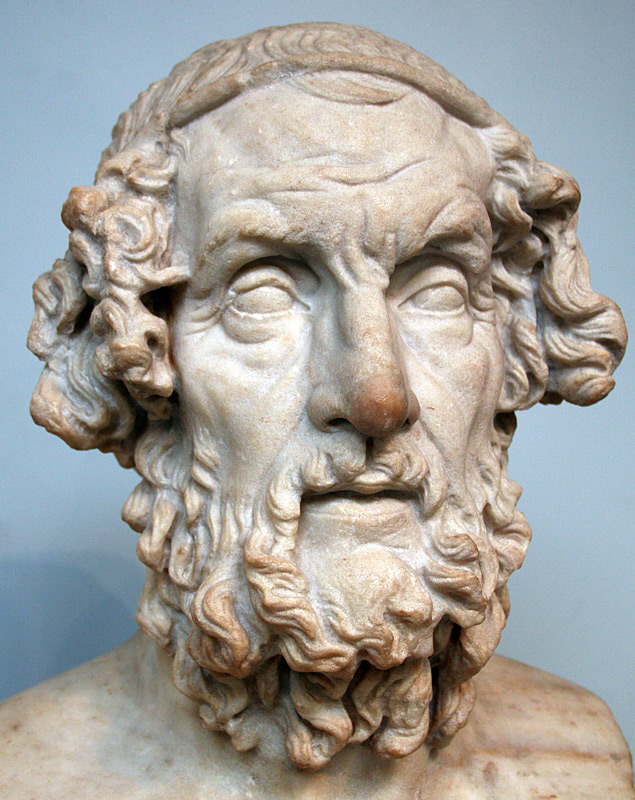
Homer
c. 800–c. 701 BCE · Ancient Greece
“Rage—Goddess, sing the rage of Peleus' son Achilles, murderous, doomed, that cost the Achaeans countless losses.”
Peak-work percentile in the canon.
Homer
c. 800–c. 701 BCE · Ancient Greece
“Rage—Goddess, sing the rage of Peleus' son Achilles, murderous, doomed, that cost the Achaeans countless losses.”
Peak-work percentile in the canon.
The lineage through Homer
Drew From(1)
who shaped Homer
- Odysseus's strangest episodes echo a far older story: scholars (M.L. West et al.) read Circe behind Gilgamesh's ale-wife Siduri, Alcinous behind the flood-survivor Utnapishtim, the Nekyia behind Gilgamesh's descent to the dead
- The proposed route is Near-Eastern transmission — Phoenician contact, a lost Heracles poem — carrying these shapes from Mesopotamia to Greece
- Reading Gilgamesh first makes the Odyssey feel less like an origin and more like a late, brilliant heir to a much older quest for the world's edge
Inspired(25)
who Homer shaped
- Pope didn't just admire Homer — he translated the whole Iliad into English, and built a mock-epic out of the machinery while he was at it
- Sarpedon's grave battle-speech to Glaucus in Book 12 returns, near line for line, as Clarissa's moralizing in Canto V — the sublime original played for comedy over a stolen lock of hair
- Every Homeric device — the arming of the hero, the catalog, the divine intervention — gets shrunk to a card game and a lady's dressing table
via The Aeneid
- Virgil set out to compete against Homer — to write Rome's Iliad and surpass the reputation of the man who started it all
- The second half of the Aeneid (books 7–12) is modeled directly on the Iliad's warfare; the climactic duel mirrors Achilles and Hector in Iliad 22
- Down to the similes and the phrasing, Virgil works in conscious echo of Homer — the lineage is the whole ambition
via The Republic
- Homer is the poet Plato can't stop arguing with — the Republic quotes the Iliad directly, only to put it on trial
- Books 2–3 single out specific passages — Achilles raging, the gods at war — as lies that would corrupt the city's young guardians
- Book 10 widens the indictment into a full case against Homer as the chief of the mimetic poets: the Iliad is the literature Plato wants to censor
via War and Peace
- Tolstoy found the Iliad in the summer of 1857 — and never let it go
- In his 1891 list of the books that formed him, only Homer and the Bible span every stage of his life
- He admired Homer's "picture of manners and customs based on historical event" — which is precisely the thing he set out to do across the vast Russian canvas of War and Peace
- Aristotle made the Iliad the central exhibit of his theory of epic
- He singled out one thing — Homer organizes the whole poem around a single connected action, the anger of Achilles, instead of cramming in the entire war
- That focus became the template every later epic was measured against; in the Poetics the Iliad isn't an example, it's the standard
via The Histories
- The Iliad is the model Herodotus builds his history on — its Catalogue of Ships becomes his catalogue of Persian provinces and the muster of Xerxes' army
- The fight over the body of Leonidas at Thermopylae is patterned on the fight over Patroclus
- And Herodotus quotes Homer by name to argue against him — cross-examining the Iliad as evidence in his own case that Helen never reached Troy
via The Lusiads
- Camões took Odysseus's wandering and pointed it at the real ocean
- The hard slog up the African coast gave him room to imitate the Odyssey's episodic voyage; the Isle of Love openly recalls Calypso's island and the garden of Alcinous
- Homer's homecoming-by-sea becomes a nation's outbound voyage to India — same hostile waters, same gods meddling, new destination
via Paradise Lost
- Milton 'had his Homer by heart' and wrote Paradise Lost as a Christian epic meant to outdo him
- The catalogue of fallen devils is patterned on the Catalogue of Ships, the great speeches on Homeric speeches, the similes repurposed wholesale
- Satan's martial heroism is the Achillean ideal deliberately put on trial — Milton borrows Homer's grandeur precisely to overturn it
via Sappho's Poems
- Sappho turns Homer's epic of war inward — fragment 44 retells the Iliad's wedding of Hector and Andromache in epic meter, but as a celebration of love, not a prelude to slaughter
- Where Homer makes Helen the cause of a war, Sappho's fragment 16 recasts her as a figure of pure desire
- The same Homeric diction, bent to a private music: martial glory traded for the things a woman actually longs for
via The Satyricon
- Petronius drags the Odyssey through the gutter — and it's the funnier for knowing the original
- Encolpius wanders Italy dogged by the wrath of Priapus, a low-rent stand-in for Poseidon's wrath at Odysseus
- He even runs into his own Circe — a temptress, no enchantress; the Satyricon is the epic remade as sexual farce
via The Oresteia
- The story Homer keeps telling on the side becomes Aeschylus's whole trilogy
- Throughout the Odyssey — Nestor in Book 3, Menelaus in Book 4, Agamemnon's own shade in Books 11 and 24 — the murder of Agamemnon is the cautionary foil to Odysseus's safe homecoming
- Aeschylus took that recurring moral paradigm and built the Oresteia on it, reworking Homer's frame for the tragic stage
via Philoctetes
- Philoctetes and Achilles are named together back in the Catalogue of Ships — two heroes alienated, absent, and in pain
- Sophocles seized on that pairing: he built Philoctetes along the lines of Iliad 9's embassy, the great scene of a wronged hero refusing to rejoin the war
- The wrath-and-withdrawal pattern Homer gave Achilles becomes the engine of Sophocles's marooned, embittered archer
via Faust, Part Two
- Goethe had Homer by heart from childhood — and in Faust, Part Two he reaches all the way back to the war the Iliad is fought over
- The entire Helen act picks up Homer's matter at Menelaus's palace in Sparta, casting Helen of Troy as its heroine
- The face that launched the thousand ships becomes Goethe's, summoned back from the dead to marry Faust
- Achilles' heroic temper outlived Homer's battlefield — Bernard Knox and later scholars trace it straight into Euripides's Medea
- The man who cannot bear a slight, who fears mockery above all and turns his fury on friend and enemy alike: that is the Iliadic code, transplanted into a woman
- Euripides even inverts it — where Achilles finally returns Hector's body, Medea refuses Jason the burial of their sons
via Lysistrata
- Hector's farewell to Andromache — "war will be the concern of men" — became a line Aristophanes couldn't resist turning inside out
- In Lysistrata, the husbands quote that very sentiment to silence their wives; the women then seize the war anyway
- The most tender, domestic moment in the Iliad gets recast as the punchline of an anti-war sex comedy
via Metamorphoses
- Book 12 of the Metamorphoses is so steeped in Homer that scholars call it Ovid's "little Iliad"
- Same war, same cast — Achilles, Paris, Priam, Hecuba — but Ovid swerves past Homer's great duels toward stranger transformation tales
- Ovid follows the Iliad closely enough for verbal parallels, then reworks Achilles entirely on his own terms
via Meditations
- Homer's most famous simile became a Stoic emperor's text for meditation
- The Iliad's "generations of leaves" (Book 6) — one generation falling, another springing up to replace it — is the image Marcus Aurelius returns to when he steadies himself against death
- He quotes the line directly and lists Homer among the authorities he draws on
- Dryden Englished Homer the way he'd Englished Virgil — measuring his own verse against the founding epic poet
- He translated Hector and Andromache's parting from Iliad Book VI, then the entirety of Book I
- The first book of the Iliad in heroic couplets is Dryden taking the measure of where Western poetry began
- Fielding made the Iliad the engine of his comedy — the model he names alongside Aristotle in Tom Jones
- Homer's battle-scenes and extended heroic similes get lifted wholesale into mock-epic brawls: the churchyard fight, the Mrs. Partridge episode
- Apply Achilles-grade grandeur to a country squabble and you get the mock-heroic — the whole joke depends on the Iliad standing behind it
- Thoreau kept the Iliad on his cabin table all summer and read it in the original Greek
- Homer becomes the centerpiece of Walden's argument that the great books reward — even require — reading in their first language
- "The shaft of the Iliad still meets the sun in his rising" — Homer is Thoreau's proof that the oldest poetry stays new
- Shakespeare reached the Iliad through Chapman's 1598 translation — and turned it inside out
- He kept the cast — Achilles' ruinous pride, Hector's tragedy — but soured the glory into satire, hanging the foul-mouthed Thersites at the center as a chorus of disgust
- Troilus and Cressida is what the Iliad looks like when a cynic retells it: the same war, none of the honor
- The moment history breaks away from epic — and it happens on Homer's terms
- Thucydides opens his History by treating the Iliad as evidence to be tested: mining the Catalogue of Ships for data, then scolding the poet for inflating the numbers
- He builds his own factual method by arguing with Homer — the epic tradition is the foil he defines himself against
- Lucretius makes Homer the standard-bearer of poetry — and then bends him to Epicurus
- He imitates the Iliad's great shield-ecphrasis (Book 18), reading Achilles' shield as an image of the cosmos, and salutes Homer in the proem to Book 3
- The oldest epic becomes the model Lucretius writes his didactic poem against — an invitation to read Homer philosophically
- Horace opens Odes 1.6 by translating the Iliad's first lines — and shrinking them on purpose
- Achilles' towering menis becomes a comically small stomachus, a fit of pique: Horace's way of bowing to Homer while refusing to write epic himself
- The Iliadic allusions thread through the rest of the Odes too, especially Book 4 — Homer is the giant he keeps measuring himself against
via Plutarch's Lives
- Centuries on, Homer is still Plutarch's first witness — the Iliad gets quoted throughout the Lives for moral color and the texture of heroic character
- Plutarch reaches for Homer to gloss everything from the Abantes' haircut to Aethra at Troy in his Theseus
- In the Moralia he calls him 'the divine Homer' and mines him for how a young man should read poetry at all
Famous Quotes
“Sing, O goddess, the anger of Achilles son of Peleus, that brought countless ills upon the Achaeans.”
“Rage — Goddess, sing the rage of Peleus' son Achilles, murderous, doomed, that cost the Achaeans countless losses.”
“Sing to me of the man, Muse, the man of twists and turns driven time and again off course, once he had plundered the hallowed heights of Troy.”
“Sing in me, Muse, and through me tell the story of that man skilled in all ways of contending.”
About Homer
The name "Homer" is attached to the two foundational works of Western literature, but almost nothing is known about the person behind them — or whether a single person wrote both. Ancient Greeks generally believed he was a blind bard from Ionia (the coast of modern Turkey), but even in antiquity there was debate about his identity, his dates, and whether one poet could have composed both the Iliad and the Odyssey.
Modern scholarship (the "Homeric question") ranges from the "single genius" camp to theories of collective oral composition over generations. What's not debated is the result: two poems of extraordinary sophistication that defined the epic form, established the literary vocabulary of the ancient world, and remain the starting point for the entire Western literary tradition. Every epic that followed — Virgil, Dante, Milton — is in conversation with Homer.
Conventional dating places the poems in the 8th century BCE, but they draw on oral traditions stretching back centuries earlier to the Mycenaean age.